

Author: A crypto enthusiast (like me, staying up late at night looking at charts and reading the news) 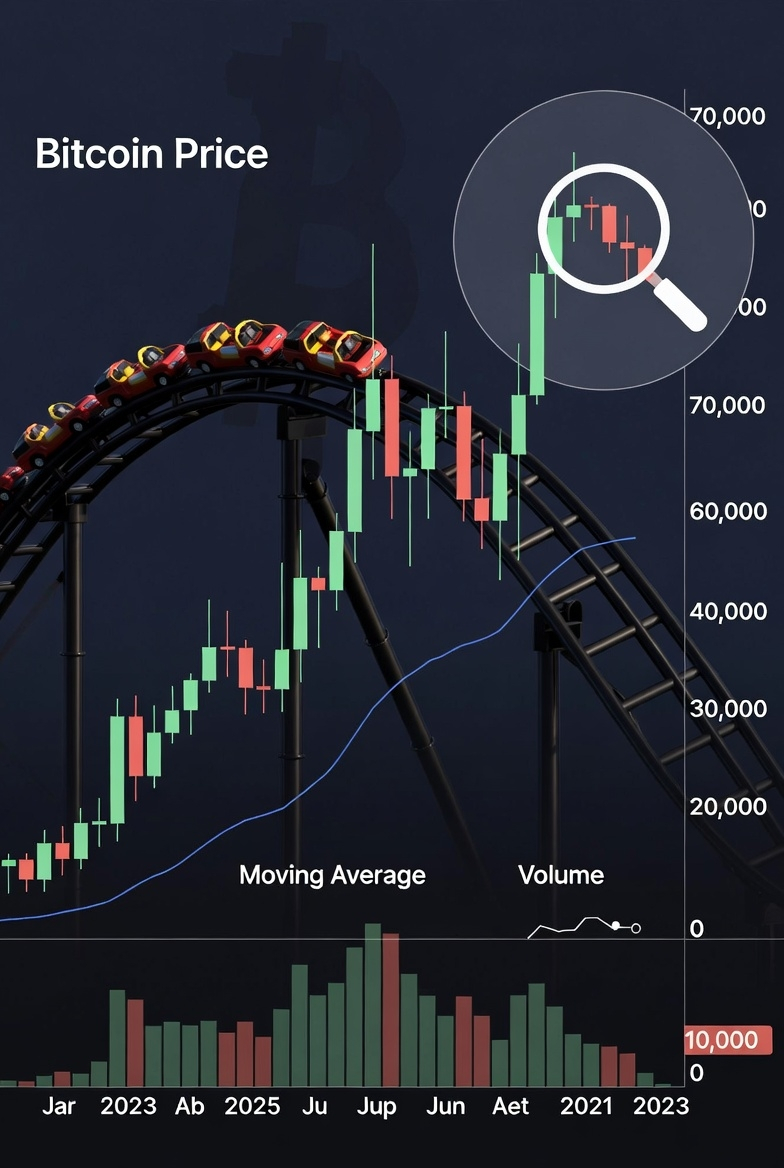
At this time in February 2026, talking about Bitcoin ($BTC) feels like a rollercoaster ride. Its price reached close to $126,000 late last year, but now? It's now hovering between $69,000 and $70,000.Yes, it's a big blow down nearly 38% from its peak. But what's behind this decline? And what could be ahead? Let's take a closer look, like we discuss over coffee with a friend.
What's happening now? Bitcoin has gone through a 'crash' in recent weeks. The price fell below $60,000 in early February, which scared off many investors.There are a few big reasons behind this: First, the US Federal Reserve's policy of reducing liquidity. They are withdrawing as much as $74 billion in liquidity per month, which is affecting the crypto market.
Secondly, there was an outflow of about $2.5 billion from ETFs (exchange-traded funds), But surprisingly, prices did not collapse that much. This shows that underlying demand is still strong.
One more thing: Institutional investors are still bullish. CME futures are trading at a 32% annualized premium, while retail leverage is low (perpetual funding rate 8%).In the past, when retail leverage was high, a liquidation cascade would have killed the rally, but that is not the case this time. The hash rate is also at an all-time high, indicating good network health.Chinese banks have been ordered to reduce US Treasury holdings, which is indirectly bullish for Bitcoin as dollar weakness benefits the crypto.
Additionally, the market structure suggests that this is a 'compression' phase—prices are stuck between 68,400 and 70,800. Options gamma exposure is capped at around $100,000, but 42% of it will expire soon.
Why is this the case? Many are calling this decline a 'weak bear case'. That is, it is not a systemic failure, but simply a weakness in sentiment. Unlike the last cycle, where there was retail hype.
Institutional adoption is increasing, with banks and large firms accepting Bitcoin.
But the macro environment is difficult: inflation, CPI, NFP data are coming, which could increase volatility. cb69bb Furthermore, some analysts say this is the beginning of a 'crypto winter', Donald Trump's policies could cause a crash.
Bitcoin is now 28% below its long-term power-law trend, which is unprecedented at this stage of the cycle. Capitulation is extreme, long-term holders are not selling, smart money is accumulating.
What's next? There's disagreement about the future. Bernstein says this decline is the 'weakest bear case in history', and will reach $150,000 by the end of 2026. CoinDCX predicts 100,000-105,000 by the end of February.Changely says average 73,000, max 76,000 in February.
But there's a downside: Motley Fool says a 50% plunge is possible. The prediction market has a 24% chance of going above 80,000. If the Fed increases liquidity or ETF inflows increase, there will be a recovery. Otherwise, it could go even lower.
In my opinion, Bitcoin's foundation is solid—this could be a 'buy the dip' moment. But there are risks, so DYOR (Do Your Own Research). Being undervalued at this stage of the cycle is historically a sign of a big rally.
Bottom line: Bitcoin never moves in a straight line. It's volatile, but for those who are patient, the possibilities are endless. What do you think? Comment!
