
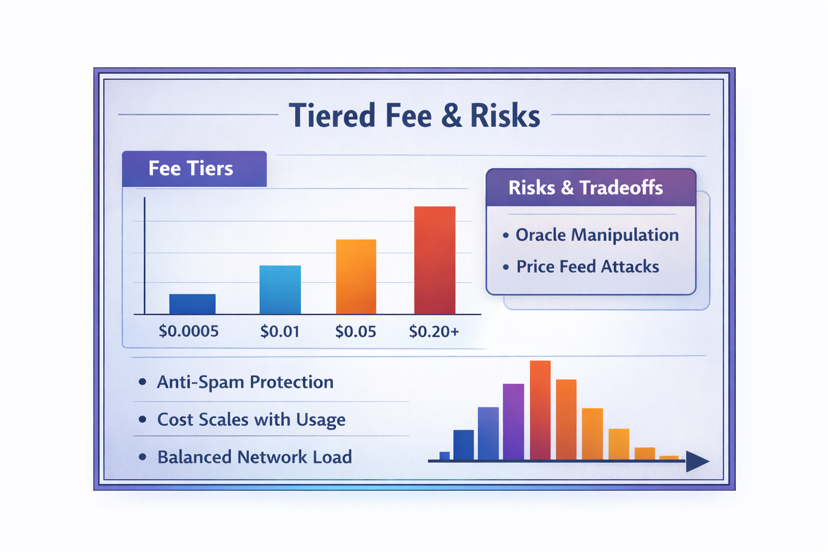
If you’ve used blockchains for anything beyond a one-off experiment, you know the moment when fees stop being a background detail and start shaping your behavior. You hesitate before clicking. You check a wallet like it’s a weather report and wonder whether now is a good time to do something ordinary. That anxious pause is part of why fee fairness is getting attention again. As more teams ship apps that behave like services—games with constant actions, payment flows, automated tools—a sudden spike in cost is not quirky, it’s a failure. Vanar’s approach starts with a plain promise: anchor transaction costs to a dollar value instead of letting them be set by a bidding war. Users still pay in VANRY, but the protocol adjusts the amount of VANRY required so the fee stays near a fixed USD target as the token price moves. In Vanar’s documentation, the Vanar Foundation is described as calculating a VANRY market price from multiple on-chain and off-chain sources, validating it, and feeding it into the protocol so charges update while the user-facing dollar cost stays steady. The docs describe updates happening on a regular cadence, and a security audit also describes the chain updating its fee price from an external system after every 100 blocks. Vanar ties this pricing choice to a second idea of fairness: who gets served first. The docs and whitepaper describe a first-in, first-out ordering model where validators include transactions in the order they reach the mempool, rather than prioritizing whoever pays more. I find that instinctively legible. It feels closer to taking a numbered ticket than entering a bidding room. Stable micro-fees do raise an obvious worry, though: if it’s cheap for me, isn’t it cheap to spam the chain too? Vanar’s answer is tiered fixed fees. Everyday actions like transfers, swaps, NFT mints, staking, and bridging are described as staying in the lowest tier, around $0.0005 worth of VANRY, while larger, block-hungry transactions become progressively more expensive. It’s basically a fairness filter. Everyday actions remain smooth, but if someone tries to flood the system, the cost ramps up until it’s not worth it. What users get out of that isn’t some big discount—it’s the relief of knowing the price won’t jump around when they’re just trying to do something routine. Predictable fees remove the background stress where every action feels like a wager, and they let developers budget and price products without building a whole strategy around sudden fee spikes. For VANRY, it clarifies the token’s job as gas, but measured against a fiat yardstick, so the quantity paid flexes to hit a target value. There are tradeoffs worth naming. A model that depends on a price signal makes that signal an attack surface, and it raises governance questions when a foundation is part of the pricing loop. If the price input is wrong or manipulated, users could overpay or underpay, and the anti-spam balance could wobble. That risk deserves real scrutiny. Still, I understand why this design is resonating now. It’s an attempt to make blockchain costs behave like something adults can plan around.
@Vanarchain #vanar #Vanar $VANRY
