In the world of global finance, information moves at the speed of light, but capital the actual money is still stuck in the era of paper ledgers and multi day delays. Moving $1 million across borders should be as easy as sending a text, yet it remains one of the most expensive and slowest processes in modern banking. This friction is exactly where XRP has positioned itself, not as a speculative "meme" asset, but as the essential plumbing for the next generation of the global economy.
$XRP is no longer just a legacy name in crypto it’s becoming a live case study of what happens when blockchain utility meets real-world demand.
While much of the market still trades narratives, XRP continues to operate in production, moving value across borders every day. That difference is becoming more visible as the crypto cycle matures.
What’s often missed about XRP today is that its value is no longer centered on potential it’s centered on function. XRP exists to solve a very specific problem: moving money globally, instantly, and at low cost. In simple terms, it acts as a bridge currency that allows institutions to transfer value without needing multiple intermediaries, pre-funded accounts, or long settlement times. This is not a future idea it’s an active use case.
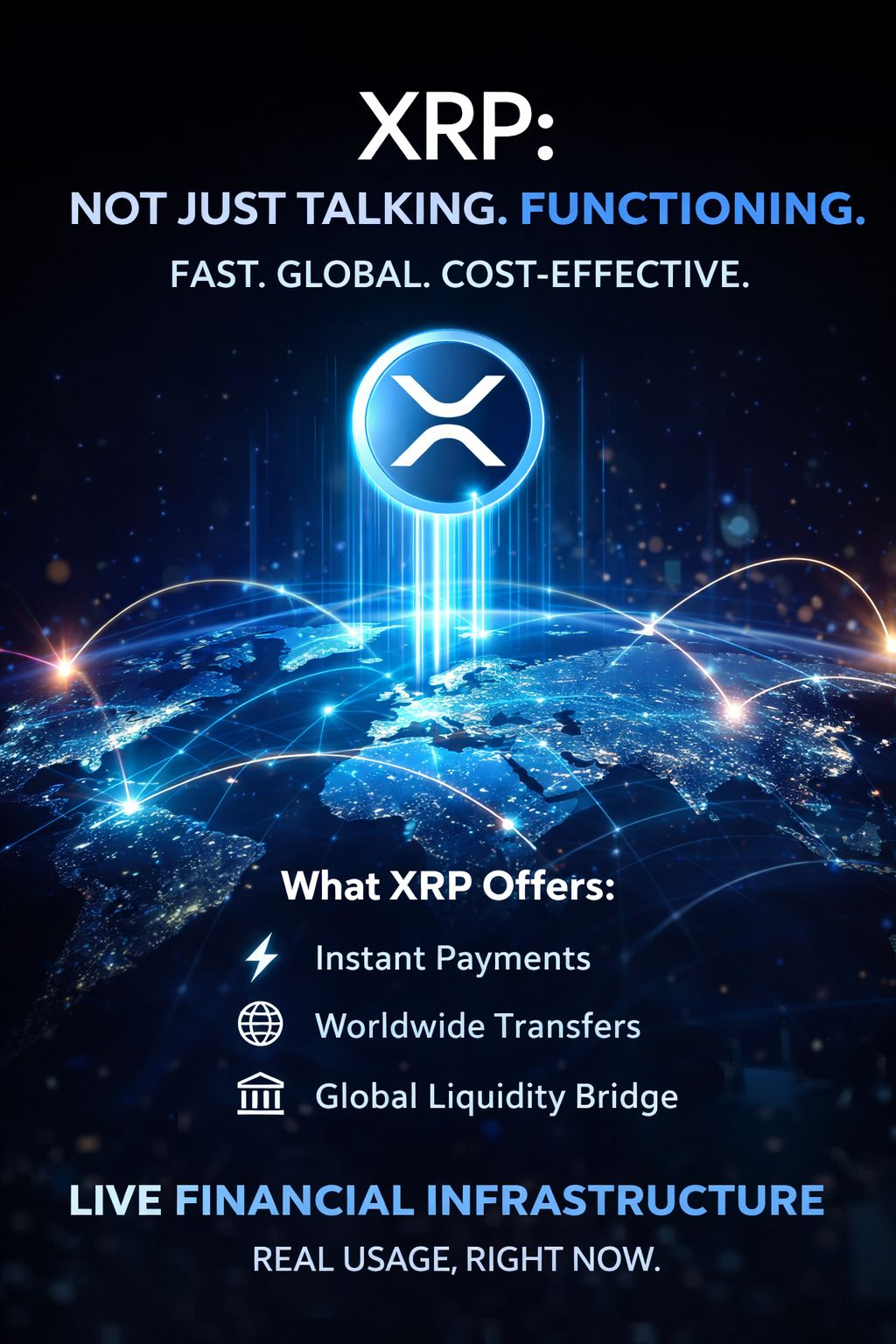
XRP is the "universal translator." Instead of banks holding massive amounts of Yen and Real in accounts just in case they need them, they can convert their local currency into XRP, send it across the globe in three seconds, and convert it into the destination currency on the other side. It turns a three day ordeal into a three second transaction.
The biggest problem XRP solves is one most people never see: Nostro/Vostro accounts. Currently, global banks have an estimated $27 trillion sitting idle in foreign bank accounts just to facilitate international trades. This is "dead money" it can’t be used for loans, investments, or growth because it’s parked there as a liquidity cushion
XRP eliminates the need for this pre-funding. By using On-Demand Liquidity, banks can buy XRP only when they need to move money. This unlocks trillions of dollars for the global economy, making XRP a fundamental tool for financial efficiency rather than just another digital token.
As of February 2026, the market is in a unique phase of "Institutional Decoupling." While XRP has corrected from its 2025 highs of $3.67 to settle in the $1.45–$1.60 range, the underlying activity tells a different story.
Trend: We are seeing a shift from retail-driven hype to institutional "accumulation on weakness."
Sentiment: Short-term traders are frustrated by the recent price dip from the January peak of $2.40, but momentum indicators like the RSI show deep oversold conditions. Historically, this "uncomfortable" silence is when serious positioning happens.
Competitors: While networks like Solana focus on consumer apps and NFTs, XRP has carved out a niche in institutional-grade "plumbing." It isn’t competing for your next profile picture; it’s competing with SWIFT for the $150 trillion cross-border payment market.
Why XRP Matters in This Cycle
We have moved past the era of "promises" and into the era of Utility and Tokenization.
The ETF Factor: With spot XRP ETFs now active and seeing over $1.4 billion in inflows, the asset has been "legitimized" in the eyes of Wall Street. It is no longer a fringe experiment.
RWA Tokenization: The XRP Ledger (XRPL) has emerged as a top-tier network for Real-World Assets (RWAs). From tokenized gold to government debt, the ledger's built-in compliance and security features make it the preferred choice for banks like DBS and Franklin Templeton.
RLUSD Integration: Ripple’s USD-backed stablecoin (RLUSD) acts as the perfect companion to XRP. While RLUSD provides a stable unit of account, XRP provides the high-speed liquidity layer that moves it between systems.
XRP is not a "get rich quick" scheme, and it doesn't need to "moon" overnight to be successful. Its value is tied to its throughput. The more volume that flows through the XRP Ledger whether it's remittances, stablecoin transfers, or tokenized assets the more essential the token becomes.
The current market volatility is a reflection of broader macro trends, but the infrastructure being built underneath is stronger than it has ever been. For the patient investor, the noise of the daily price chart is often a distraction from the signal of massive, institutional adoption.
If you want to understand the future of global settlement, look into the current growth of Institutional Custody on the XRPL. Would you like me to pull the latest report on how major banks are integrating XRP for asset custody?