
I was waiting in line at a government office last week. Nothing dramatic. Just a counter, a stack of forms, and a clerk who kept pushing papers back because one stamp was missing. Everyone complained about speed. No one questioned the process itself. The line moved slowly but it never collapsed. That stayed with me longer than I expected.
Later that day I opened Binance Square and tapped into the CreatorPad task titled What Plasma Gets Right About Scalability That Most Modular Chains Ignore. I remember pausing before typing anything because I felt an odd resistance. The prompt did not invite optimism. It asked me to look closely. On the submission screen the word counter sat there quietly while I reread the task title again and again. That moment of rereading on the CreatorPad page is where the discomfort started. I realized I was being pushed to judge behavior not promises and that is not how I usually think about scalability.
My opinion formed in one sentence and it still feels risky to say. Scalability that prioritizes composability and modular purity often ignores the cost of coordination and Plasma does not pretend that cost disappears.
As I wrote and deleted lines in that CreatorPad text box I noticed something unsettling. Most modular narratives assume that breaking systems apart automatically makes them easier to scale. The task forced me to sit with Plasma long enough to notice that it accepts friction instead of trying to design it away. That acceptance felt almost unfashionable. The screen did not tell me this directly. The act of trying to articulate one clear thought under the task constraints made it obvious. I was reacting not to documentation but to the way the system behaves when imagined under load.
Outside this task I have absorbed the idea that modular equals flexible and flexible equals scalable. But flexibility has a social cost. Every interface becomes a negotiation. Every module adds another place where responsibility can blur. Plasma seems to lean into a different assumption. It treats scalability less like infinite expansion and more like controlled throughput. That sounds conservative and it is. It also feels more honest.
What disturbed me is how rarely we talk about who pays the coordination tax. In many modular designs it is quietly pushed onto developers users or off chain processes. Plasma feels like an example where that tax is acknowledged upfront. It does not chase elegance through abstraction. It stays closer to settlement discipline. That choice limits certain freedoms but it also reduces ambiguity about where finality lives.
I am not praising Plasma as a solution. I am reacting to the contrast it created in my own thinking. While performing the task I kept comparing it to other modular chains I have read about where scalability is framed as a matter of stacking components. Plasma instead made me think about queues checkpoints and exits. Those are not exciting words. They are administrative words. And yet administration is how systems survive stress.
The uncomfortable part is this. We might be overvaluing architectural cleverness and undervaluing operational restraint. Plasma as an example made that hard to ignore. It suggests that some scalability problems are not technical puzzles but governance decisions disguised as engineering. That idea would not have surfaced if I had not been forced by the CreatorPad task to slow down and articulate one specific insight instead of summarizing features.
I keep thinking back to that office line. The process was inefficient by design. It prevented certain failures at the cost of speed. Plasma triggered the same feeling. It made me wonder whether the chains we call scalable are simply the ones postponing their hardest coordination problems.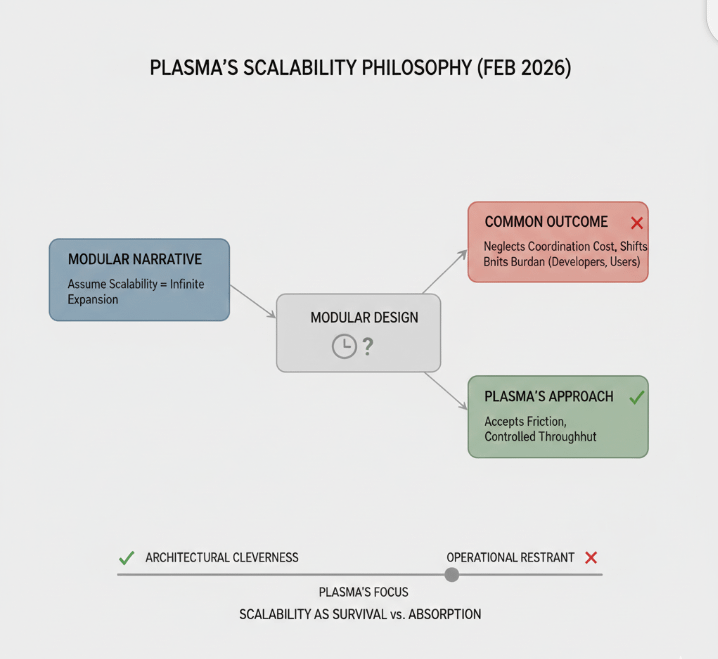
If scalability is really about surviving pressure rather than absorbing volume then what are we optimizing for when we celebrate modularity so easily?

