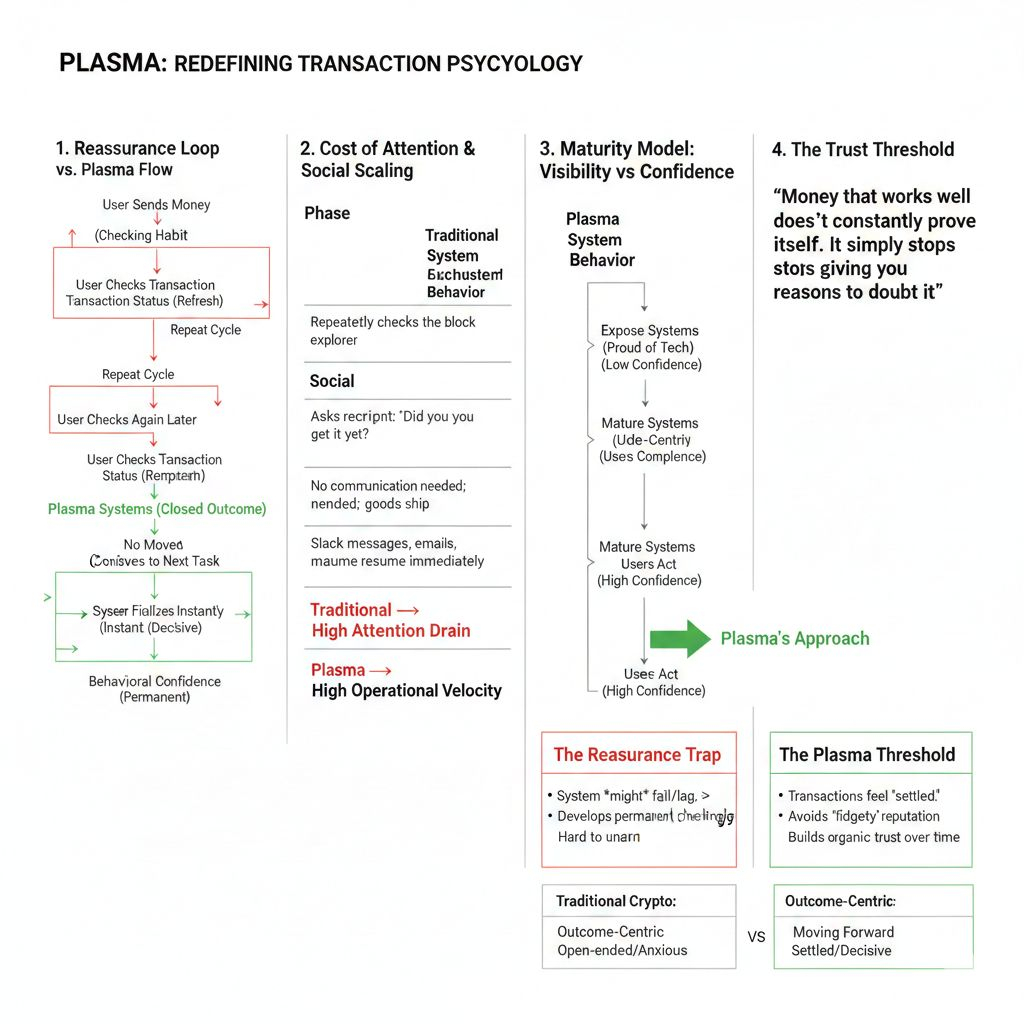
There’s a behavior most payment systems quietly encourage even when everything is working: checking.
You send money then you look again. You refresh. You glance back later just to be sure. Nothing is wrong but the system hasn’t quite convinced you that nothing could be wrong. Over time, that habit becomes part of using money. Reassurance turns into routine.
What keeps standing out about Plasma is how much it seems to resist creating that habit in the first place.
Most crypto payments are technically transparent but emotionally unresolved. You can see the transaction track the hash follow confirmations and yet the experience still feels open ended. The system shows you process when what you really want is closure. So users compensate by watching.
Plasma feels like it’s built around a different goal: to make reassurance unnecessary.
That’s not about hiding information. It’s about shaping behavior so that information doesn’t need to be consulted during normal use. When a payment completes it’s meant to feel finished enough that the next action happens without a second thought. The screen doesn’t invite you to linger. The system doesn’t reward monitoring.
This distinction matters because reassurance has a cost.
Every time users feel the need to check, they’re spending attention. Attention is a limited resource and payment systems that drain it slowly become fatiguing. People don’t consciously decide to leave. They just start using the system less for things that matter.
Plasma seems to be trying to short-circuit that erosion.
Instead of training users to verify outcomes repeatedly it appears to aim for outcomes that are immediately usable. You don’t wait for a feeling of safety to arrive later. Safety is implied by how decisively the system behaves in the moment.
That decisiveness changes the rhythm of use.
In systems that require reassurance the payment itself becomes the center of attention. Everything else pauses until confidence returns. In systems that don’t the payment is just a step quickly forgotten as the next task begins.
What’s interesting is how this design choice scales socially.
When individuals feel unsure they ask others. Did this go through? Is it okay to proceed? Those questions multiply inside organizations. Slack messages. Emails. Approvals. All of it exists to compensate for a lack of emotional finality, not technical correctness.
A system that removes the need for reassurance removes that social overhead as well.
Plasma’s design seems tuned to that reality. It doesn’t just aim to be correct it aims to feel settled. That feeling is what allows workflows to move forward without extra communication. Work resumes. Goods ship. Access is granted. Nobody has to confirm the confirmation.
There’s a subtle maturity in that approach.
Early systems often overexpose their internals because they’re proud of them. They want users to see how things work to appreciate the machinery. Mature systems do the opposite. They hide complexity not to obscure it but to prevent it from interfering with use.
Plasma feels closer to the second category.
It doesn’t appear to assume that users want insight into the system’s state during routine actions. It assumes they want permission to stop caring as soon as the action is complete. That’s a harder problem to solve than raw visibility because it requires behavioral confidence not just data.
Behavioral confidence is fragile.
Once users learn that a system sometimes needs reassurance they never fully unlearn it. Even if reliability improves the habit of checking remains. That’s why many platforms struggle to shake reputations long after the underlying issues are fixed.
Plasma seems to be trying to avoid creating that reputation at all.
By making outcomes feel closed and self-sufficient it teaches users that checking is unnecessary. That lesson compounds over time. The fewer times you feel the urge to look back the more natural the system feels. Eventually the idea of monitoring a payment feels strange.
That’s when infrastructure has crossed a threshold.
Of course this approach isn’t about eliminating transparency. When something genuinely goes wrong information still needs to be available. But the key is proportionality. Normal behavior shouldn’t require abnormal levels of attention.
Plasma’s philosophy appears to be that reassurance should be reserved for exceptions not baked into every transaction.
There’s also a psychological payoff here that’s easy to underestimate. When users stop checking they stop worrying. When they stop worrying they trust the system enough to use it in less controlled contexts for routine spending recurring transfers background operations.
Trust expands outward from there.
Many crypto systems try to earn trust by proving robustness. Plasma seems to be earning it by reducing the situations where trust is actively tested. That’s not avoidance. It’s design discipline.
Money that works well doesn’t constantly prove itself. It simply stops giving you reasons to doubt it.
What I find compelling is how this aligns with Plasma’s broader posture. No dramatization. No insistence on being watched. Just an assumption that if the system behaves properly users will stop looking for reassurance on their own.
In payments that’s a bold assumption.
But it’s also the one that separates tools people experiment with from systems they quietly rely on. The former demand attention to feel safe. The latter earn safety by making attention unnecessary.
Plasma feels like it’s aiming for that second outcome.
Not by asking users to trust it, but by designing things so that trust never has to be actively exercised at all.@Plasma #plasma #Plasma $XPL