

I want to look at DUSK from a completely different perspective.
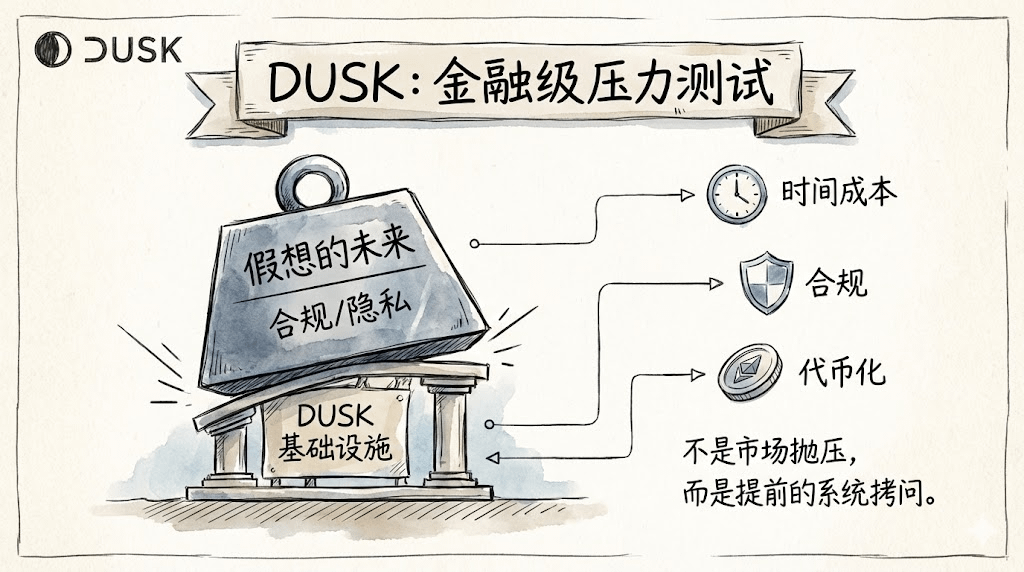
Rather than starting from price, sentiment, or narrative heat, view it as a system being 'intensified' ahead of time—what DUSK is experiencing resembles a pressure test that has not officially started yet.
1. Most projects' pressure comes from users; DUSK's pressure comes from the 'imagined future'.
You will find a counterintuitive phenomenon:
Many DeFi or application projects only see concentrated issues after the user scale grows—security, compliance, responsibility, auditing.
On the contrary, DUSK’s logic is just the opposite.
It puts all these issues into the design before the user scale is far from adequate.
What does this mean?
This means it has already been bearing the system pressure that should have occurred in the later stages before it was truly 'used'.
Compliance, auditable privacy, and tokenized securities are not just embellishments, but rigid demands that the financial system reveals only under high-pressure conditions. DUSK's choice to face these issues from the start is itself a counter-intuitive choice.
Second, why this kind of project is sure to be 'unattractive' in the early stages.
Because what they solve is not the 'most painful problem now', but the 'problems that will definitely hurt in the future'.
At the current market stage, most participants are more concerned about:
Liquidity, returns, efficiency, opportunity cost.
What DUSK cares about is:
When the asset scale grows, regulatory intervention occurs, and responsibilities need to be traced back, can the system continue to operate?
These two sets of concerns are inherently misaligned.
The result of misalignment is that the project appears heavy, slow to heat up, and difficult to price in the early stages.
Third, place DUSK in the coordinates of 'financial infrastructure evolution'.
If you extend the timeline, you will discover a pattern:
Every generation of financial infrastructure will add 'constraints' after 'efficiency'.
In the early stages, only pursuing speed;
Start adding rules in the mid-term;
It was only later realized that efficiency without rules cannot be scaled.
The position of DUSK is precisely at this stage of 'supplementing constraints'.
It is not competing with existing public chains on who is faster, but answering a more troublesome question:
When problems arise in the system, who can stand firm?
Fourth, the current coldness of the market is actually a premature 'system interrogation'.
At this stage, the market's attitude towards DUSK is not a complete denial, but more like repeated questioning:
Do you really need to make it this complicated?
Have you advanced too much in advance?
Do you deserve such a long wait?
These issues are essentially not technical problems, but time problems.
And the issue of time is precisely the cost that infrastructure projects cannot avoid.
Fifth, what truly determines DUSK's upper limit is not on-chain.
The success or failure of DUSK largely depends on an external variable:
Is the reality of finance really moving towards a combined path of 'on-chain + compliance'?
If the financial world chooses to continue patching up the traditional system, then DUSK will seem superfluous;
If the financial world is forced to migrate to new settlement and issuance methods, it will seem 'premature but necessary'.
This is a proposition that a non-crypto market can decide on its own.
Sixth, re-examine it with a cooler standard.
Instead of asking whether DUSK is worth paying attention to now, why not ask a more realistic question:
When large-scale on-chain compliance demands first arise in the future financial system, will there already be a long-validated solution?
If the answer is negative, the market will definitely compensate;
If the answer is affirmative, then the time cost of compensation will be very high.
What DUSK is doing now is actually taking on this part of the time cost in advance.
DUSK's situation is more like a system that has entered a 'harsh environment' early, rather than a project that took a wrong turn.
It is being viewed under a standard far above the current market demand.
This will make it seem disadvantaged in the short term, but it also means—once the standards really switch, it won't need to start over.
Such projects are destined to not be understood through popularity,
Can only be verified by whether the trend ultimately materializes.
The above content is merely personal analysis and does not constitute any investment advice.
