

If you have been in this market long enough, you probably understand one thing: network security has never been a matter of 'is it safe or not', but rather 'when something happens, how much can the network withstand'.
I have seen quite a few chains that look very stable from the outside. The documentation is complete, the audit is prominently displayed on the homepage, and the roadmap sounds very confident. But just one wrong assumption can make everything go very quickly, so fast that you can't react in time.
Looking at Plasma XPL, what I care about is not how safe they say the network is, but what they assume will fail first. More importantly, once it fails, do users have an exit route.
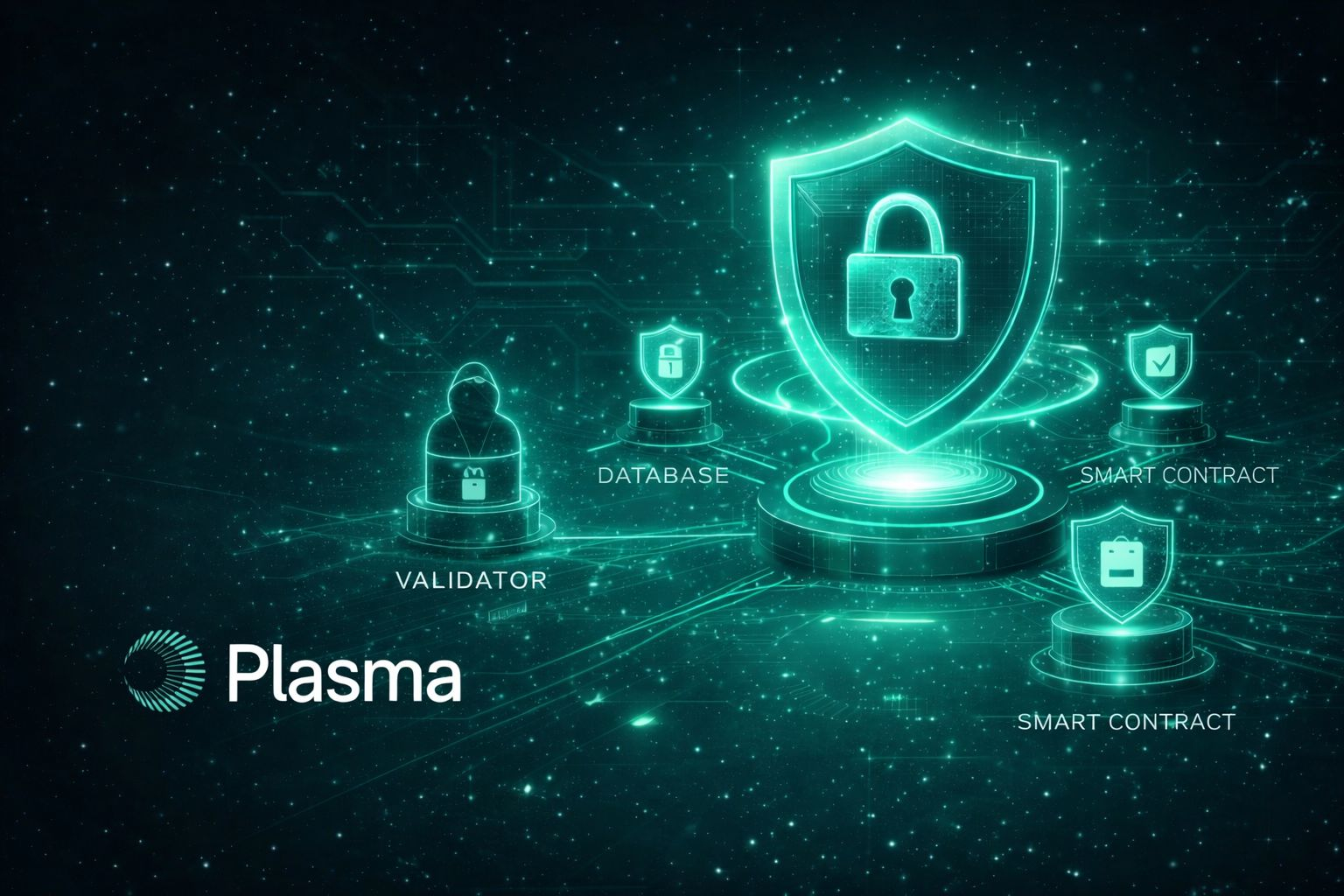
Plasma XPL does not build security by betting everything on a single layer. The way they design gives me a feeling of being quite 'market mature.' The architecture clearly separates the consensus layer, execution layer, and data layer. For those who have suffered because of a small bug spreading from a contract to the entire system, it will be understood that this is not to show off technical skills, but to contain risks.
When one layer encounters problems, the damage does not bring down the entire network. This is the mindset of someone who has seen the market penalize heavily those designs too confident in the assumption that 'it will be fine.'
At the consensus layer, Plasma $XPL uses a validator model with staking and penalty mechanisms. It sounds familiar to everyone already. But I do not focus on the stake number or block speed. What I pay attention to is whether the cost of doing something bad is sufficiently high.
A safe network is not because no one can attack it, but because after attacking, it is not worth it. Plasma XPL designs incentives in that direction, making validators carefully weigh short-term benefits against long-term costs. For those who have invested serious capital and infrastructure, this is not a small barrier.
There is one area I am always quite picky about, which is data availability. I have seen many scaling solutions fail not due to hacking, but because when it gets tight, users cannot withdraw funds. That experience makes people lose trust very quickly.
Plasma XPL requires important data to be published and verifiable, rather than forcing users to trust an intermediary layer. This approach may be slower and consume more resources, but in return provides self-protection in the event of incidents. After several cycles, I see that the ability to escape is sometimes just as important as the ability to scale.
At the smart contract layer, Plasma also does not try to appear overly ambitious. They do not chase a 'super flexible' environment, but prioritize standards that have been widely used and well understood in terms of risk. For those who have deployed contracts outside the mainnet and encountered bugs due to tiny details, this will be seen as a fairly wise choice.
A good system, in my opinion, is not one that assumes the developer is always right. Rather, it is a system that assumes humans will make mistakes and must self-protect against that.
One factor that is rarely mentioned but I pay a lot of attention to is node infrastructure. Plasma XPL seems quite cautious in distributing validators, avoiding too much dependence on a single cloud provider. Anyone who has seen the entire network freeze just because everyone used the same infrastructure will understand this is not a trivial matter.
Security is not only in algorithms, but also in very mundane things like servers, networks, and how people operate behind the scenes.
Finally, governance, which I find extremely sensitive. Plasma XPL does not upgrade the network hastily. Every change must go through discussion and testing. It may sound slow, but I have seen hasty upgrade decisions lead to consequences heavier than an exploit.
A network that someone can steer too quickly is often not as safe as they think.
In summary, Plasma XPL does not give me a feeling of 'impenetrability.' And actually, I no longer believe in such promises. What I see is a system built on the assumption that errors will occur, humans will be wrong, and the market will not go easy.
For those who have stayed long enough to understand this, that alone is a serious security foundation to continue monitoring.

