

@Dusk Tokenization is trending, but it feels different from the last cycle. The question has shifted from “can we do it?” to “can we do it safely, repeatedly, and under supervision?” The BIS argues tokenization can modernize payments and securities markets by recording claims on programmable platforms while still relying on trusted settlement assets. DTCC’s DTC says it expects to begin rolling out a tokenization service for DTC-custodied assets in the second half of 2026. The hope is that the digital version keeps the same investor rights and protections, with less manual reconciliation along the way.
That backdrop makes privacy less philosophical and more operational. Positions and counterparties are sensitive, yet markets still demand proofs and audit trails. Commentary heading into 2026 points to tokenization moving from pilots toward real issuance. Regulation is starting to look more hands-on, especially where cross-border structure is involved. China’s securities regulator has added oversight around offshore tokenised ABS that reference onshore assets, raising concerns about speculation and cross-border risk. In that environment, “privacy” can’t mean opacity. It has to mean controlled disclosure—enough visibility to satisfy the rulebook, without exposing everyone’s positions to the room.
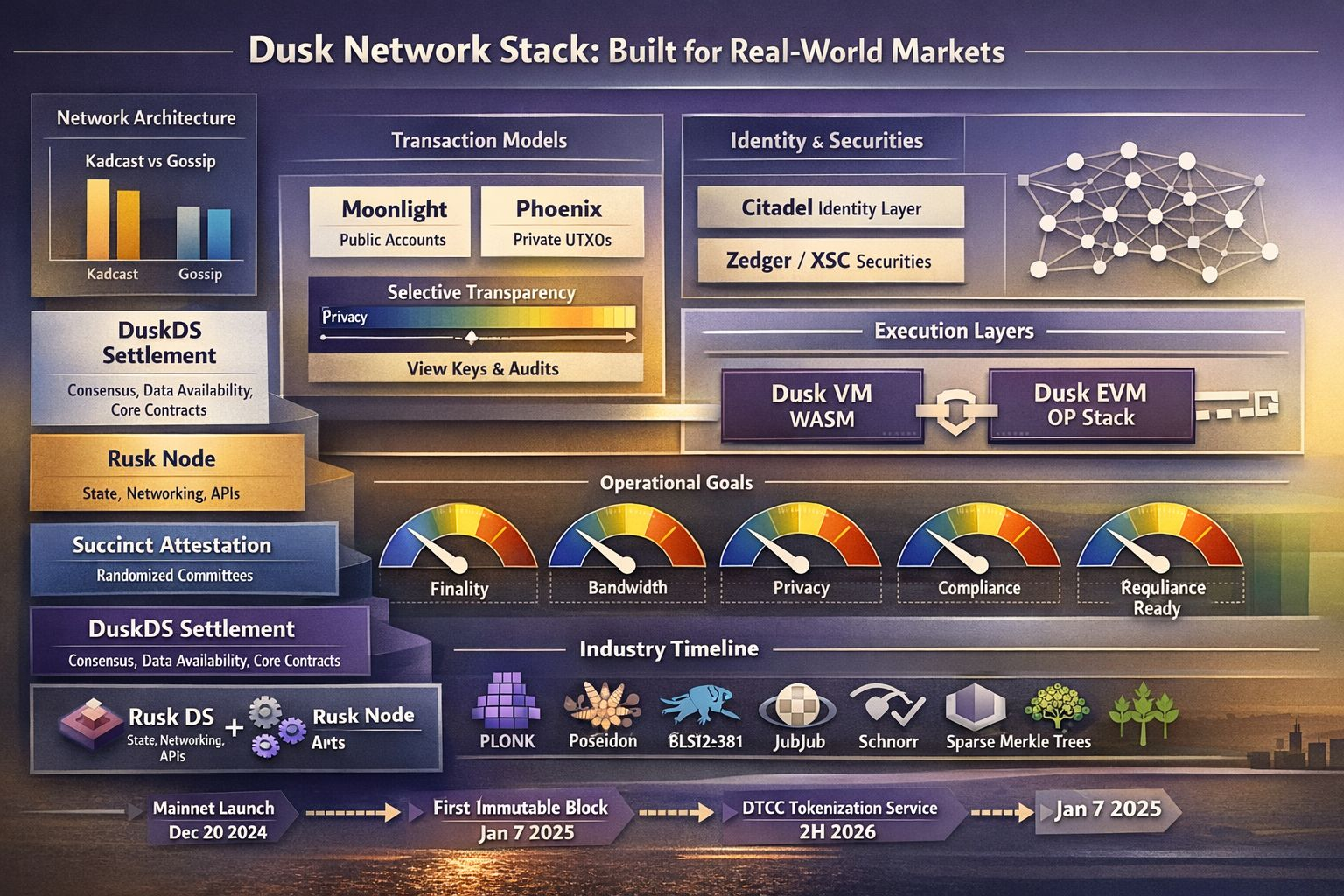
Dusk’s stack is designed for that world. At the base is DuskDS, a settlement layer that bundles consensus, data availability, and core contracts. Rusk is the reference node: it keeps state, handles networking, and exposes APIs for integration and monitoring. Succinct Attestation, its proof-of-stake consensus, uses randomly selected committees to propose, validate, and ratify blocks, aiming for deterministic finality rather than “hope it reorganizes less.” In real markets, finality is not a vibe; it’s a risk limit, a cutoff time, and eventually a legal record.
Networking decides whether settlement stays boring. Dusk uses Kadcast, routing messages through a structured overlay rather than broad gossip to reduce bandwidth and smooth latency. That matters in markets, where peak load and weird edge cases drive risk. Even if no protocol can make the internet polite, it helps when the design goal is predictable delivery, not loud propagation. Small architectural choices like this tend to shape the curve of bad days over time.
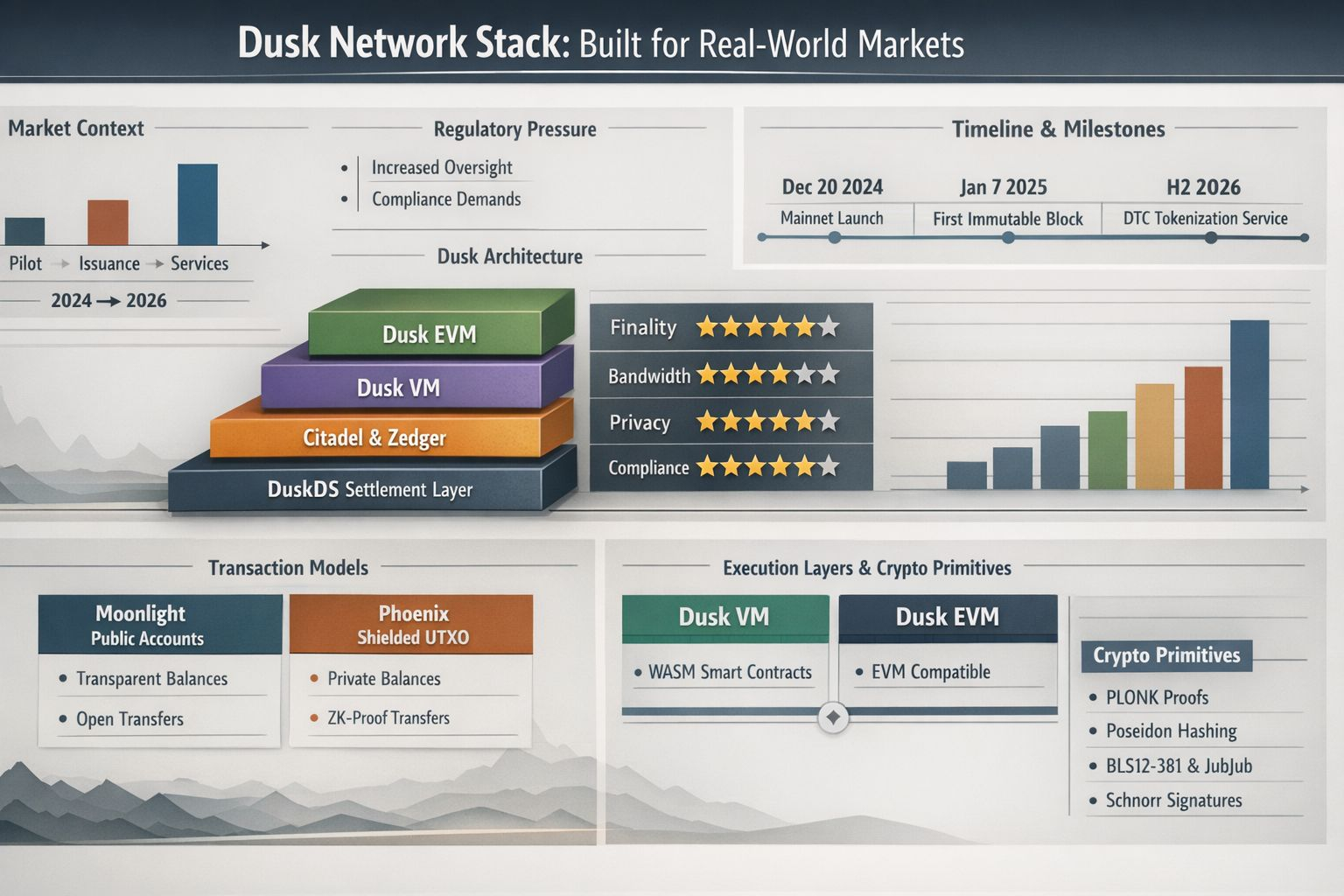
The transaction model is where privacy and oversight collide. Dusk’s Transfer contract supports Moonlight, a public account model, and Phoenix, a shielded UTXO model powered by zero-knowledge proofs. Phoenix can prove ownership and prevent double spending without exposing full details, and view keys let holders reveal exactly what they choose. That could matter for things like confirmations, investigations, or simple dispute resolution, where a “trust me” answer is not acceptable. Dusk also describes an identity layer (Citadel) and a securities-oriented design (Zedger/XSC) aimed at rules like restrictions and eligibility checks.
Above settlement, Dusk separates execution from settlement guarantees. It supports a WASM-based Dusk VM for privacy-oriented contracts and proof verification, and a Dusk EVM built on the OP Stack for familiar tooling, with references to newer Ethereum scaling work like EIP-4844. The trade is extra complexity, but it also avoids asking every developer to learn a new world from scratch. A native bridge between execution layers is part of the stack’s story, which is sensible, because bridges are often where assumptions leak.
None of this works without the cryptography doing its job quietly. Dusk points to PLONK proofs, Poseidon hashing for proof circuits, and primitives like BLS12-381, JubJub, Schnorr signatures, and sparse Merkle trees. Fast verification is the whole point; otherwise privacy becomes a luxury feature. Dusk’s mainnet rollout began on December 20, 2024 and targeted its first immutable block on January 7, 2025.
The open question is whether stacks like this can earn trust outside their own communities. UniCredit has issued tokenised instruments recorded on a public blockchain, and IOSCO has mapped tokenization’s implications for investor protection and market integrity. To me, “compliance-ready” only becomes real after uncomfortable audits and boring incidents. It won’t be decided in a bull market. If Dusk behaves like infrastructure on its worst day, the rest is just adoption work.
