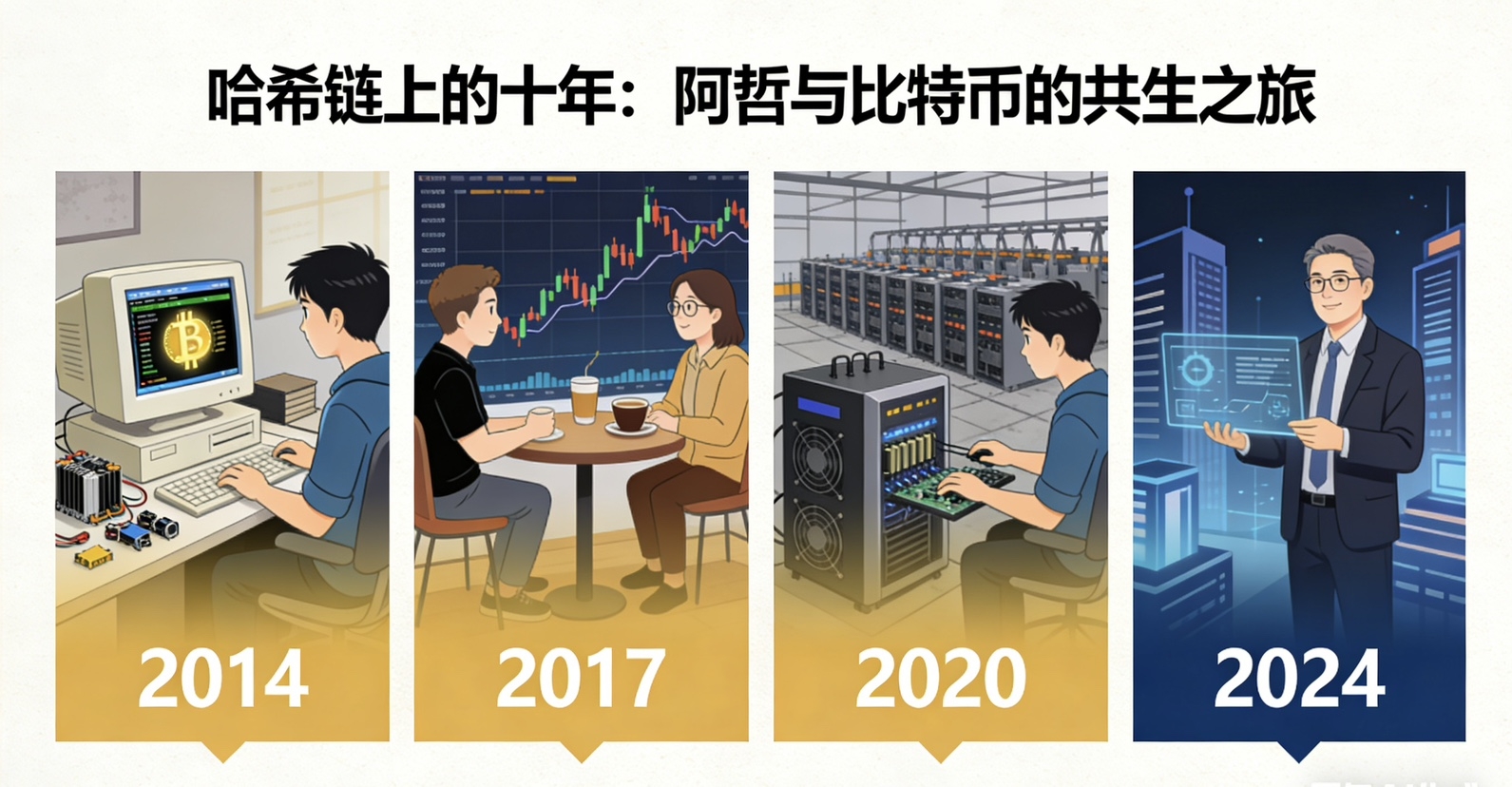
On a winter night in 2009, in a rented room in Shenzhen's urban village, A-Zhe stared blankly at lines of unfamiliar code on the screen. As a freshly graduated computer science student, he stumbled upon Satoshi Nakamoto's white paper (Bitcoin: A Peer-to-Peer Electronic Cash System) on a forum, and concepts like 'decentralization' and 'blockchain' shone like stars in the dark night, illuminating his confusion about the traditional financial system. At that time, the Bitcoin network had just started, and mining could still be done with a regular computer. A-Zhe, with a mindset of giving it a try, let his laptop run the mining program overnight, and unexpectedly, three days later, he really mined 50 bitcoins—the reward for the 173rd block after the genesis block.
"Can this thing be spent like money?" A roommate scoffed at the numbers on the screen, but A-Zhe mysteriously saved the wallet key, writing it on a note and slipping it behind the picture frame. He never imagined that this thin piece of paper would thread through the next ten years of his life.
In the summer of 2010, news spread on forums that Bitcoin had achieved its first real transaction: programmer Laszlo traded 10,000 Bitcoins for two pizzas. A-Zhe looked at the 50 coins in his account and suddenly had the idea to put it into practice. He posted on an overseas forum, trading 5 Bitcoins for a box of imported instant noodles. When the delivery arrived at his rental, he rubbed the foreign label on the packaging, truly feeling the value of this virtual currency crossing national borders. That year, the first exchange, Mt.Gox, went online, and Bitcoin began to have a public price, rising from a few cents to $1, and A-Zhe's assets unknowingly multiplied by a hundred times.
2013 was a crazy year. Bitcoin's price soared from $13 to $1200, surpassing gold's price per unit, making headlines in the financial news. A-Zhe had already quit his job to mine full-time, upgrading from a laptop to professional mining equipment. The machines lined up in the living room roared 24/7, and electricity bills piled up like snowflakes, yet they were far less than the earnings from mining. He sold 10 Bitcoins at the peak, paying a down payment for a small apartment, while his parents rushed from their hometown, watching their son make money just by staring at the computer screen, their faces filled with disbelief. But the party ended abruptly; by the end of the year, China implemented regulatory policies, and Bitcoin's price plummeted. The Mt.Gox exchange suffered multiple hacking attacks, and A-Zhe's remaining Bitcoins shrank by more than half during the fluctuations. For the first time, he experienced the wildness and danger of this decentralized currency.
In 2016, the second halving of Bitcoin occurred, reducing the block reward from 25 coins to 12.5 coins, and mining difficulty surged. A-Zhe joined a mining pool to share the cost of computing power with miners worldwide. That year, he met Lin Xi, a girl working in blockchain security, who often said, 'The security of Bitcoin lies not in anonymity but in immutability.' Lin Xi's words were validated in 2020 when the U.S. Department of Justice successfully recovered the Bitcoin ransom paid by Colonial Pipeline, shattering the myth of 'cryptocurrency being untraceable.' A-Zhe watched the news and recalled the key note hidden behind a picture frame, suddenly realizing that this currency, seen as a 'lawless land,' had long been wrapped in a network woven by technology and regulation.
In 2024, Bitcoin's fourth halving occurred, reducing the block reward to 3.125 coins. The U.S. SEC approved the listing of Bitcoin spot ETFs, and mainstream institutions rushed to enter the market. A-Zhe's mining machine had long been upgraded, and his wallet still held the initial 10 Bitcoins he mined, along with the assets accumulated over the years. That year, the news of 127,000 Bitcoins seized from a Cambodian scam group by the U.S. government shocked the world, and on-chain analysis technology made hidden fund flows visible. The blockchain security company co-founded by A-Zhe and Lin Xi received its first order from regulatory authorities to help trace suspicious transaction addresses.
One deep night, A-Zhe opened that yellowing key note again, the characters glowing faintly under the light. He opened his computer, and the blockchain explorer displayed the information of the genesis block, with Satoshi Nakamoto's sentence, 'The Times 03/Jan/2009 Chancellor on brink of second bailout for banks,' still clear. Over the decade, he witnessed Bitcoin transform from a code that no one cared about into an asset that stirred global finance; from a tool for dark web trading to a stage for compliant regulation. The roar of mining machines gradually faded away, replaced by the alert sounds of on-chain analysis systems in the office. A-Zhe knew that the story of Bitcoin had never ended; it was continuously evolving in the game between decentralization and centralization, and he, along with countless participants, had become an indelible mark on this hash chain.
Outside, the city was ablaze with lights. A-Zhe transferred 0.01 Bitcoins to his wallet, writing in the remarks section: 'To that night in 2009 when I believed code could change the world.' The transaction was packed into a new block, and with the generation of the cryptographic hash, it was forever recorded in the distributed ledger that spans the globe, just like the ten years of his coexistence with Bitcoin, steadfast and irreversible.$BTC