
Crypto likes to imagine that failure looks dramatic: exploits, hacks, sudden collapses. In reality, when real money enters a system, things break much earlier — and much more quietly.
They break at the seams no one tweets about.
Before price volatility.
Before throughput limits.
Before governance drama.
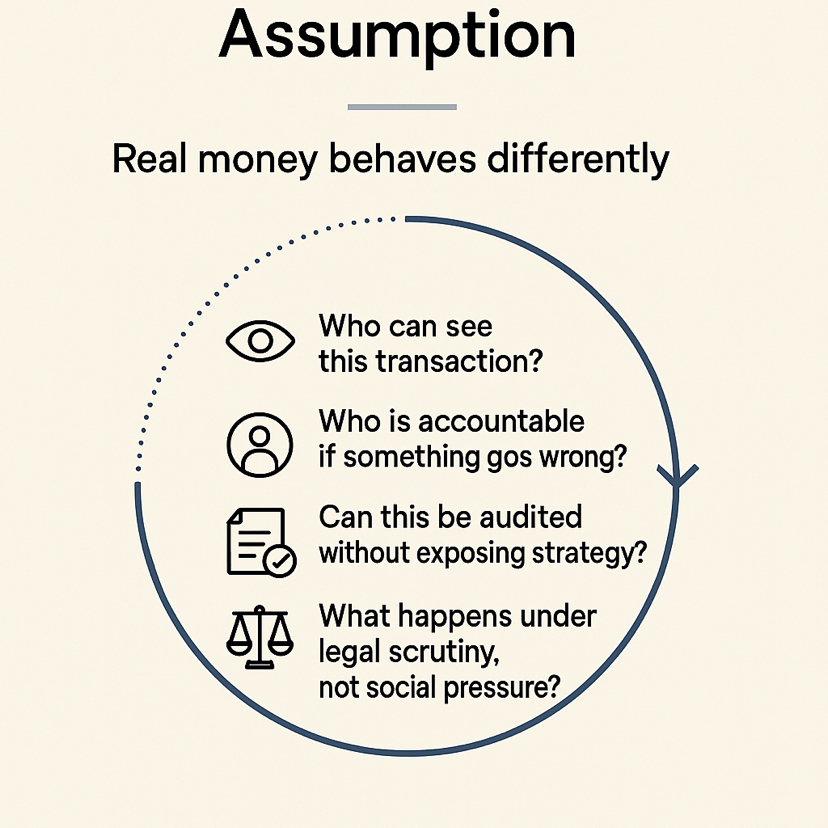
The first thing that breaks is assumption.
Most blockchains are built on the assumption that transparency is always good, speed is always rewarded, and users are tolerant of chaos. That assumption holds in speculative environments. It collapses the moment regulated capital shows up.
Real money behaves differently. It asks different questions.
Who can see this transaction?
Who is accountable if something goes wrong?
Can this be audited without exposing strategy?
What happens under legal scrutiny, not social pressure?
This is where many on-chain systems quietly fail. Not because the code is wrong, but because the context changes.
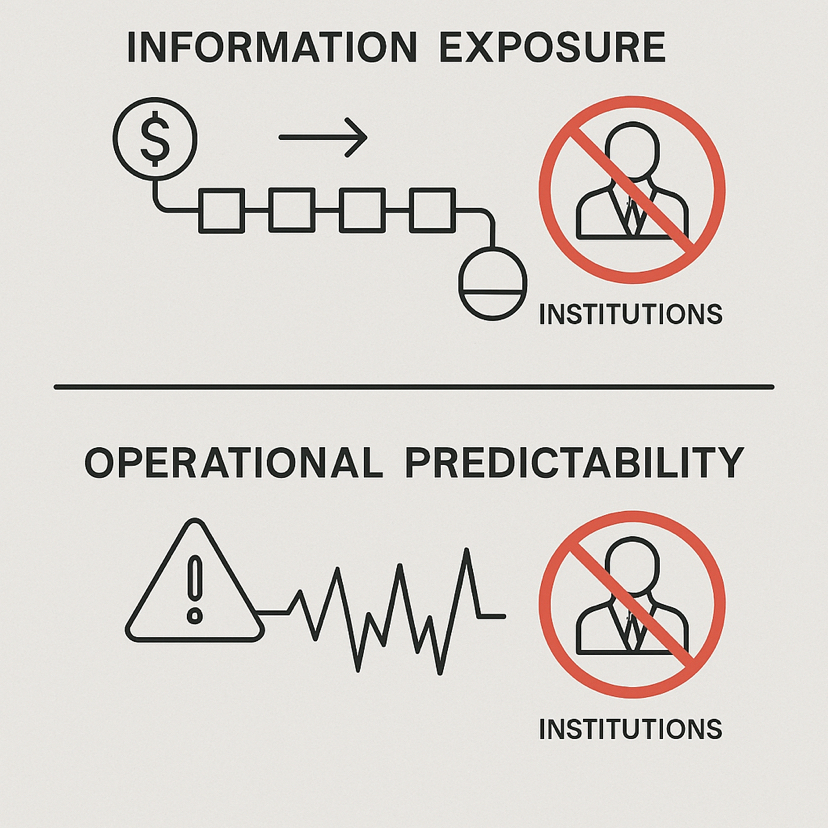
One of the earliest fracture points is information exposure. Public blockchains broadcast everything by default. Amounts, flows, timing, counterparties — all visible. For retail users, this feels ideological. For institutions, it feels reckless. In real markets, visibility is selective by design. You don’t publish your order book intentions. You don’t expose settlement flows to competitors. You don’t turn internal operations into public artifacts.
When on-chain systems ignore that, institutions don’t complain — they simply don’t use them.
The second thing that breaks is operational predictability. Crypto systems love edge cases. Flash liquidity, MEV games, reorg risks, gas spikes. These are tolerated because participants expect instability. Regulated finance does not. A system that works “most of the time” is functionally broken if it fails during stress.
This is why reliability matters more than novelty when real money is involved. Not uptime screenshots — but behavior under pressure. Can transactions settle cleanly when activity spikes? Can privacy guarantees hold without slowing execution? Can compliance requirements be met without emergency patches?
Most chains discover these answers too late.
Then there’s the third fracture: privacy ideology.
Many privacy-focused systems equate privacy with invisibility. Hide everything. Reveal nothing. That framing works until regulation enters the room. Regulators don’t oppose privacy — they oppose unaccountable opacity. The moment a system can’t support lawful disclosure, audit trails, or controlled access, it becomes unusable for serious finance.
This is where selective privacy stops being a philosophical choice and becomes an engineering requirement.
Dusk stands out here not because it “has privacy,” but because it treats privacy as a contextual tool. Some data is confidential. Some data must be provable. The system doesn’t force one worldview onto every transaction. It allows applications to decide what needs to be shielded and what needs to be verifiable.
That’s a subtle distinction, but it’s often the difference between a demo and a deployment.
Another thing that breaks early is developer friction. Institutions don’t build on exotic stacks unless they have no choice. If integrating a system requires relearning tooling, rewriting contracts, or justifying unfamiliar infrastructure to compliance teams, adoption slows to a crawl. Compatibility isn’t a convenience — it’s survival.
That’s why execution environments that meet developers where they already are tend to win quietly over time. Not because they’re more exciting, but because they reduce organizational resistance.
And finally, what breaks first is narrative patience.
Speculative markets reward speed. Regulated markets punish it. When timelines stretch, when releases are cautious, when launches are gated behind audits and reviews, impatience shows up in price before it shows up in usage. This is where many observers misread what’s happening.
Slow does not mean failing.
Quiet does not mean irrelevant.
Delayed does not mean abandoned.
Often, it means the system is being hardened instead of advertised.
Dusk feels built with this reality in mind. Not optimized for attention, but for survivability. Not designed to win every cycle, but to remain intact when scrutiny arrives. Its choices suggest an understanding that the first test of real adoption isn’t scale — it’s restraint.
When real money hits on-chain systems, what breaks first isn’t throughput. It’s trust boundaries. It’s information discipline. It’s the ability to say “no” to behaviors that don’t belong in regulated environments.
Most chains don’t fail loudly here. They simply never cross the threshold.
The ones that do are rarely the loudest. They’re the ones that feel boring until you realize boredom, in finance, is often another word for reliability.
And that’s usually the point where things finally start to work.
