

@Dusk Blockchains love to talk about consensus and cryptography, but the part that actually touches users is often simpler: how you learn what just happened. That question is getting louder now because the applications people keep asking for—settlement, tokenized assets, privacy with auditability—don’t tolerate guesswork or slow interfaces. If a wallet can’t say when a transfer is accepted, or an explorer lags behind finalized blocks, everything else feels like a promise. The Rusk Universal Event System, usually shortened to RUES, is Dusk’s attempt to make “what just happened?” a first-class feature.
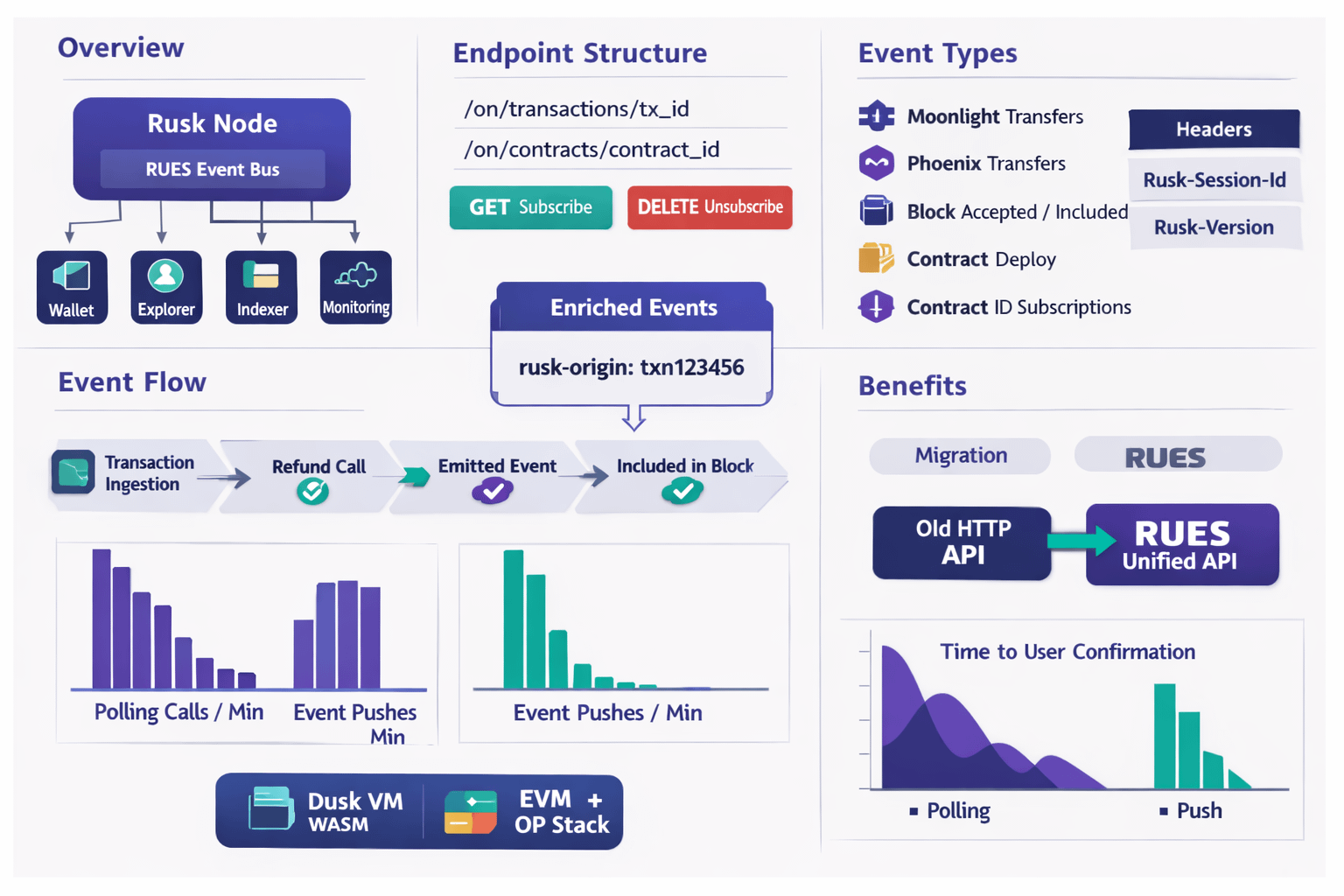
RUES sits inside Rusk, Dusk’s node implementation. Dusk describes Rusk as the core that runs consensus, maintains chain state and networking, and exposes external APIs. RUES turns node activity into signals outside software can listen to. The structure is intentionally plain: events live at /on/[target]/[topic], where targets can be contracts, transactions, blocks, node, or GraphQL-related components. To hop on a subscription, it’s a simple GET. To hop off, it’s DELETE. And the docs literally spell out headers like Rusk-Session-Id and Rusk-Version, so sessions and compatibility never feel like a guessing game.
Transactions are where the system stops being abstract. Dusk supports two transaction models—Moonlight for public transfers and Phoenix for shielded ones—and the engineering team has described emitting a model-specific event at the end of transaction ingestion. They note the event is emitted during the refund call so it captures both the changes made and the gas spent. The useful part is not that an event exists; it’s that it consistently packages what downstream software needs to react. You can listen for a single signal and then decide what “done” means for its own users.
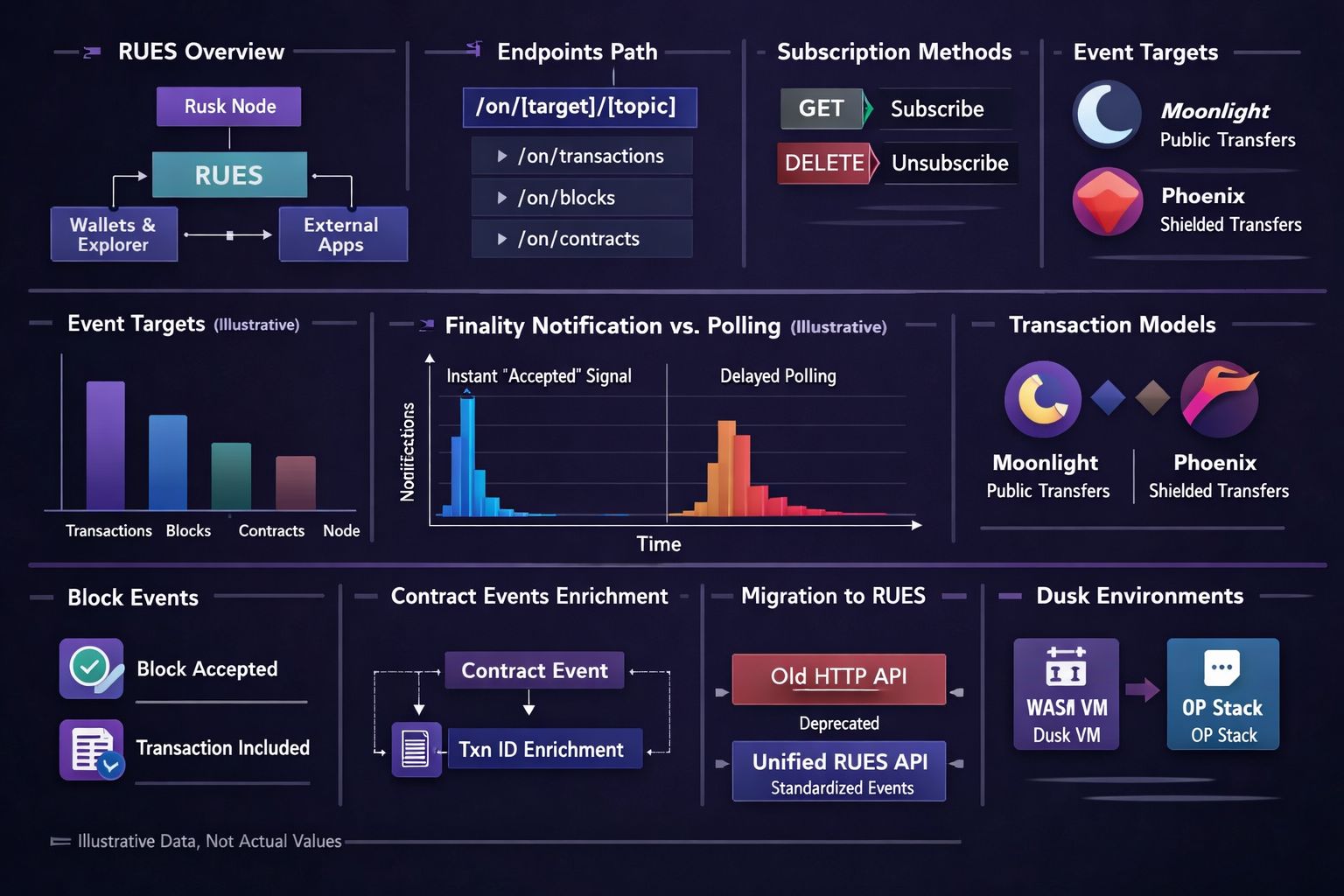
Blocks bring the same clarity to the chain’s pacing. The documentation shows granular subscriptions like /on/blocks:block_hash/accepted and /on/transactions:transaction_id/included. Dusk frames its settlement layer around deterministic finality aimed at financial use cases. In that context, a pushed “accepted” signal is operational sanity. Reconciliation jobs and monitoring dashboards can react to finality instead of polling and hoping they didn’t miss something important.
Contracts are where event design usually gets messy. On Ethereum-style systems, events exist largely because reading contract state continuously is awkward, so developers lean on emitted signals to observe behavior. RUES mirrors that practicality at the node interface, with broad topics like /on/contracts/deploy and subscriptions scoped to a single contract id. One detail from Dusk’s engineering updates feels especially real-world: to help archive nodes, contract events were enriched with the transaction id via a rusk-origin header, without altering the event data, and the enrichment was done at the node level rather than inside VM execution. That’s the kind of improvement that solves practical debugging and indexing pain, and it proves without dragging performance into the contract runtime.
RUES is getting attention partly because it marks a consolidation moment. Dusk has said it migrated older HTTP events over to RUES so events are standardized and the node exposes a unified API used by both wallets and the explorer. A related GitHub issue is blunt about direction: the wallet relied on the old HTTP API, and the plan was to deprecate that API in favor of RUES. When a team is willing to break with an older interface, it’s usually because internal complexity has started leaking into user-facing reliability.
The timing also fits a broader trend toward modular execution layers. Dusk documents multiple environments, including a WASM-based Dusk VM and an EVM-equivalent environment built on the OP Stack with support for EIP-4844. More environments usually means more tooling, and tooling lives on events. I’m drawn to projects that sweat these boring surfaces, because they’re where trust is earned. If RUES keeps maturing with stable schemas, useful filtering, and a clean catch-up story after downtime, it won’t be the headline feature, but it will make headline features usable. It’s a quiet layer that keeps promises.
