
I remember the first time I tried wiring money overseas for my cousin's wedding in Lahore—hours on hold with the bank, fees eating half the amount, and that nagging wait for "settlement" to clear, like the funds were stuck in some invisible customs line. It wasn't dramatic, just exhausting, the kind of friction that makes you question why moving value still feels like smuggling contraband in 2026. That mundane irritation stuck with me, a quiet resentment toward systems that prioritize their own machinery over the people caught in it.
I've been digging into blockchain projects on Binance Square, not hunting for the next moonshot, but trying to understand why some designs quietly invert the usual playbook. One evening, thumbing through a thread on Plasma's launch, I paused on their core architecture diagram—the one labeling the "settlement layer" as the foundational spine, with stablecoin rails embedded right into the protocol from genesis. It wasn't a flashy UI mockup or a DeFi yield farm teaser; it was this deliberate blueprint showing how every transaction funnels back to a verified, gasless USDT settlement before anything else blooms on top. That screen, with its clean lines tracing value flows from edge to core, jolted me. In a space obsessed with instant liquidity and viral apps, why start here, with the backend drudgery? It forced me to confront something I'd glossed over: maybe the rush to user-facing bells and whistles is just crypto's way of papering over insecure foundations.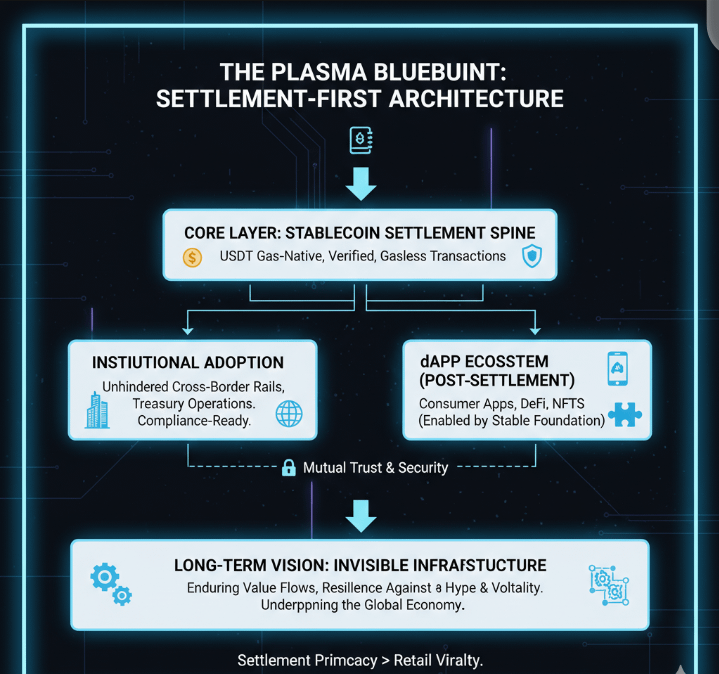
Here's the thought that unsettled me: true scalability in blockchains isn't about layering on consumer toys first—it's about forging an unyielding settlement backbone that institutions won't touch otherwise, even if it means delaying the party. We've all bought into this narrative that crypto disrupts by democratizing access through slick wallets and meme-driven tokens, but Plasma's choice exposes how fragile that is without settlement primacy. It's arguable, sure—critics might call it overengineered conservatism—but it rings true when you see how general-purpose chains buckle under real volume, fragmenting stablecoin flows into silos that bleed efficiency. By baking in stablecoin-native settlement from the outset, Plasma isn't just optimizing for payments; it's admitting that the "revolution" we hype often skips the plumbing that keeps value from evaporating in transit.
This flips a deeper assumption in crypto: that innovation cascades from retail experimentation, where users tinker and markets self-correct. But what if that's backward? What if the long-term survivors are the protocols that first satisfy the dull demands of cross-border rails—the trillion-dollar stablecoin economy humming in the background—before inviting the chaos of apps? It's slightly heretical to say, because it dings the underdog ethos we cherish, the idea that a solo dev with a smart contract can upend finance overnight. Yet, peering beyond the task that sparked this, I see echoes in traditional finance's evolution: SWIFT didn't start with consumer apps; it began with banks hashing out secure ledgers in windowless rooms. Crypto's youth makes us forget that endurance favors the methodical, the ones who treat settlement not as an afterthought but as the quiet enforcer of trust.
Plasma stands as a stark example here, not because it's reinventing the wheel, but because its design whispers a critique of the broader ecosystem. While others chase EVM compatibility as a checkbox for dApp ports, Plasma weaves it into a stablecoin-first frame, where gas is denominated in USDT to sidestep volatility traps that plague everyday transfers. It's observational, almost austere—no promises of governance tokens or NFT drops, just a layer tuned for the "how money actually moves" reality I felt in that bank queue. This reveals a long-term vision that's less about capturing mindshare today and more about embedding into the invisible flows that power everything else: remittances, treasury ops, the unglamorous arteries of global value. It's critical in the sense that it highlights how many projects, in their zeal for virality, leave settlement as a bolted-on vulnerability, prone to exploits or regulatory chokepoints.
In the end, this leaves me wondering: if settlement-first becomes the unspoken rule for chains that outlast the hype cycles, what hidden infrastructures will we have to build next to keep the whole edifice from quietly crumbling?

