

There’s a paradox in crypto that’s finally starting to click with serious traders and institutional players alike: what made blockchains revolutionary total transparency is precisely what’s kept most of the world’s capital on the sidelines. We’ve all traded on chains where every wallet move is public, every balance exposed, every strategic position visible to whales before a big release. For speculators and retail traders, that’s part of the thrill. But ask any bank, asset manager, or corporate treasury why they won’t touch DeFi with a ten‑meter pole, and you’ll hear the same thing: “We can’t expose our books to the world.”
This insight that too much transparency kills adoption isn’t some hot take. It’s a hard reality baked into regulatory frameworks like Europe’s GDPR and MiCA, and it’s precisely the problem that Dusk set out to solve. Traditional blockchains make transaction history and balances public forever. On Ethereum or Bitcoin, the ledger is an open book. You can’t hide how much you moved, who you paid, or when you paid them. And while that openness was a virtue in the early years of crypto building trust without intermediaries it turns into a liability as real financial markets and regulated assets seek on‑chain infrastructure. 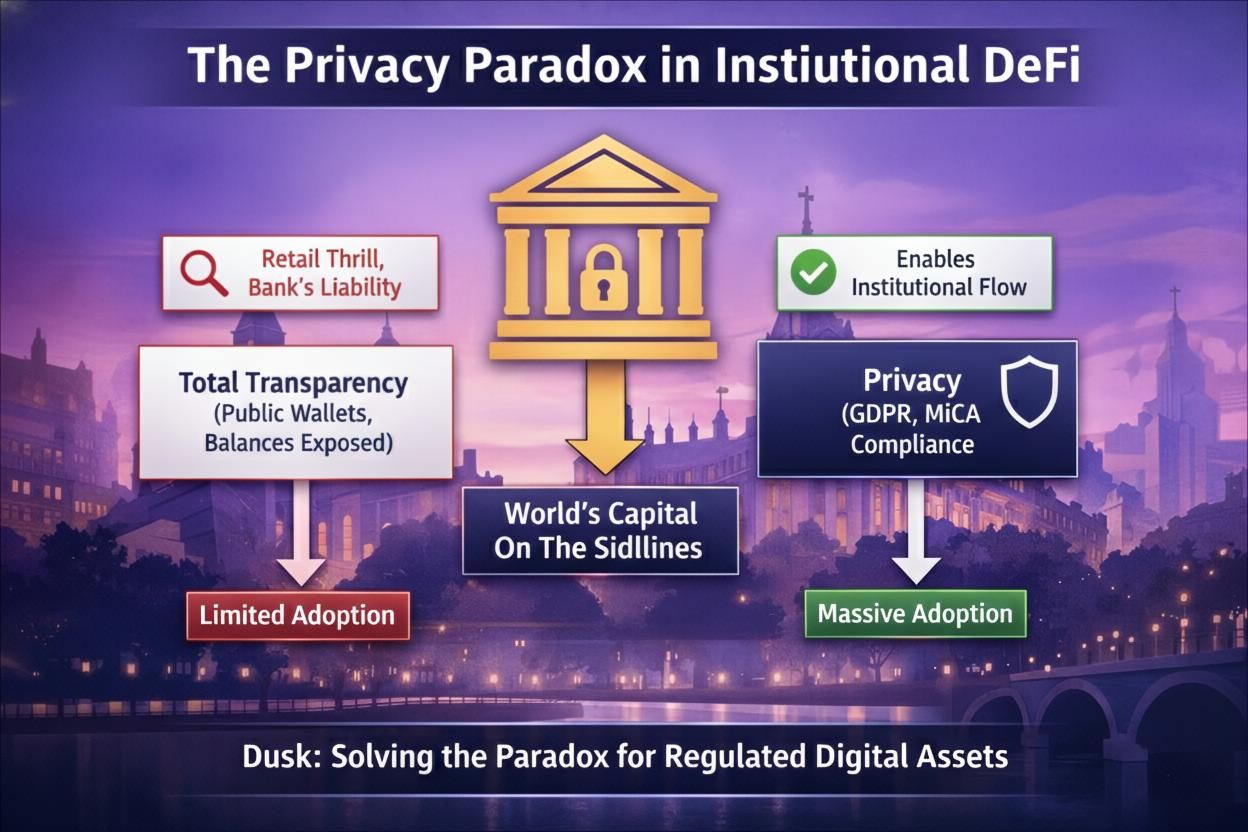
Where Dusk diverges from the mainstream is in questioning the old assumption that transparency must come at the cost of privacy. Instead of treating privacy as a trade‑off against openness, Dusk’s design treats privacy as a feature enabler of regulated adoption. That’s more than a slogan it’s a philosophical shift underway in 2026. Institutional adoption is no longer just a buzzword. It’s a necessity for blockchain to scale beyond retail speculation into the trillion‑dollar world of securities, bonds, and settlement systems. And without privacy built into the protocol, that adoption will never happen.
Let’s unpack that a bit. Traditional financial markets operate under confidentiality. You don’t see a bank’s daily cash flows, a hedge fund’s order book, or corporate treasury movements on a public billboard. Competitive advantage, counterparty risk, salary data, and strategic asset allocation all of that is typically shielded even from regulators until quarterly disclosures are due. Now imagine trying to put that on a public chain where everyone can see everything in real time. It’s a non‑starter.
Dusk’s answer and the reason it’s gaining real attention is selective disclosure powered by zero‑knowledge proofs. Zero‑knowledge cryptography lets a user prove something is true without revealing the underlying data. In simple terms, you can show that a transaction complies with regulatory rules like AML/KYC without actually showing the transaction details. It’s like proving you’re over 21 without showing your full ID the verifier gets only what they need to know. That’s the kind of balance regulators can sign off on.
That’s why, as of early 2026, both institutional traders and compliance teams are watching Dusk closely. The network’s architecture lets institutions issue and manage real‑world financial instruments on‑chain without exposing confidential balances or transactional histories. It doesn’t shove every participant’s financial life into a public ledger for all to see instead, it gives them control over what is visible and to whom. That’s not just a technical tweak; it’s a business necessity. 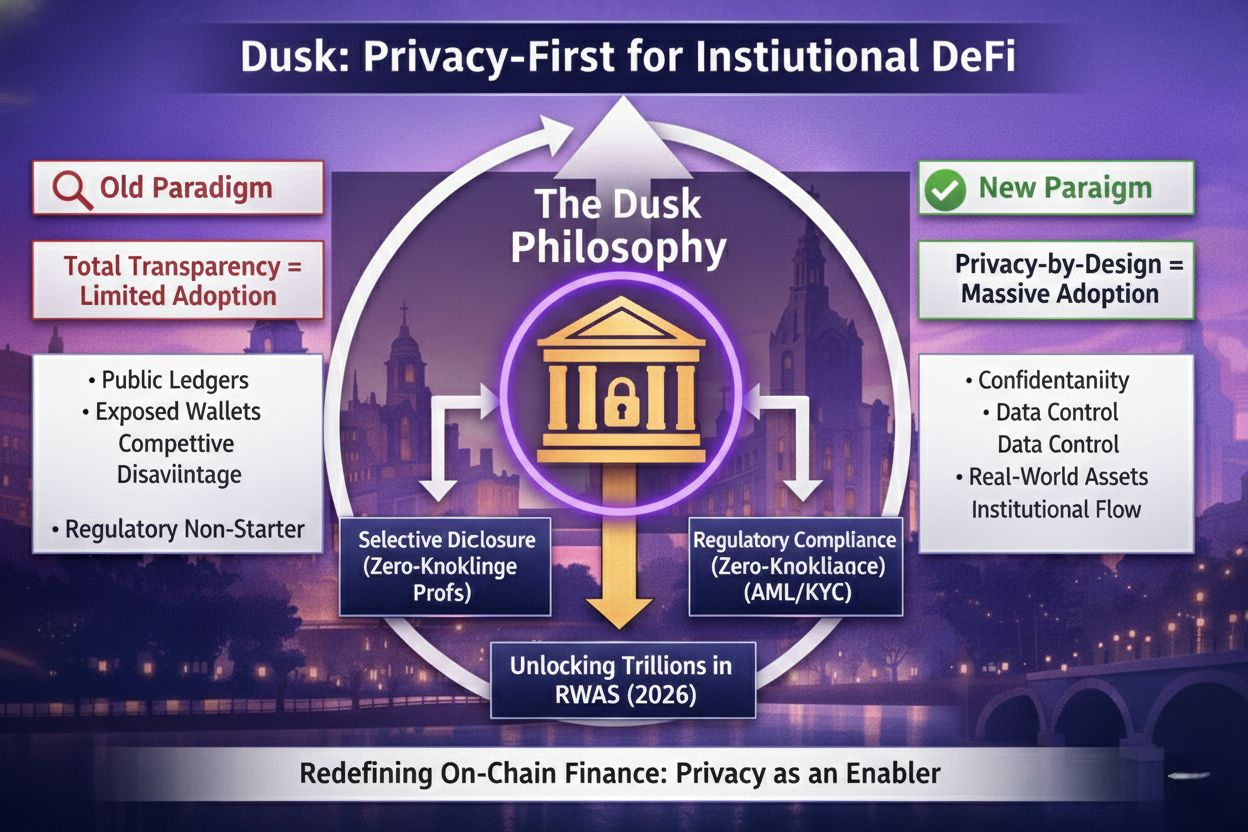
And let’s be clear this isn’t vaporware or some academic whitepaper ambition. Dusk’s roadmap has been steadily advancing toward these goals. Testnets have demonstrated core privacy mechanics, and mainnet launches incorporating these primitives are scheduled in 2026. The team has ticked off multiple key milestones, and incentivized testnets are already letting node operators experiment with privacy‑focused operations ahead of full launches.
From a personal trader perspective, this kind of shift feels like watching the markets evolve from street corner deals to regulated exchanges. In the early days, we learned and thrived on openness charting every on‑chain move, reading mempools like tea leaves. But as markets mature, the opacity that once hindered scams and rug pulls now hinders legitimate capital flows. The players with real capital don’t want their risk models leaked to competitors. They don’t want every settlement visible to the world’s cheapest bots. They want privacy with accountability, and Dusk is offering both.
Of course, this isn’t without challenges. Zero‑knowledge systems are computationally heavy, and achieving both scalability and privacy at institutional scale is a non‑trivial task. Critics point out issues around developer ecosystem maturity, liquidity, and how regulators will interpret privacy layers. But the broader market narrative is shifting: institutions are tired of choosing between complete transparency and complete opacity. They want functional privacy that can still prove compliance when required. That’s a big deal.

So why is this trend gaining steam now? Two reasons: regulatory clarity and market fatigue. With frameworks like MiCA becoming live and global regulations tightening around financial disclosures, the old blockchain transparency model looks less like a competitive advantage and more like a legal minefield. Meanwhile, traders and investors are recognizing that the next phase of crypto growth won’t come from decentralized exchanges or memecoins it will come from institutional participation. And that requires practical privacy.
In the end, the lesson is simple: too much transparency the kind that exposes every detail to every observer forever isn’t just unnecessary. It’s actively stopping traditional markets from stepping into the blockchain era. Dusk’s approach blending privacy, compliance, and selective visibility may not be the universal solution for every use case, but it’s one of the most promising paths toward real‑world adoption. And as traders, that’s exactly where the liquidity and growth opportunities will come from next.