
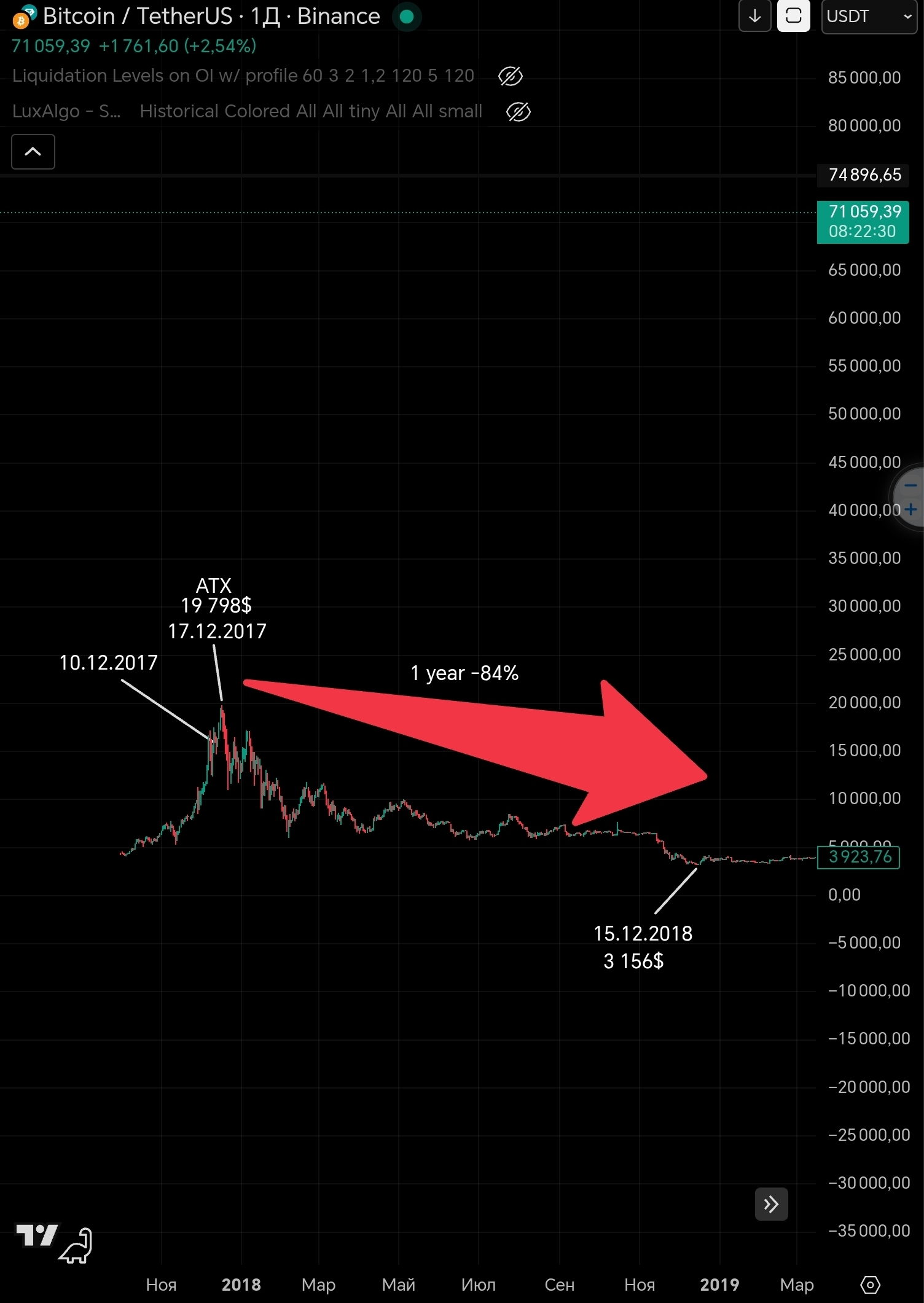
Many still look at the market through the eyes of 2017. Back then, everything seemed simple: there were few coins, many eager buyers, and large purchases drove the price up well. But on December 10, 2017, an event occurred that forever changed the DNA of Bitcoin - the first futures were launched on Chicago exchanges.
How has this affected the price $BTC ? Here we will turn to the chart for help.
If you look at the chart, you will see a very interesting coincidence in my opinion. Exactly one week after the launch of futures, on December 17, 2017, Bitcoin set its new ATH record at $19,798.
From this point, the painful and long decline began. Exactly one year later, in December 2018, the price collapsed to $3,156. The decline was 84%. In my opinion, the connection here is direct: large players received a tool that allows them to crash the market without owning a single coin.
Why is 21 million now a myth?
The market used to be linear and simple: you bought a coin - it became less on the market. Demand drove the price. Today the market has become artificial, and here are three reasons why the old model no longer works:
1. The death of real scarcity
From a mathematical perspective, there are very few Bitcoins. Let me give you an example: There are 8 billion people on Earth, and each person has only 0.0026 BTC (about $187 at the current rate). It seems like a wild shortage!
But futures allow trading 'air'. These are derivative contracts where transactions occur in dollars. Banks do not need to buy real Bitcoin to meet investor demand. They simply draw 'paper' contracts.
The result: Demand is diluted. Instead of pushing the price of the real coin up, the money goes into an endless stream of virtual pieces of paper.
2. Control over volatility
Previously, to drive down the price, one had to have coins and sell them. Now institutional players can open 'shorts', i.e., bets on the decline, of any volume. They 'squeeze' the price with paper sales precisely when Bitcoin is ready to grow. Bitcoin has ceased to be the 'wild west' and has become a compliant tool in the hands of market makers.
3. The banking trap: The pyramid effect
With the emergence of ETFs and banking products, one real Bitcoin in storage
turns into a 'matryoshka':
• It issues shares of the fund.
• It serves as collateral for loans.
• Futures are opened under it.
In summary: In the blockchain - 1 coin, but in the terminals - 5 people are confident that they own it. This is classic 'fractional reserve'. There are already many more paper rights to Bitcoin in the network than there are coins themselves.
Bitcoin has become a mature asset, and professionals are playing against us. The only working advice today: Take your coins off exchanges.
The exchange is not your wallet. As long as your BTC lies on exchanges, they are in a common pot. The exchange can (and will) use your assets as collateral for those very funds that bet against the market.
Personal storage. By withdrawing coins to a cold wallet, you physically pull them out of this resale system. You see news every day about how large players are withdrawing their coins to wallets; now you know why this happens.
The output is simple: Bitcoin no longer grows just like that. For the limit of 21 million to become a reality again, the coins must be in the hands of people, not intermediaries. Only by creating a real shortage in wallets can we break the game of 'paper' manipulators.
Do you believe that futures have completely changed Bitcoin?
