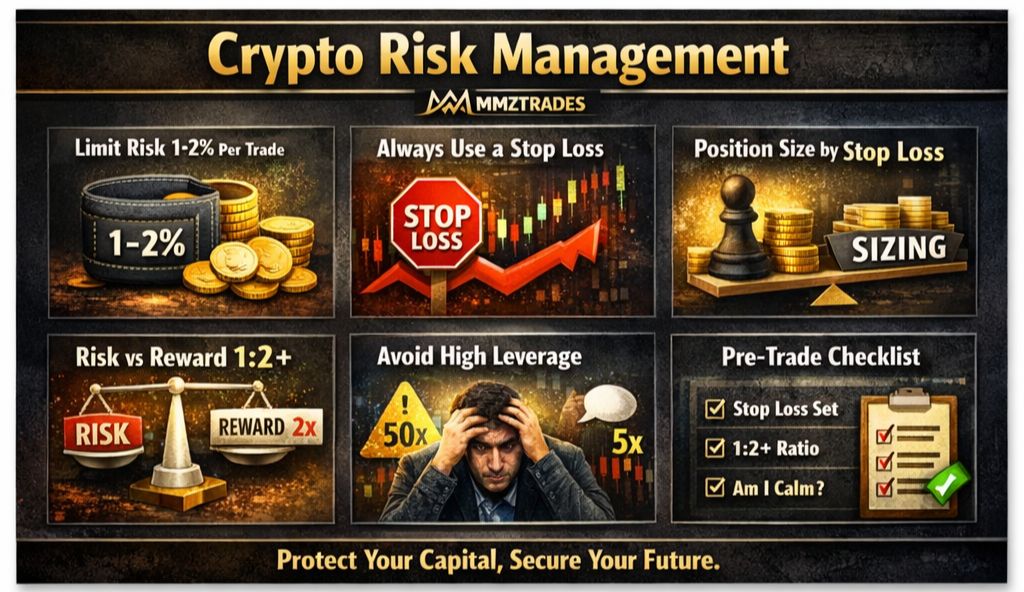
Why Risk Management Is Your Real Strategy
In the fast-paced, emotional world of cryptocurrency, most beginners focus on finding the next big winner. Everyone wants the coin that will “moon.” But experienced traders understand something far more important: survival matters more than prediction.
In crypto, risk management is not optional. It is not a backup plan. It is the real strategy. Many traders lose their entire account even when their market direction is right, simply because they ignored basic risk rules. One bad trade should never be able to end your journey.
Here’s how to structure your trading like a professional.
1. Protect Your Capital (The Oxygen Rule)
Your trading capital is like oxygen. Once it’s gone, the game is over.
A simple and powerful rule is to risk only 1 to 2 percent of your total capital on a single trade.
Example:
If your capital is PKR 100,000, the maximum you should lose on one trade is PKR 1,000 to 2,000.
Why this works:
Even if you hit several losing trades in a row, your account survives. You stay in the game long enough to improve, learn, and recover.
2. Always Use a Stop Loss
Trading without a stop loss is not trading. It is gambling.
A stop loss is a pre-planned exit that automatically closes your trade if price moves against you. It removes emotional decision-making when the market turns ugly.
Example:
You buy Bitcoin at 100 and decide that if price drops to 97, you’re out. That 97 is your stop loss. The decision is made calmly, before fear or panic shows up.
3. Position Size Matters More Than Entry
Beginners obsess over perfect entries. Professionals focus on position size.
Your position size should always be based on how far your stop loss is.
If your stop loss is wide, your position should be smaller
If your stop loss is tight, your position can be slightly larger
The goal is simple. No matter where the stop loss is, the amount you lose stays within your 1–2 percent risk limit.
4. Respect the Risk-to-Reward Ratio
Before entering any trade, ask one question:
Is the potential reward worth the risk?
A solid beginner rule is a minimum risk-to-reward ratio of 1:2.
Example:
Risk: PKR 1,000
Target: PKR 2,000 to 3,000
If the realistic profit is smaller than the possible loss, skip the trade. There will always be another opportunity.
5. Leverage Can Destroy Accounts
Leverage increases profits, but it also multiplies losses. For beginners, high leverage is one of the fastest ways to blow an account.
Smart approach:
Start with spot trading
If using futures, keep leverage under 5x until you are consistently profitable
Using 20x or 50x leverage without experience is not confidence. It is a shortcut to zero.
6. Control Your Emotions
Most big losses come from fear, greed, or revenge trading. That urge to “make it back” after a loss is extremely dangerous.
If your heart rate is high, if you feel angry, or if you are desperate to recover a loss, stop trading.
Remember this:
Not trading is also a valid decision.
7. Protect Profits When You’re Right
When a trade moves in your favor, don’t just sit and hope.
Move your stop loss to breakeven so the trade becomes risk-free
Take partial profits to lock in real gains while letting the rest run
This turns winning trades into protected opportunities instead of emotional roller coasters.
The Pre-Trade Checklist
Before clicking “Buy” or “Sell,” ask yourself:
Where is my stop loss?
How much will I lose if I’m wrong?
Is the reward at least twice the risk?
Am I calm and focused?
If you can’t answer all of these, don’t take the trade.
Crypto markets will still be here tomorrow. Your capital might not be if you ignore risk.
Set daily loss limits. For example, stop trading after two losing trades in a day. Close the app and walk away.
Protecting your money today gives you the chance to profit tomorrow. In crypto, survival always comes before success