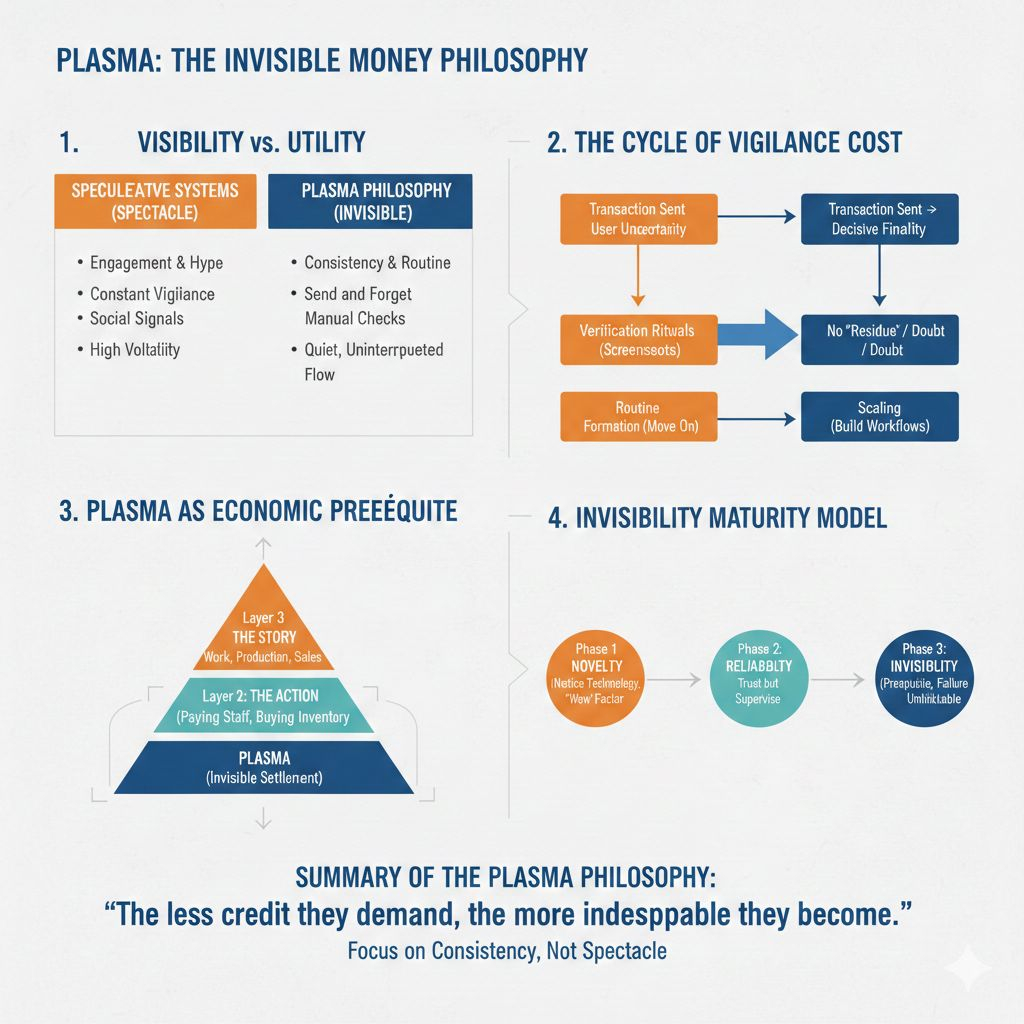
Plasma Feels Like It Was Designed for Money You Don’t Get Credit For Moving
There’s a kind of money movement nobody celebrates. No one tweets about it. No one screenshots it. It happens in the background, on schedule, without incident and if it stops happening, everything downstream starts to creak.
That’s the kind of money Plasma seems preoccupied with.
Most crypto systems are built around moments that generate visibility. Spikes, launches, bursts of activity that make the network feel alive. Those moments are useful for attention, but they’re not how real economies breathe. Real economies depend on transfers that no one notices because noticing them would mean something is wrong.
Plasma feels like it’s aiming for that unnoticed middle.
What stands out is how little it appears to care about producing signals of activity. There’s no sense that the system wants to be watched. If anything, it feels like it wants to be trusted enough to be ignored. That’s a strange goal in an industry trained to equate engagement with success, but it makes sense once you stop thinking about money as content.
In mature payment environments, moving money is rarely a value-generating act on its own. It’s a prerequisite. Salaries have to land before work continues. Suppliers have to be paid before inventory moves. Settlements have to close before reports can be finalized. The payment itself isn’t the story — it’s the condition that allows the story to continue.
Plasma seems to understand this asymmetry.
Instead of designing for excitement at the moment of transfer, it designs for the absence of consequences afterward. The goal isn’t to feel fast. It’s to feel complete. A payment that completes cleanly doesn’t pull attention forward into the next hour or the next day. It leaves no residue.
That residue is where many systems quietly lose trust.
Even when transactions succeed, they often leave behind small doubts. Should I check again later? Should I wait before assuming this is final? Should I keep a note, a hash, a screenshot? None of these actions are dramatic, but together they teach users that vigilance is part of the cost.
Plasma’s design feels like an attempt to remove that lesson.
By narrowing the range of possible outcomes and making completion feel decisive, it trains a different behavior. You send. You move on. You don’t build rituals around the system. Over time, that absence of ritual becomes its own form of reliability.
What’s interesting is how this plays out at scale.
When systems require attention, organizations compensate with process. Extra checks. Internal buffers. Manual oversight. Those compensations become permanent, even if the system improves later. The cost of attention never fully goes away once it’s been learned.
A system that avoids teaching vigilance in the first place avoids that cost entirely.
Plasma feels like it’s designed to protect that long term behavior. Not by eliminating risk that’s impossible but by making normal outcomes obvious enough that people don’t feel the need to supervise them.
There’s also a social dimension to this that’s easy to miss. Money movement that draws attention creates hierarchy. Someone watches. Someone approves. Someone waits. Money movement that fades into routine flattens those hierarchies. Things just happen when they’re supposed to.
That flattening is part of why boring systems scale.
Legacy payment rails survived not because they were elegant, but because they made it possible for people to stop negotiating every transfer. Once routines set in, organizations built entire workflows on top of them. Replacing those rails became difficult not because of lock in, but because of behavioral dependence.
Plasma feels like it’s trying to earn that dependence the hard way.
No incentives to overuse.
No spectacle to distract.
Just consistency, repeated enough times that people stop noticing it.
Of course, there’s a risk here. Systems that don’t produce visible success are easy to underestimate. If adoption stalls, there’s no noise to mask it. Plasma is effectively betting that repetition will do the work that marketing often does in crypto.
That’s not a safe bet in the short term. It’s a rational one in the long term.
Money systems don’t win because they’re admired. They win because they become prerequisites something you rely on before you think about everything else. The less credit they demand, the more indispensable they become.
Plasma doesn’t feel like it’s trying to be the most impressive system in the room.
It feels like it’s trying to be the system you forget to thank because nothing went wrong.
And in payments, that kind of invisibility isn’t a flaw.
It’s the highest form of success.