
Recently discussed on the public platform X, ZK is indeed the real endgame. As the competition among single chains gradually evolves into a confrontation between networks, ZKsync has quietly completed its elevation from a superchain to an elastic hub. The future landscape of blockchain is shifting from 'thousands of chains galloping' to 'island connections.' The evolutionary path ZKsync has recently shown clearly reveals a deeper trend: the true endgame is not a single chain winning based on technical parameters, but an elastic network that can seamlessly connect diverse ecosystems and achieve free value collaboration.
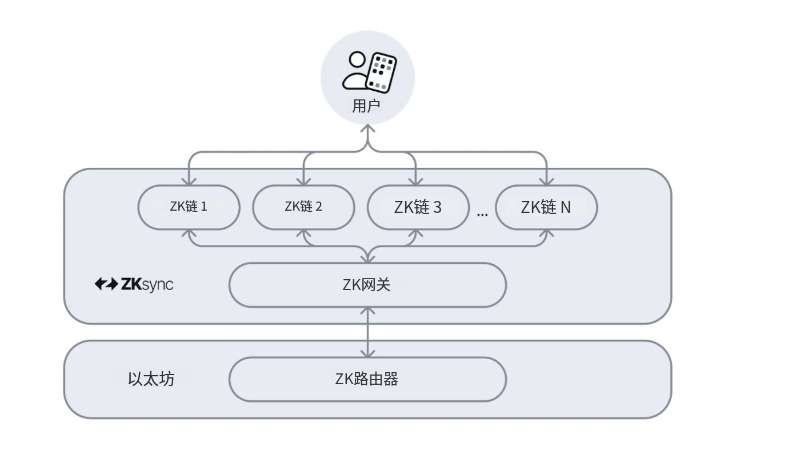
This is no longer a framework that requires applications to fill; rather, it is an underlying matrix capable of giving rise to and carrying a prosperous ecosystem. From the AbstractChain focused on modular development to the Sophon building the chain gaming ecosystem, and to the Heurist integrating artificial intelligence, over 21 vertical chains based on zero-knowledge proofs have gathered here.
One, paradigm shift: from isolated 'chains' to a collaborative 'network'.
Traditional blockchain narratives often revolve around a single mainnet, measuring its success by the total locked value on-chain and the number of top applications. This model can easily lead to ecological involution and liquidity fragmentation. ZKsync's Elastic Network model is essentially a paradigm shift. It no longer seeks to build a closed garden where 'everything is available to me' on a single chain but is committed to becoming a secure and interconnected underlying value network.
Each connected vertical chain (zkChain)—whether serving games, AI, finance, or social interactions—functions like a uniquely functional 'digital city-state'. They possess independent business logic and governance rules but share the core infrastructure provided by ZKsync: a verification security layer based on zero-knowledge proofs and an efficient interoperability protocol.
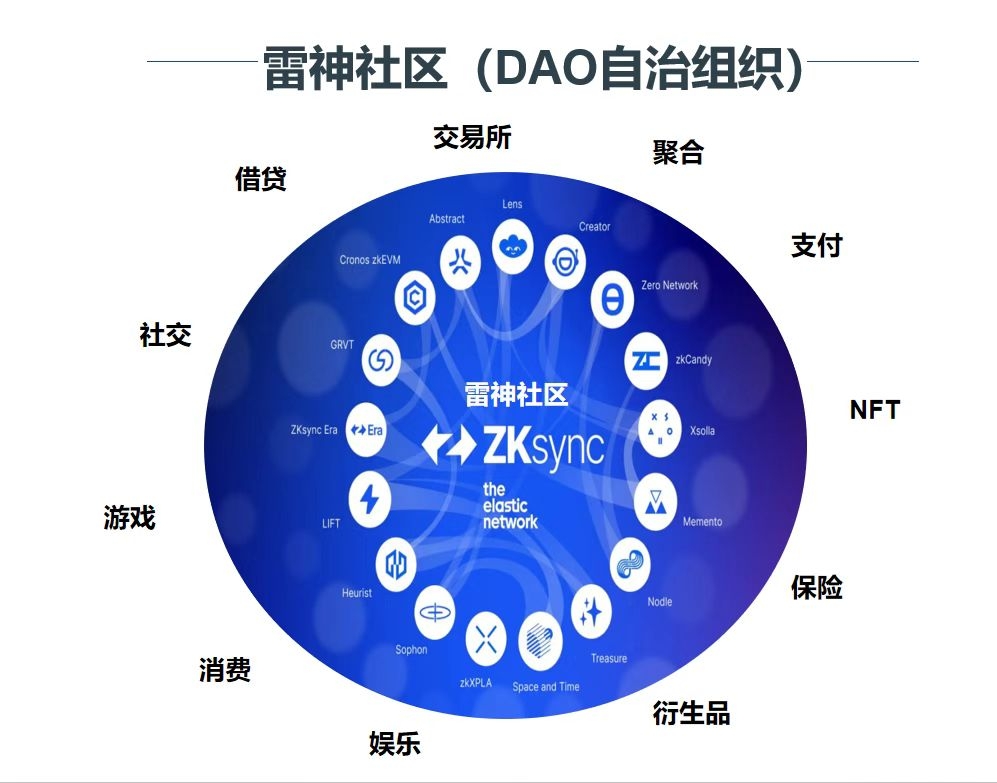
The brilliance of this architecture lies in its ability to resolve the unsolvable contradiction of the 'scalability trilemma' on a single chain. By distributing different performance and functional requirements to different customized chains while ensuring final consistency and trust transmission through a highly secure core layer, the entire network achieves a unity of elastic scalability and robust security.
Second, the core of network effects: the triple synergy of technology stack, security, and liquidity.
The value of this elastic network is not merely the simple addition of chains but arises from the deep synergy effects generated on three levels:
First, it is the standardization and open-source collaboration of the technology stack. The modular ZK Rollup solution provided by ZKsync allows developers to quickly customize and deploy a zkChain that meets specific needs, like building blocks. This greatly lowers the barriers to building high-performance blockchains and fosters explosive innovation in applications, while all innovations continuously refine and enrich the shared technology stack.
Secondly, it is the trusted collaboration of the shared security model. Each vertical chain does not need to build its own validator network and security trust from scratch. They can rely on the security framework jointly guaranteed by the ZKsync core layer and the Ethereum mainnet, which has been tested in real-world scenarios. This model of 'security as a service' clears the biggest trust barriers for various types of real-world assets (RWA) and high-end financial applications to go on-chain.
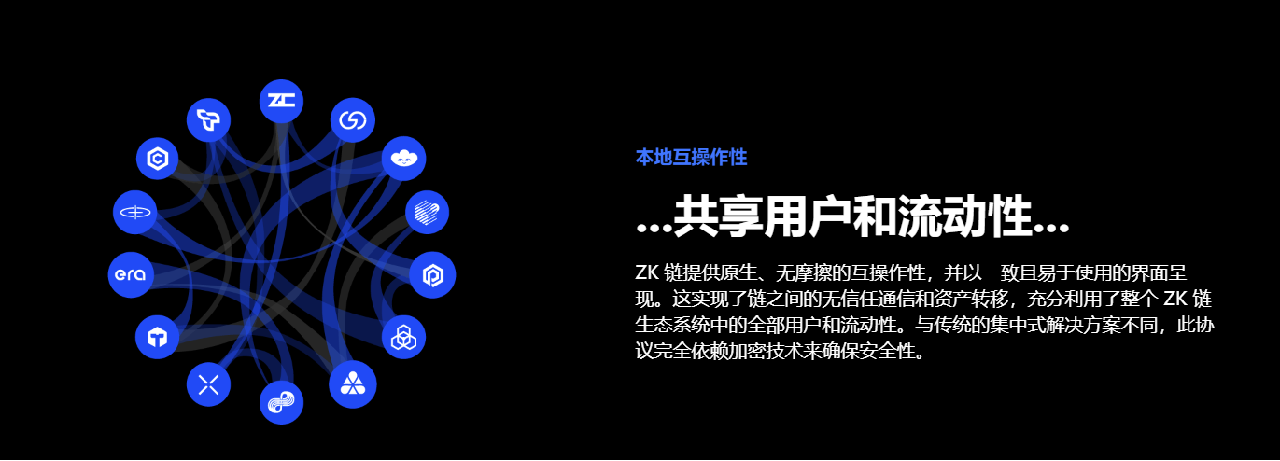
Lastly, and most importantly, it is the liquidity synergy brought by native interoperability. Through carefully designed cross-chain communication protocols, assets and data can flow almost seamlessly between different zkChains. Asset items on one gaming chain can instantly become collateral on another DeFi chain. This breaks the common liquidity island problem in traditional multi-chain ecosystems, making the network effect of '1+1>2' truly possible.
Three, future value anchor: becoming the core hub of digitalization of real-world assets.
The ultimate positioning of ZKsync's Elastic Network far exceeds cryptocurrency trading itself. Its most imaginative future value lies in becoming the core trusted hub connecting the real world and the digital world. Dedicated private chains in the network can perfectly meet the stringent requirements of enterprises and financial institutions regarding data privacy, compliance checks, and customized permissions, allowing traditional assets like stocks, bonds, real estate, and carbon credits to be reliably put on-chain. All these on-chain assets can then safely and efficiently enter a global, 24-hour operating open market for circulation and pricing through the network's public layer. This means a globally covering, peer-to-peer value exchange internet is taking shape. What ZKsync is building is the crucial protocol and routing layer in this internet—it does not directly produce 'goods', but sets the rules and highway networks for the digitalization, confirmation of rights, and circulation of 'goods'.

The evolution of ZKsync reveals a profound industry truth: the ultimate value of blockchain technology lies not in extreme single-chain performance but in whether it can form an organically synergistic and securely trusted ecosystem.
The leap from 'chain' to 'network' marks the development of blockchain infrastructure entering deep waters. The core of competition has shifted from a comparison of technical parameters to a comprehensive contest of ecological synergy capabilities, standard-setting abilities, and real value capture capabilities.
When technology, security, and liquidity form a flywheel in a triple synergy, what ZKsync anchors is a future financial landscape where everything can be valued and global assets are efficiently interconnected. This is not only the future of ZKsync but also outlines a clear picture of the next generation of the internet's value layer.

