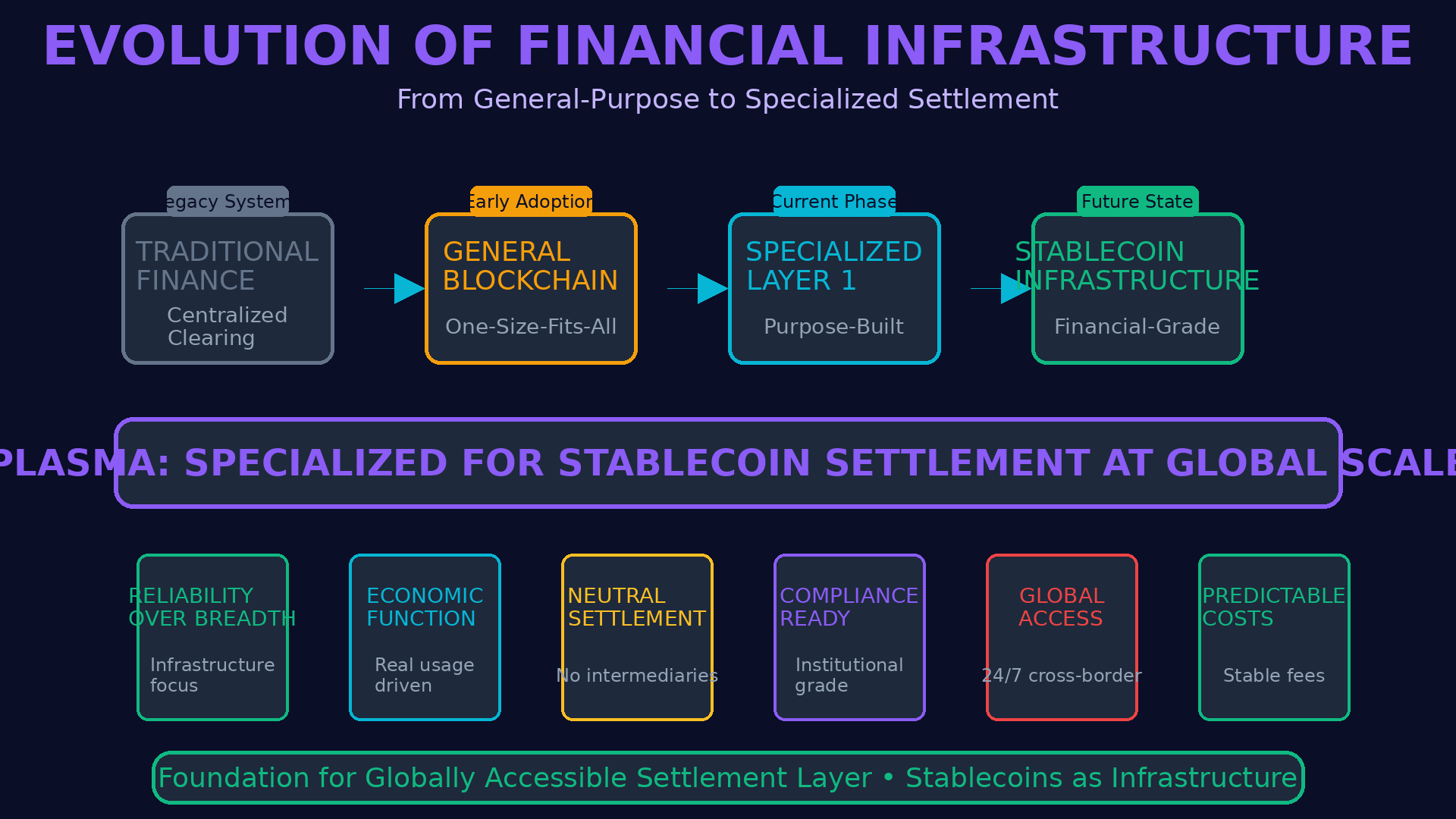
 Plasma (XPL) is currently focused on scaling its stablecoin-native Layer 1 infrastructure with the explicit goal of supporting real-world financial settlement at a level that traditional blockchains have struggled to achieve. This focus reflects a mature understanding of where blockchain adoption has proven most durable and economically meaningful. Over the past several years, stablecoins have emerged as the dominant use case in crypto, accounting for the majority of on-chain transaction volume and serving as the primary bridge between decentralized networks and traditional finance. Plasma’s design philosophy begins from this reality rather than attempting to retrofit payment functionality onto a general-purpose system. By building a Layer 1 where stablecoins are the primary unit of account, Plasma aligns its technical architecture, security assumptions, and scaling strategy with the actual behavior of users and institutions. This approach allows the network to prioritize predictable settlement, low transaction costs, and operational reliability, all of which are essential for payments, remittances, treasury flows, and institutional-grade financial activity. Instead of competing on experimental features or maximal programmability, Plasma positions itself as infrastructure, aiming to function as a neutral, efficient settlement layer that can support stable value transfer at global scale.
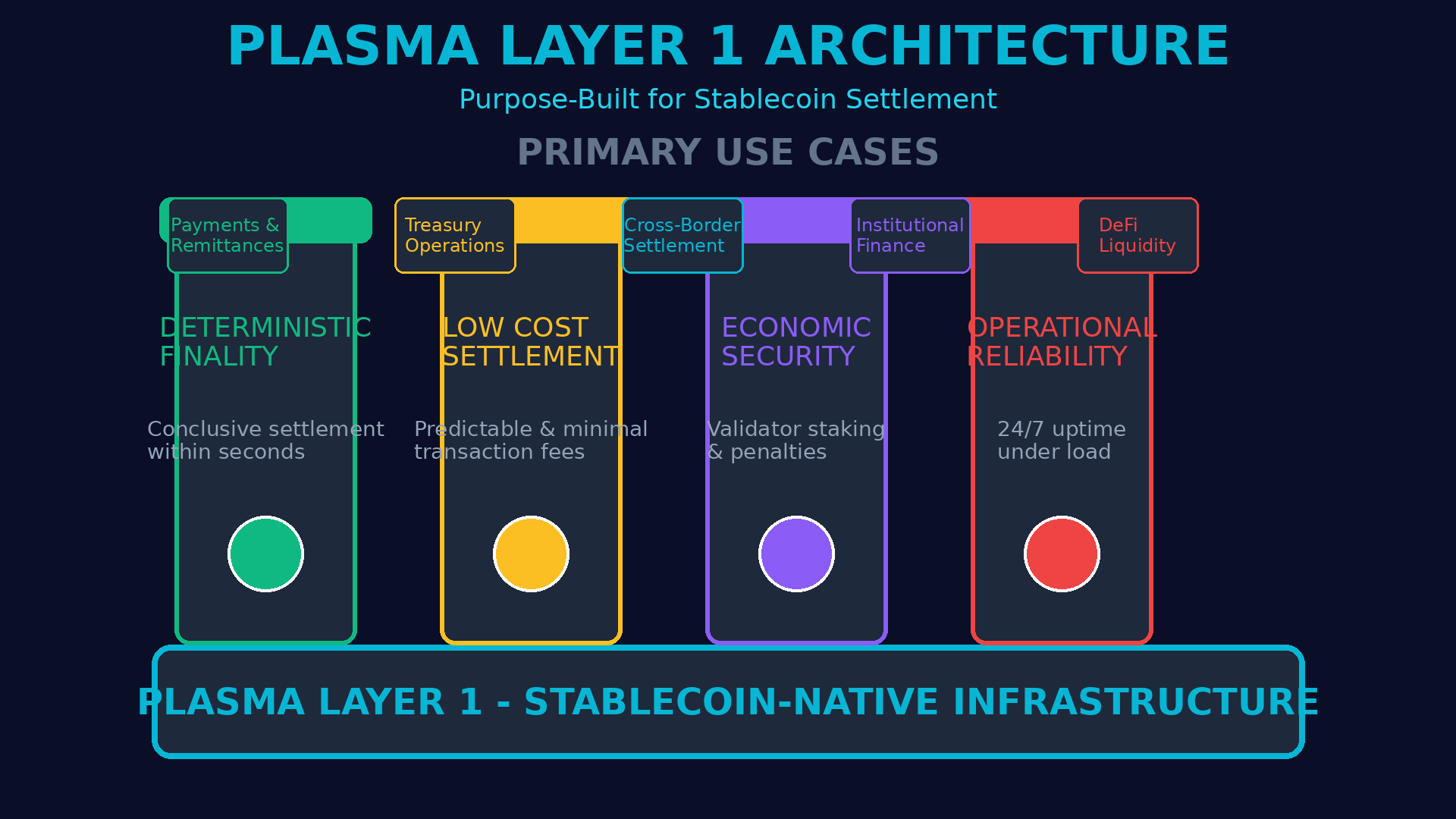
At the core of Plasma’s scaling strategy is the recognition that stablecoin settlement places fundamentally different demands on a blockchain than speculative trading or high-complexity smart contract execution. In a stablecoin-native environment, the most important performance metrics are finality speed, consistency, and throughput under sustained load. Plasma’s Layer 1 is designed to minimize uncertainty by offering deterministic finality, ensuring that transactions are conclusively settled within a very short time window. This characteristic is critical for financial workflows where delayed or probabilistic confirmation introduces reconciliation risk, capital inefficiency, and operational friction. For example, a merchant accepting stablecoin payments cannot reasonably wait multiple minutes for confirmation, nor can a financial institution tolerate the possibility of chain reorganizations after accounting entries have been recorded. Plasma addresses these issues by optimizing its consensus and validator coordination around fast, irreversible settlement rather than probabilistic assurance. This design choice reduces the need for off-chain guarantees, intermediaries, or complex risk buffers, allowing stablecoin transactions to behave more like traditional electronic payments while retaining the transparency and neutrality of a decentralized system.
Scaling a stablecoin-native Layer 1 also requires a different approach to network economics and security. Plasma relies on a decentralized validator network secured through XPL staking, aligning validator incentives directly with the integrity and performance of the settlement layer. Because stablecoins represent real-world value, the cost of failure is significantly higher than in purely speculative environments. Plasma’s economic model reflects this by requiring validators to commit capital that can be penalized in the event of malicious behavior, downtime, or protocol violations. This staking-based security model creates a strong deterrent against attacks while encouraging long-term participation from validators with aligned interests. At the same time, Plasma’s fee structure and throughput design aim to keep transaction costs low and predictable, a necessity for payment-focused systems where even small fees can become prohibitive at scale. By avoiding congestion-driven fee volatility and excessive computational overhead, Plasma seeks to provide a stable operating environment for applications that depend on consistent settlement costs, such as payroll distribution, cross-border remittances, and automated treasury operations.
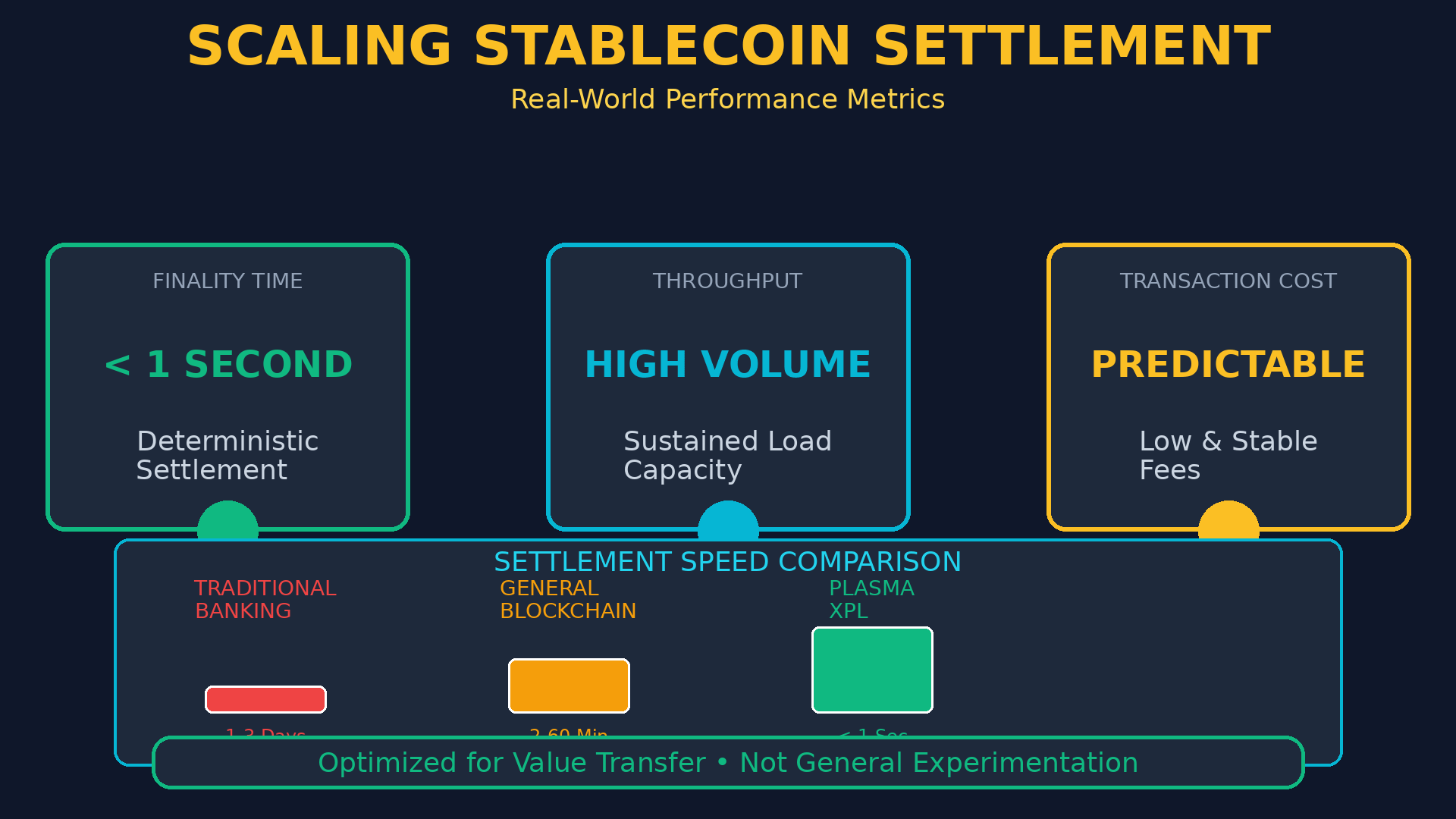
Another critical dimension of Plasma’s scaling strategy is its emphasis on reliability and operational continuity. A stablecoin-native Layer 1 must function as always-on infrastructure, capable of handling high transaction volumes during periods of market stress, regional demand spikes, or macroeconomic volatility. Plasma’s architecture is designed to maintain performance under sustained load rather than optimizing solely for peak benchmarks. This includes efficient block propagation, disciplined validator participation requirements, and consensus mechanisms that prioritize liveness without sacrificing safety. In practical terms, this means the network is built to support continuous settlement across time zones and jurisdictions, a requirement for global financial systems. For stablecoin issuers and integrators, this reliability reduces dependency on centralized clearing systems or manual intervention, enabling more automated and scalable financial products. Plasma’s focus on infrastructure stability also supports regulatory and institutional use cases, where predictable uptime and settlement behavior are prerequisites for compliance, auditing, and risk management.
From a broader industry perspective, Plasma’s stablecoin-native Layer 1 represents a shift away from one-size-fits-all blockchain design toward specialization driven by economic function. As blockchain technology matures, it becomes increasingly clear that no single architecture can efficiently serve every use case. Payment systems, decentralized finance platforms, data availability layers, and execution environments each have distinct requirements and trade-offs. Plasma’s decision to concentrate on stablecoin settlement allows it to make clear architectural choices without compromise, optimizing for value transfer rather than general experimentation. This specialization does not limit innovation; instead, it provides a reliable foundation upon which higher-level applications can be built. Developers and institutions can integrate with Plasma knowing that the underlying settlement layer is designed explicitly for stable value movement, reducing uncertainty and simplifying system design.
In the long term, Plasma’s approach positions it as potential core infrastructure for the expanding role of stablecoins in global finance. As stablecoins are increasingly used for international trade settlement, on-chain liquidity management, and digital representations of fiat reserves, the demand for robust, scalable, and neutral settlement layers will continue to grow. Plasma’s focus on a stablecoin-native Layer 1 aligns with this trajectory by emphasizing finality, security, and operational predictability over speculative differentiation. By scaling infrastructure around real economic usage rather than theoretical maximums, Plasma aims to bridge the gap between decentralized networks and the practical requirements of modern financial systems. In doing so, it reflects an evolution in blockchain design philosophy, one that prioritizes reliability and purpose over breadth, and positions stablecoins not as an auxiliary feature, but as the foundation of a new, globally accessible settlement layer.