

Many people’s first impression of Plasma ($XPL) is still secondary: whether it has risen, whether it has fallen, or whether there has been a pump. But honestly, the more volatile and emotionally fluctuating the market phase, the clearer one thing becomes—prices can be erratic, narratives can change skins, but only the 'settlement' demand will not disappear. The most noteworthy aspect of Plasma is not whether it can double your investment overnight, but how clearly, obsessively, and practically it addresses the question of 'how to make stablecoins more like money.'
First, let's clarify the positioning: Plasma is not an asset issuance platform, not a 'gateway' for RWA, and definitely not a project that can be explained simply by slapping a scalability label on it. Its core track is very singular and rigid: a stablecoin settlement-oriented Layer 1. It uses a fully EVM-compatible execution environment (Reth), combined with sub-second finality consensus (PlasmaBFT), and integrates stablecoin-prioritized product logic into the system—such as gas-free USDT transfers and a gas mechanism tilted towards stablecoins. These may seem like 'experience optimizations,' but they are actually competing for a more fundamental position: when people truly use stablecoins for transfers, payments, and cross-border settlements, users shouldn't have to first learn to buy gas, switch networks, or calculate confirmation times. If you make every step difficult for newcomers, even the grandest narratives can only remain within the crypto circle's self-indulgence.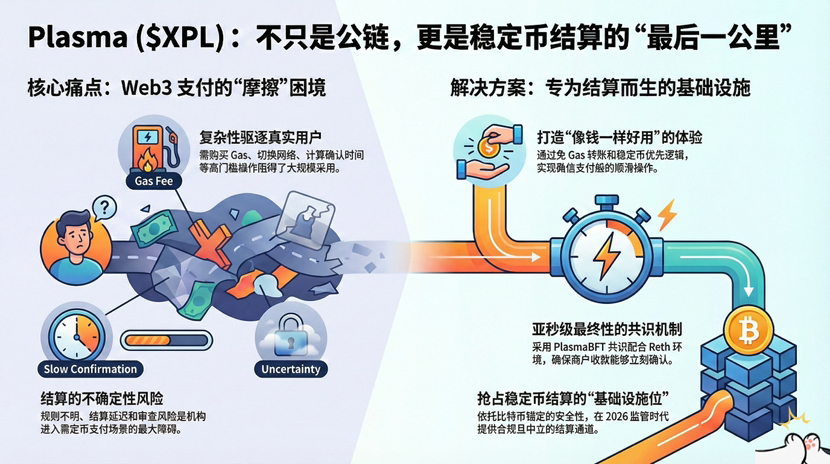
Many veteran players are reluctant to admit: the biggest bottleneck of Web3 has never been 'insufficient performance', but rather 'too much friction'. Uncertainty in transaction fees, confirmation, chain selection, and address input—each uncertainty drives real users away. Plasma's approach is similar to hiding all complexity in the backend, allowing you to see a stablecoin transfer experience that is 'as smooth as WeChat' in the frontend: you only need USDT to complete the most commonly used actions. It is not about competing in a digital game of TPS, but rather about addressing something more practical—making stablecoins as easy to use as money.
If you raise your perspective a little higher, why is this path more important in 2026? Because the industry is beginning to enter a stage of 'regulation and real choices'. The narrative on the asset side will increasingly struggle to sustain itself through storytelling; instead, payment, settlement, deposit and withdrawal, and compliance will become the real concerns of institutions and large-scale users. The ultimate goal of stablecoins is not 'cooler chains', but 'lower barriers to use + greater certainty in settlement + stronger neutrality'. Plasma places the security anchored by Bitcoin on the table, emphasizing neutrality and resistance to censorship, with a clear purpose: once stablecoins enter payment and financial institution scenarios, the greatest fear is not cost, but 'uncertainty', including uncertainty in rules, settlement, and risks of scrutiny. You might say this sounds very 'grand', but in the end, it all boils down to one question: can merchants confirm payments immediately, and will funds get stuck for no reason.
Returning to the creator and task track that everyone is currently focused on. Many treat it as 'easy money', but the truly smart way is never about seeking presence, but about using this process to see the project's product rhythm clearly: what it emphasizes, where it invests resources, and what the priorities for iteration are. Plasma’s expression has always been very focused: stablecoin settlement, user experience, developer compatibility, and designing stablecoins as the system's default asset. This focus is very important because the vast majority of projects can say anything during a bull market, but in a bear market or high volatility period, resources will force you to reveal your true nature: whether to continue telling stories or to make the product smooth. If you observe for a long time, it will be very clear whether the project is 'action-oriented'.
Of course, I do not recommend deifying Plasma as a 'safe-haven asset'. This round of market has educated everyone: when Bitcoin pulls back, no one can remain unscathed, and $XPL will also look bad. The value of infrastructure does not equal price immunity; its value is another kind: when sentiment recedes and the market shifts from 'betting on direction' to 'focusing on execution', things that can be repeatedly used will gradually be re-priced. What you see now is volatility; if it truly runs through the stablecoin payment and settlement experience loop in the future, what you will see is network effects. This difference is crucial: the former relies on sentiment, while the latter relies on users.
So, if you ask me why I still pay attention to it, my answer is simple: I do not expect it to bear the brunt of every pullback for me; I only look at whether it is addressing a sufficiently hard demand—the 'last mile' of stablecoins. While most public chains are still relying on parameters to clash and using narratives to survive, someone is willing to take stablecoin settlement to the extreme and eliminate friction at the system level—this direction typically has more longevity in cycles. When the market truly warms up, the first to be utilized is often not the loudest, but the most user-friendly.
Finally, a word for those still struggling with 'whether to chase': you can ignore the volatility of $XPL , but do not overlook the main line of stablecoin infrastructure. The market will change, stories will shift, but the scale of stablecoin usage will only grow, and a chain that is 'as easy to use as money' will eventually attract users. It’s that simple.


