
When I think of Plasma, I do not envision a flashy new blockchain trying to outdo all others in innovation. I picture a quiet engineer sitting in the corner of a crypto room, asking:
“Hey... why is sending stablecoins still so annoying?”
Just this question explains almost everything that Plasma is trying to accomplish.
Most blockchains were created by people who assumed that users want to interact with blockchains. Plasma seems to operate under the opposite assumption: people want to send money and forget about the blockchain's existence.
Especially when that money is stablecoins.
Especially when users live in places where USDT is not a trading tool, but a salary, a means of remittance, or a way to survive inflation.
If you have ever tried to explain to someone unfamiliar with cryptocurrencies why they need to buy a volatile token just to send digital dollars, you already understand Plasma's starting point. The situation is the opposite. Plasma's solution to do basic USDT transfers without a gas fee is not 'a way to accelerate growth'; it is an acknowledgment that the current situation... This model fundamentally does not align with how people think about money. Sending dollars should be perceived more like sending a message than performing a financial ritual.
What makes this idea more human and not theoretical is its limitation and purposefulness.
Plasma does not claim that 'everything is always free.' It claims: this specific action — sending stable value from one person to another — should not penalize the user with the difficulties of setup. This is a very payment-oriented mindset. Banks do not charge a separate currency just for transferring your own money; a blockchain seeking to replace or complement them should not have to do that either.
Even if you go beyond simple translations,
Plasma is still trying to meet users' needs.
Paying fees in stablecoins seems trivial until you realize how much it simplifies things. You don't have to track another token, you don't have to worry about price fluctuations to interact with the application, and you don't have to explain the mechanics of fees to someone who just wants something to work.
Plasma handles complex transformations in the background. The chain absorbs complexity, so the user doesn't have to.
What I find pleasant is that Plasma doesn't pretend that its own token has to be the star of the show. XPL exists, it is important for validators and for the health of the network, but it is not enforced on the user as a prerequisite for participation. This is a rare example of honesty in the crypto industry. Essentially, the blockchain says: 'Our token secures the system. What you really care about is your stablecoin.' This separation seems
a mature approach.
Even the data on the blockchain confirms this feature. You won't see stories of explosive speculative volume or crazy experiments in DeFi dominating the information space. You see a steady number of transactions, many stablecoin holders, and activity that resembles routine use rather than financial speculation. It may not be eye-catching, but it is consistent — and consistency is what
necessary for payment infrastructure.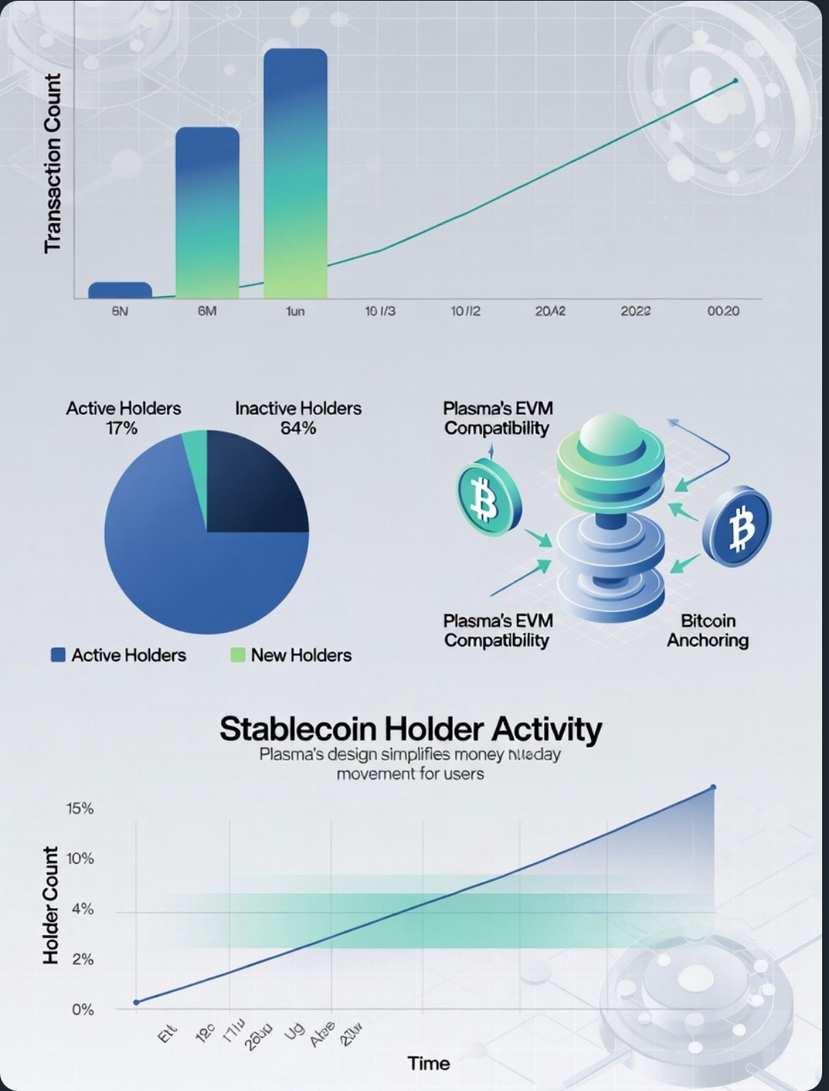
From a technical perspective, Plasma is not chasing novelty for novelty's sake. It maintains compatibility with EVM not because it is exciting, but because forcing developers and organizations to relearn everything from scratch is a surefire path to implementation failure. Innovation is not about a new programming language, but about changing perceptions of what a baseline should provide.
Essentially, the message of Plasma to developers is this:
'Develop as usual. We will make the financial part less painful.'
The aspect of tying to Bitcoin also carries more
an emotional than technical character, when you think about it. Bitcoin embodies neutrality in the crypto community — there is no issuer, no company, no one country dictating terms. By tying its security system and bridge design to Bitcoin, Plasma signals that settlements with stablecoins should not depend on any one party. For people and organizations dealing with serious amounts of money, this sense of neutrality is more important than transaction speed metrics.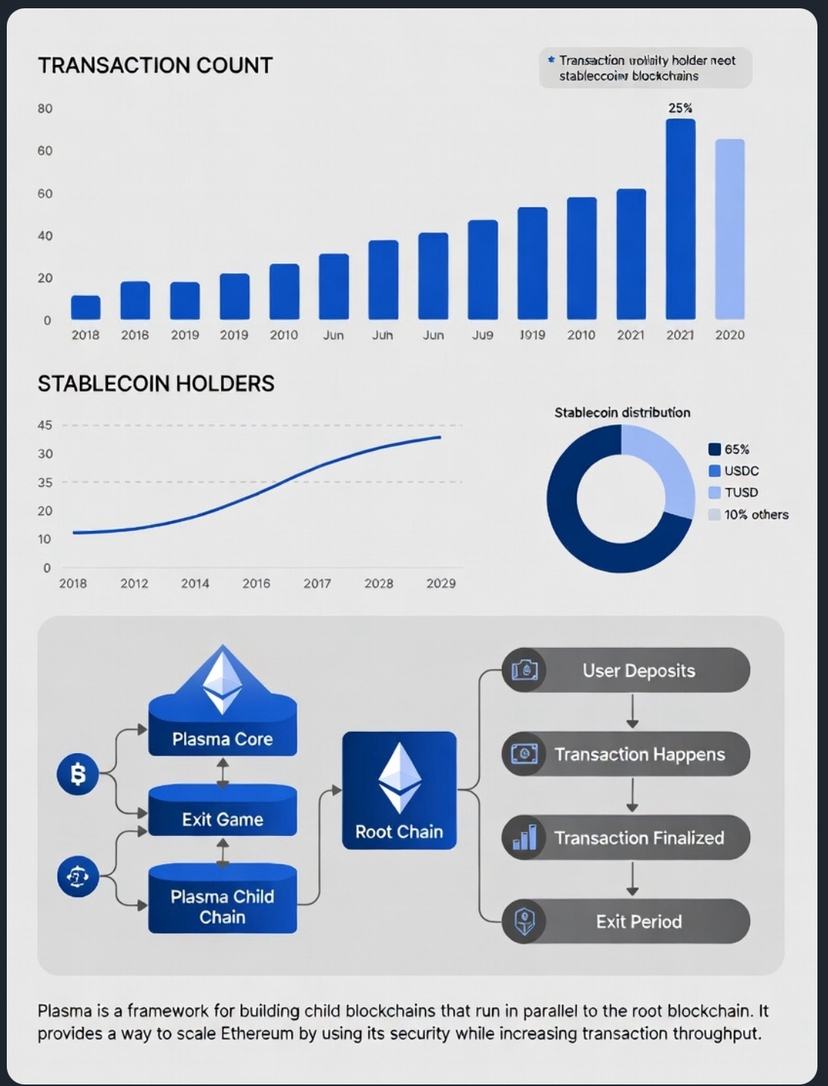
Of course, none of this is guaranteed. There is still a need to pay for free transfers somehow. Bridges have to earn trust the hard way. Any system working with real money will ultimately be subjected to scrutiny from regulators, bad actors, and scalability itself. Plasma is not immune to these issues.
But what makes it interesting is that it seems to be preemptively aware of these issues, rather than pretending they don't exist.
To me, Plasma looks less like a crypto experiment and more like an attempt to properly restructure the boring aspects of finance.
And 'boring' in this context is a compliment.
Boring means predictable. Boring means reliable. Boring means that no one notices when it works — because it always works.
If Plasma succeeds, people won't talk about it the way they talk about blockchains today.
They will simply say, 'Yes, that's how I send dollars.' And that is likely the most human outcome that a blockchain can aspire to.

