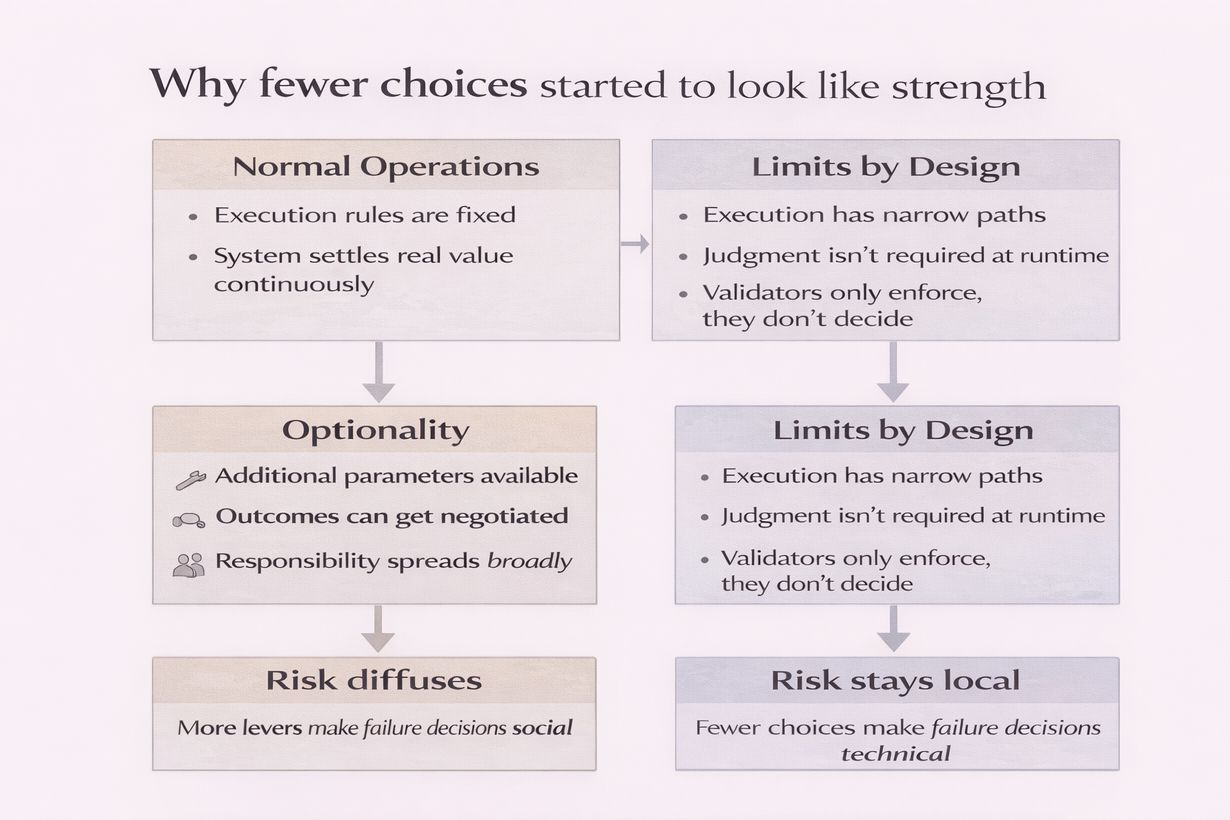
For a long time, I associated robustness with optionality. The more levers a system exposed, the safer it felt. If something went wrong, there was always another parameter to adjust, another path to explore.
Over time, that confidence started to erode.
What I kept seeing was that every additional option widened the space where outcomes were decided socially rather than mechanically. When pressure hit, the system didn’t fail outright—it stalled. Decisions migrated from code to people, and results depended on judgment, alignment, and timing.
Choice didn’t disappear risk.
It relocated it.
Plasma stood out to me because it takes the opposite stance. Instead of preserving flexibility until the last moment, it commits early. Execution paths are narrow by design. Roles are constrained. When something breaks, the system doesn’t ask what should happen—it already knows.
That can feel uncomfortable. There’s no room to improvise, no soft landing through coordination.
But there’s also no ambiguity about responsibility.
Watching Plasma made me realize that many systems confuse freedom with safety. In environments where real value is settling continuously, freedom under stress often turns into discretion—and discretion is hard to price.
Limits reduce surface area. They shrink the space where narratives form and power concentrates. Failures still occur, but they occur inside boundaries everyone understood beforehand.
Plasma doesn’t try to make hard moments easier.
It makes them clearer.
And increasingly, I’ve come to believe that clarity—not flexibility—is what resilient infrastructure actually compounds over time.
@Plasma #Plasma $XPL