

In the first half of 2025, one of the most talked-about tectonic shifts in crypto has been the rise of autonomous AI agents that don’t just advise users they can act for them. These systems are essentially software built on modern language models and rule-based logic, designed to watch markets, adjust positions, run simple arbitrage, or even handle routine payments without constant human input. By early 2026, estimates cited by Forbes suggest the broader AI agent space could expand from around $5.1 billion in 2024 to north of $47 billion by the end of the decade, as firms and active traders increasingly lean on automation to scale decision-making and execution.
Yet there’s a glaring infrastructure problem slowing this evolution: wallets. The wallets used for crypto the core gateway to assets were built in an era when humans were the only actors signing transactions. They require private key access, manual confirmations, and static permission models. When an AI agent wants to act on your behalf, it can’t simply “log in” the way a human does. It can’t hold keys in the human sense, confirm prompts securely, or interpret intent within the rigid rules of blockchain wallets.
As commentators in Cointelegraph warned in mid-2025, most DeFi today still leans on externally owned accounts that demand manual approvals. That means agents either can’t automate securely, or in the worst cases must be given full key access to act for you. Both routes expose traders to catastrophic risk from misaligned automation, hallucinating agents, and even compromised scripts. 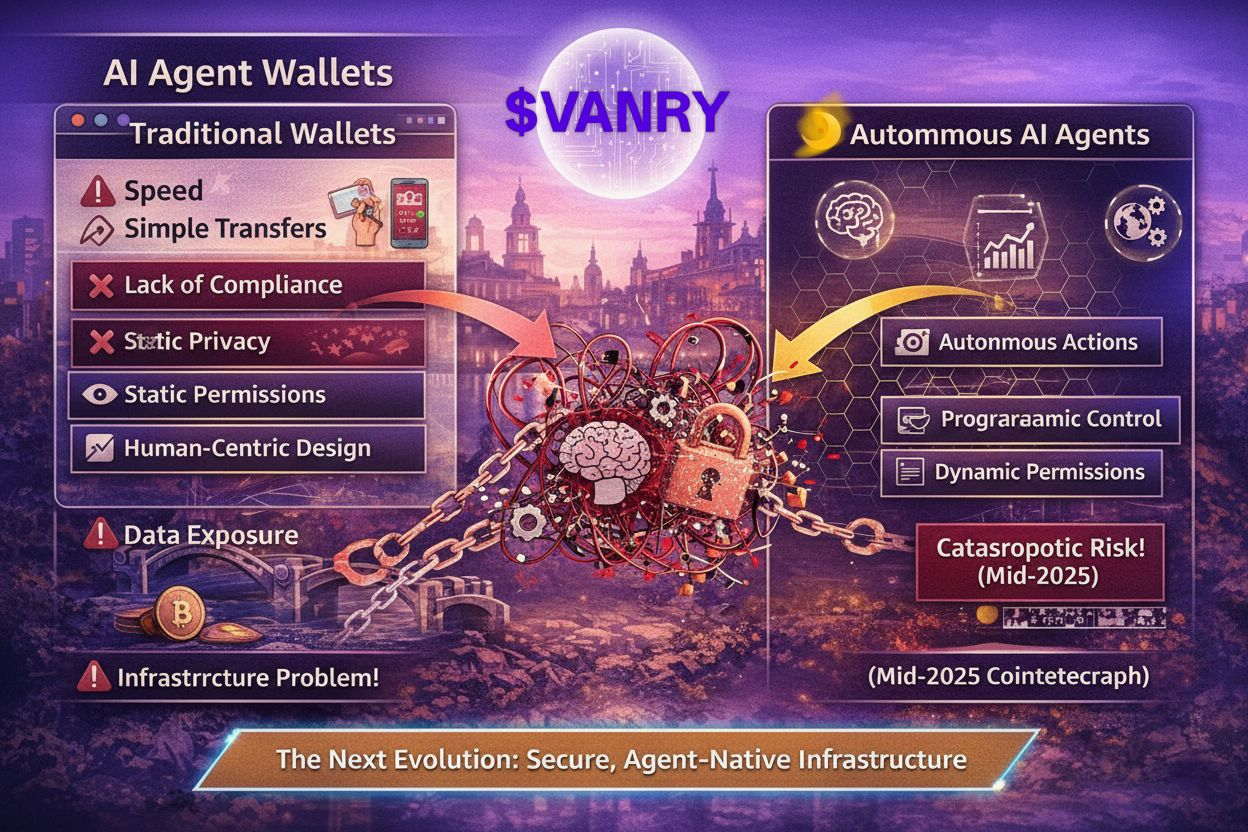
Ask yourself: how do you delegate a trading strategy to software when your wallet will only ever sign transactions after you press “confirm”? Even more basic: how do you let an AI agent optimize across markets 24/7 without breaking every security assumption embedded in wallet design since Bitcoin’s whitepaper?
There are a few technical cruxes worth unpacking. Traditional wallets are tethered to private keys strings of data controlled by a human. Smart contract wallets and account abstraction (AA) are newer concepts that let wallets behave more like programmable agents with configurable rules, session keys, modules, and automatic gas payments. But adoption remains fragmented, and few standards bind AI agents to wallets in a way end-users trust. Crypto’s bleeding edge can build autonomous wallet agents in hackathons, but that’s experimental, not the backbone of DeFi.
LabLabEnter projects like Vanar Chain, which is pitching a different baseline. More than just another layer-1, $VANRY has articulated itself as an AI-native blockchain a stack designed not just to carry transactions but to understand and integrate intelligence within the protocol itself. The team’s recent collaborations, notably the September 2025 partnership with Plena Finance, highlight a push toward account abstraction wallets engineered with AI in mind wallets that aim to bridge human will and autonomous execution in Web3.
What does this mean in practice? Instead of treating wallets as dumb signers of transactions, an AA wallet can embed rules about what actions an agent can take, what limits it must respect, and what verification is required before funds move. Think of it as a middle layer that interprets intent, not just endorses a signed command. This is crucial because without it, agents are forced into blunt automation or unsafe key sharing.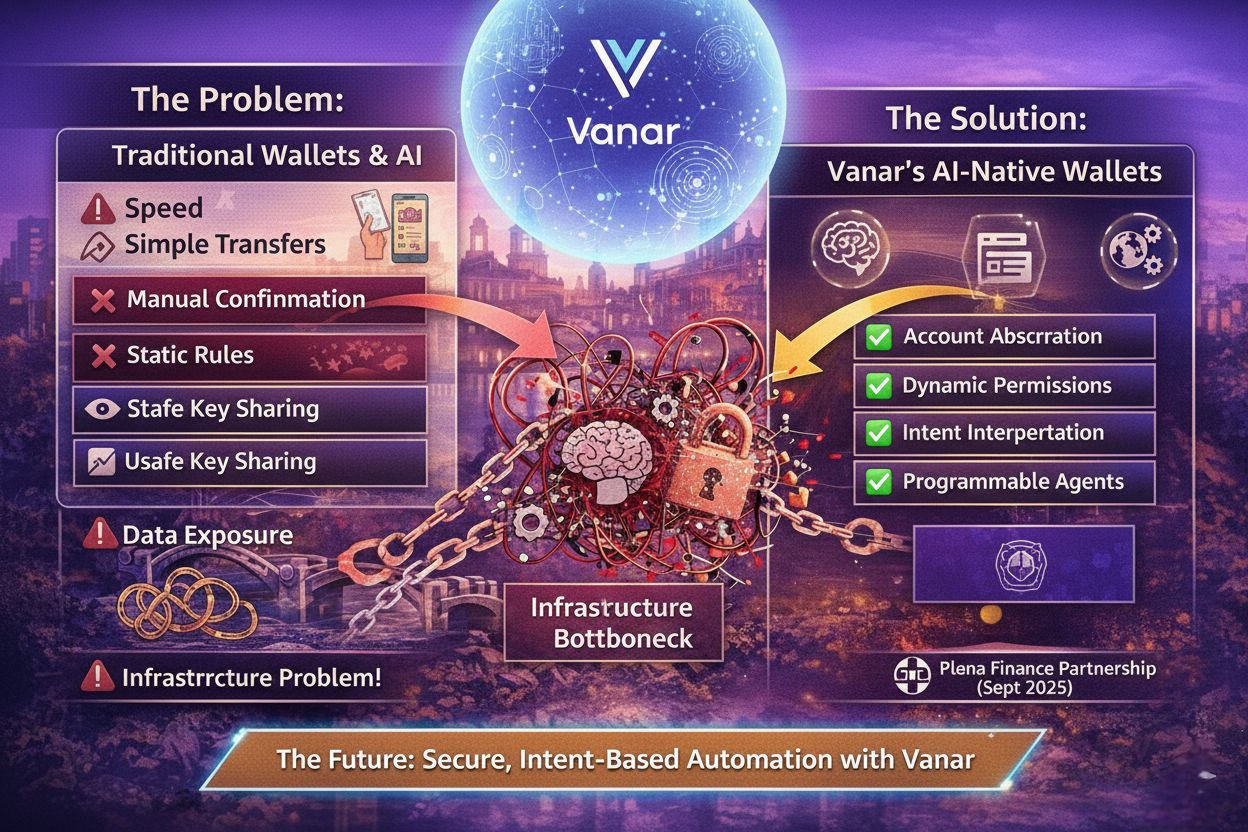
Vanar’s approach also leans on natively AI-aware infrastructure meaning the chain is built to support memory, reasoning, and persistent contexts that agents require. Traditional blockchains assume every transaction is a one-off. An AI agent, in contrast, learns, stores state, and tries to reason over time. Vanar’s architecture is positioned to make that part of the ledger itself.
From a trader’s standpoint, this is big. Imagine an agent that can manage risk thresholds, execute strategies, and yet never holds your private key directly. Better yet, imagine that agent’s actions are traceable, auditable, and bound by on-chain constraints you set. That’s not science fiction that’s what programmable wallets plus AI-aware chains aim to deliver.
There’s still work to do. The foundational research community is actively debating how to cryptographically verify an agent’s true intent, not just the transactions they produce. Academic proposals like using zero-knowledge proofs to bind behaviors to identity and policy constraints are in play, reflecting how much innovation is needed for trustless automation at scale.

From a risk perspective, this evolution highlights why wallet design will be a central frontier in the next bull market. It’s not just about signing faster or supporting more chains it’s about safe delegation. Traders, developers, and investors all stand to benefit if wallets evolve from static key vaults into programmable conduits that can enforce strategy guardrails, revoke access, and log intent in a verifiable way.
AI agents won’t replace traders tomorrow. But as they get better at executing strategies, the wallets they rely on must do more than store keys. They must understand context, enforce rules, and integrate with the intelligence driving them. Vanar’s work with AI wallet tech shows one possible path forward not perfect, but enough to turn a structural impediment into a competitive edge.
In an ecosystem where machines increasingly execute value, the wallet is no longer just a container it’s the trust boundary between you and your automated capital. Fixing it isn’t optional. For markets hungry for safe autonomous execution, it’s inevitable.