

Artificial intelligence systems are creating unprecedented challenges for the structure of the Internet, which was originally designed based on human-to-human interaction scales. Creating voices, videos, and text that mimic reality is becoming cheaper and sophisticated to the point where it’s hard to distinguish what is real from what is fake. We are all too familiar with annoying CAPTCHA verification codes, but now AI agents have even begun to transact and interact just like humans.
The issue is not the existence of AI, but the current Internet's lack of a natural mechanism to separate the boundaries between humans and machines, while still ensuring privacy and convenience. This is when blockchain technology plays a more important role than ever.
Increasing costs for impersonation behaviors
Artificial intelligence has the ability to fake voices, faces, writing styles, videos, and entire social identities on a large scale. A malicious actor can control thousands of fake accounts, impersonating customers or voters at increasingly low costs.
These impersonation tactics are not new, as fraudsters have previously been able to hire voice actors or send fake messages. However, the biggest change is the price, as modern technology allows these attacks to be carried out on a large scale at extremely low costs.
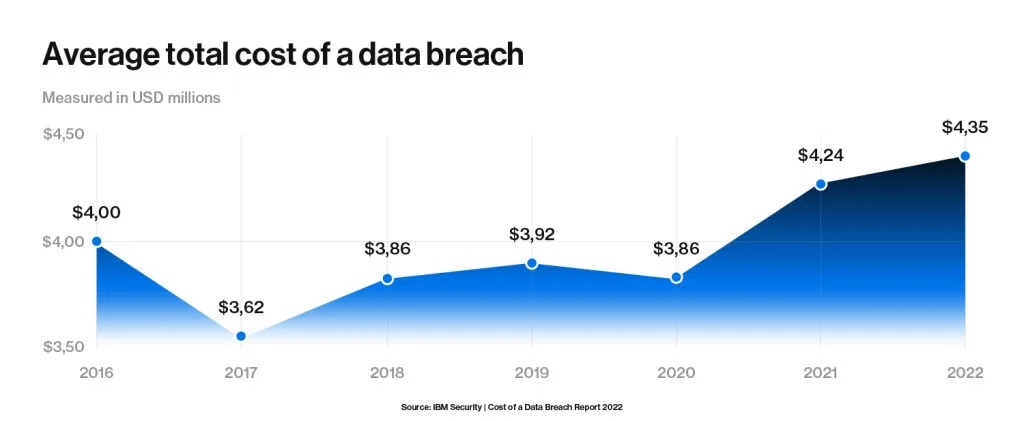
Meanwhile, most online services operate under the assumption that one account corresponds to one real person. When this assumption is violated, all backend processes are at risk. Traditional detection methods like CAPTCHA will certainly fail as AI learns and improves faster than the tests designed to catch them.
Blockchain technology addresses this issue through decentralized real-person authentication systems, making personal identity verification easier but making it very hard for someone to create multiple fake identities. This significantly raises the cost for impersonation attacks, restoring scarcity at the identification layer without making it difficult for ordinary users.
Building a decentralized identification system
One of the common ways to prove you are human is through digital identity, including usernames, passwords, and third-party credentials like ID cards or credit scores. However, any identity system that sits at the center of the Internet is at risk of becoming a critical vulnerability.
When AI representatives act on behalf of humans to transact and communicate, anyone who controls the identity can manage user participation, from revoking access to imposing fees or monitoring.
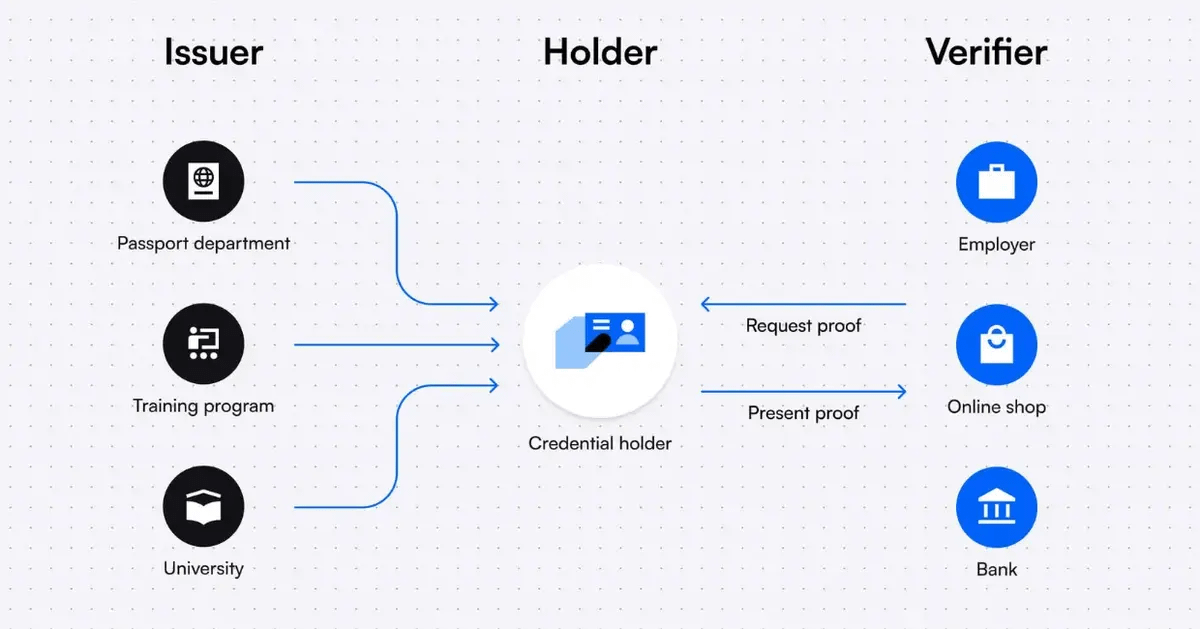
The decentralization of Blockchain completely reverses this dynamic. Users, not the "gatekeepers" of the platform, will control their own identities. This makes data safer and more resistant to censorship.
Unlike traditional systems, decentralized human authentication mechanisms allow users to self-manage their identity and verify their humanity neutrally, while maximizing privacy protection.
Universal passport for AI virtual assistants
AI agents or virtual assistants do not exist in a fixed place. A single agent can appear across chat applications, email, browsers, and many different platforms. However, there is currently no reliable way to determine that interactions in these different places come from the same agent, with the same capabilities and permissions granted by the owner. Tying the identity of an AI to just one platform makes it useless when operating in other environments.
A blockchain-based identification layer allows AI agents to possess universal passports that can be carried anywhere. These identities contain information about capabilities, permissions, and payment gateways, which can be verified from anywhere, making impersonation much harder.
This opens up opportunities for developers to create more useful virtual assistants that can operate seamlessly across various ecosystems without being locked into any proprietary platform.
Machine-scale payment solutions
As AI agents increasingly perform more transactions on behalf of humans, current payment systems are gradually becoming bottlenecks. Large-scale automated payments require new infrastructure, such as micro-payment systems capable of processing extremely small transactions from multiple sources.
Blockchain-based financial tools today have shown the potential to solve this issue, allowing transactions to be conducted at nearly zero cost and the ability to break down payments in detail.

More importantly, this infrastructure supports transactions on a machine scale, such as micro-payments and commerce between AIs, which traditional financial systems cannot handle. Micropayments can be shared among multiple data providers, allowing a user's interaction to automatically trigger small payments to all contributing sources through smart contracts. This ensures revenue is distributed fairly through pre-programmed rules instead of centralized decisions, creating a transparent financial relationship between automated agents.
Strengthening privacy in the digital age
There is a paradox at the heart of many current security systems: the more data is collected to protect users, such as biometrics or social graphs, the easier it becomes for AI to impersonate them. This is where privacy and security become the same issue.
The challenge is how to ensure that human authentication systems must guarantee privacy by default, hiding information at every stage so that only real humans can provide the necessary data.
Blockchain systems combined with zero-knowledge proofs technology allow users to prove specific truths, such as being of legal drinking age, without disclosing sensitive data such as home addresses or exact birth dates.
As a result, applications receive the necessary assurances while AI systems are denied the raw materials to perform impersonation. At this point, privacy is no longer a supplementary feature but becomes a core defense layer to protect users from the encroachment of technology.
#BinanceSquare #AI