
In the wild world of cryptocurrency, nothing is more dramatic than meme coins - they are born out of jokes, but can skyrocket a thousand times in a week; they tout "fair launches," but leave countless retail investors in tears. In April 2023, PEPE coin swept the market with a "no pre-sale, no pre-mining" fair stance, with 93.1% of the tokens directly injected into the liquidity pool and permanently destroyed. This almost paranoid transparency attracted 400,000 holders in two weeks. But few people noticed that behind this seemingly perfect fair model lies the most cruel truth of the meme coin industry: when the technical threshold is smoothed out by no-code platforms, when "decentralization" becomes a marketing rhetoric, what kind of "equality" are we pursuing?
From Dogecoin's Joke to the "Fair Launch" Myth: The Genesis Code of Memes
In 2013, to ridicule the craze for cryptocurrency speculation, programmers JacksonPalmer and BillyMarkus created Dogecoin with a Japanese Shiba Inu emoticon. No one expected that this "joke coin" would spread like a virus in the Reddit community. Netizens used it to reward joke tellers, crowdfund Olympic funds for the Jamaican sled team, and launch the absurd activity of "sending Dogecoin to the moon." This completely spontaneous community behavior unexpectedly spawned the purest and fairest model in crypto history, that is, no white paper, no team allocation, and all 100 billion coins are generated by mining. Everyone can participate on the same starting line. Ten years later, Dogecoin's market value stabilized at the level of tens of billions of dollars. Only then did people understand that the "equality" of memecoins is never in the code, but in the hands of netizens who stay up late to brush posts and actively spread emoticons.
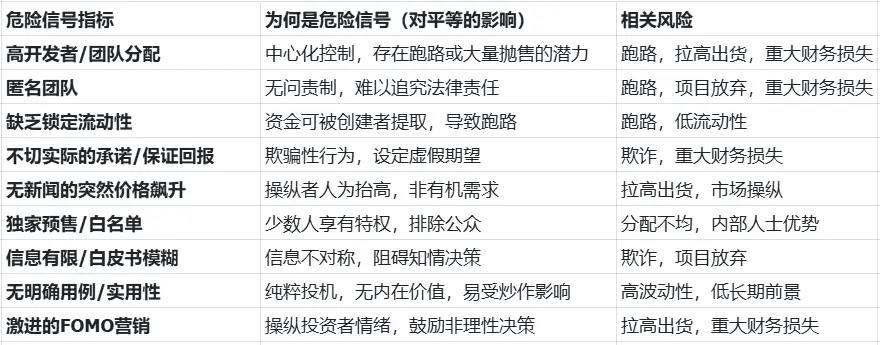
But capital quickly rewrote this idealistic experiment. In 2021, "Dogecoin Godfather" Musk jokingly called himself the "Dogecoin Father" on the SNL program, and the coin price plummeted by 34% that day. Countless retail investors who chased the high were trapped at high levels. This black humor twist revealed the fatal contradiction of memecoins: they survive on community sentiment but are easily manipulated by celebrity effects and capital. Take Bonk coin in 2023 as an example. It claimed to give half of the 50 trillion tokens to Solana ecosystem contributors, wanting to replicate Dogecoin's decentralized genes, but the definition of "contributors" was vague, and a large number of tokens eventually flowed into early institutional wallets, with large fluctuations of up to 70% on the first day of launch.
Joint Curve and Liquidity Trap: Inequality Packaged by Algorithms
No-code platforms like pump.fun simplify token creation to "done in three minutes," making memecoin issuance seem democratized. However, hidden in the "joint curve pricing model" prompt that pops up before clicking the "Create" button are mathematical traps that most people don't understand. This algorithm links price and circulation, superficially creating a fair mechanism of "buying drives the price to rise naturally," but in reality, it creates new inequalities. Data from a certain cat-themed memecoin "fair launch" in 2023 shows that the top 100 traders earned an average profit of 300% from running transactions, while subsequent participants suffered losses of up to 82%.
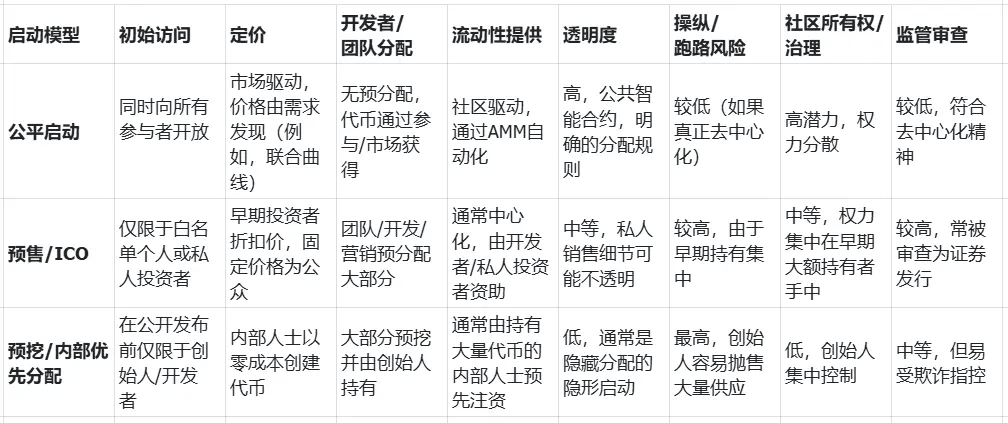
More hidden manipulation is happening in the liquidity pool. Everyone still remembers the SquidGame token crash in 2022. After the developers paired the token with Ethereum, they suddenly withdrew all the liquidity when the price soared. The tokens in the hands of retail investors became worthless code. This "rugpull" scam has a standard process in the memecoin field. First, attract funds with the promise of "100% liquidity lock," then raise the price with fake community heat, delete social accounts and run away with the money one night. CertiK blockchain security company data shows that in 2023, more than 1,200 memecoin projects "ran away with the bucket," with an average life cycle of only 4.7 days and a total amount of $4.3 billion.
The Ideal and Reality of DAO Governance: When Community Voting Becomes a "Whale Game"
In the face of endless scams, DAOs (Decentralized Autonomous Organizations) were once regarded as the redemption road for memecoins. The NeoPepe project white paper promised that "the community votes to decide every decision, and developers have no privileges," but when the community voted on "whether to destroy 50% of the tokens," early "whales" holding 30% of the tokens united to veto the proposal. The 12,000 votes of ordinary holders became decorations. This "seemingly decentralized, but actually centralized" governance dilemma is everywhere in the memecoin field. The Shiba Inu (SHIB) "community destruction plan" seems democratic, but in actual operation, 90% of the destruction comes from ordinary retail investors, while the early whale wallets remain unmoved.
The irreconcilable contradictions in the memecoin community have caused this governance failure. On the one hand, they have to rely on the "decentralization" label to attract believers. On the other hand, without the guidance of the core team, the project is easily messed up. In 2023, a famous frog-themed memecoin community had differences on "whether to launch a centralized exchange." Supporters and opponents scolded each other on Discord, and as a result, 7 core developers resigned together and the project stagnated. Cryptocurrency researcher LauraShin said: The memecoin community is like a carnival party. No one knows who will clean up the mess when the music stops.
Regulatory Gray Area: When "Non-Security" Status Becomes a Fraud Shield
The US SEC defined memecoins as "non-securities," intending to create space for innovation, but it was used by scammers as a protective shield. In 2023, TRUMP coin used political heat to raise the stock price and ship it. The SEC couldn't classify it as a security and couldn't intervene. As a result, 12,000 investors lost more than $80 million. Regulatory loopholes have spawned more hidden manipulation methods. One team first created 10 similar memecoins, deliberately letting 9 of them run away. When investors trust the 10th one, they then take the money away in the name of "cross-chain migration" or "contract upgrade."
More ironically, regulatory loopholes are used by some projects to actively carry out marketing. A so-called "compliant memecoin" launched in early 2024 prominently stated in the white paper that "this project does not meet the US Securities and Exchange Commission (SEC) definition of securities," but secretly added the words "no guarantee of any income" in the disclaimer. Ordinary investors find it difficult to identify the real risks behind this "compliance packaging + high-risk implication" rhetoric. Former US Securities and Exchange Commission (SEC) Commissioner Hester Pierce warned, "Saying that memecoins are not securities does not mean they are safe investments. They may be a hundred times more dangerous than securities."
Survival Guide for Adventurers: How to Protect Yourself in the Memecoin Carnival
Although the risks are heavy, memecoins still make countless people invest in this carnival. If you have to participate, these bloody lessons must be remembered: you can't believe the promises of "anonymous teams," 92% of runaway projects hide their identities. You must carefully check the proof of liquidity lock, and the fund pool must be managed by a third-party platform and cannot be controlled by the project party. You should also be wary of "dark horses" that suddenly skyrocket. After all, 87% of memecoins that increased by more than 1000% in 2023 showed their true colors within 72 hours.
True opportunities are often hidden in less noisy corners. Dogecoin has shown one thing in ten years: the value of memecoins is never in the price curve but in the cultural significance constantly created by the community. PEPE traders communicate with emoticons on Twitter, and the SHIB community spontaneously engages in charitable activities. At this time, these seemingly meaningless behaviors may be the closest memecoins are to the ideal of "equality." The equality mentioned here is not absolute fairness in the code, but a group of people with a common joke and a common belief, temporarily forgetting the greed and fraud of the crypto world and purely enjoying this digital carnival.
Please always remember: when the music stops, you are never the first to leave.
The Democratic Revolution of the Memecoin 2.0 Era: Reconstructing the Creation Ecosystem
While PEPE's liquidity destruction mechanism is still regarded as a fair model, the encryption market has quietly undergone a new evolution. The DJ.DOG project, incubated by HashKey in 2025, has transformed Memecoin from a "speculation tool for a few people" to a "creation platform for most people." The team that won the championship in the Hangzhou Solana Hackathon has perfectly solved the problem of democratization of creation that has plagued the industry for many years with a combination of "top institutional endorsement + community operation genes + technology competition verification."
The Identity Leap from Trader to Creator
The traditional Memecoin market has an invisible glass ceiling. 99% of participants can only trade passively. The right to create is tightly held by a few people with Cabal community identities, technical skills, and knowledge of the regulatory gray area. The DJ.DOG team has experience in operating a community of 3 million users. They found that ordinary users have three fears about issuing coins: fear of being called a liar with a psychological burden, lack of smart contract development capabilities with technical barriers, and a community threshold due to information differences of 2-3 hours with first-line players.
This shackle is about to be broken, and its upcoming "全民参与" (all-people participation) function constructs a unique solution: trustless team formation on the Solana chain can be realized. The system automatically matches 3-5 users with different skills (such as creators who understand design, spreaders who are good at community operations, etc.) with smart contracts. All members must provide unrelated clean wallet addresses to ensure the decentralization of the creation process, and there is also more innovative data feature cloning technology. When entering the "Musk tweet" theme, the system automatically extracts 15 on-chain features (such as initial liquidity ratio, trading frequency in the first 24 hours, and the activity of associated social accounts) of successful tokens such as PEPE and DOGE under similar narratives, and generates optimized token parameters with one click. The work that used to take senior developers 3 days is now compressed to 5 minutes.
The Business Logic Behind Technological Empowerment
The full-stack tool matrix built by DJ.DOG supports this democratization of creation. Its self-developed aggregation engine at the trading layer can achieve a transaction speed of 0.5 seconds, which is 3 times faster than the industry average. This speed is due to the high-performance public chain optimization scheme carefully crafted by the team in the Solana Hackathon. After accessing Musk's Grok's real-time tweet stream at the data layer, the narrative recognition speed is 2 minutes faster than traditional tools. When Musk released content related to "Dogecoin to the moon," DJ.DOG users could complete the entire process from token minting, liquidity injection to social dissemination within 120 seconds. The speed advantage directly translates into creative opportunities.
Its regulatory compliance strategy is more worthy of attention. The team clearly positions the product as an "on-chain entertainment tool," embeds a disclaimer of "no investment commitment" in the smart contract, and hides the developer address through a trustless team formation mechanism. This design not only conforms to the SEC's 2025 Memecoin non-security attribute identification guidelines, but also reduces users' legal concerns. The team emphasized in the hackathon award speech that "we are not building a financial product, but a digital creation field that ordinary people can participate in."
The Essential Difference from Traditional Paradigms
Dogecoin is a community-spontaneous model, PEPE is a fair launch mechanism, and DJ.DOG has innovations compared to it. It extends "fairness" from the issuance stage to the entire life cycle, while traditional memecoins lose fairness after token distribution. DJ.DOG relies on three mechanisms to continuously achieve fairness.
Creation Stage: Data feature cloning technology eliminates technical barriers, enabling non-technical users to replicate the on-chain genes of successful tokens
Dissemination Stage: Decentralization of early dissemination is ensured by mandatory social tasks (such as Twitter forwarding and community discussions).
Trading Stage: The 15000+ smart money tracking system enables transparency of information between retail investors and institutions to become equal.
The core definition of Memecoin 2.0 is the transformation from "purely speculative assets" to "creation tools + social platforms," and this evolution resonates with the feedback from beta users who say that issuing coins used to be like walking a tightrope, but now it's like playing in a sandbox.
Potential Challenges and Critical Thinking
However, tool democratization does not necessarily achieve creative equality. Although DJ.DOG's AI narrative analysis function lowers the technical threshold, the priority access to GrokAPI is controlled by paid institutions, which may create a new "data privileged class." Randomly matched creation teams have conflicts in profit distribution and decision-making consensus, which are still unproven uncertainties. These contradictions just show the essence of Memecoin evolution, that is, fairness is not a static end point, but a dynamic process of continuous game between technology and humanity.
If ordinary users can create their own memecoins with their mobile phones in 5 minutes and the creation income can be automatically distributed to each dissemination node through smart contracts, then Memecoin may really be undergoing a paradigm shift, from "a few people creating bubbles" to "a digital culture experiment in which most people participate." And the example of DJ.DOG shows that technological innovation changes not only the way memecoins are issued, but also reshapes its social value foundation.
Final Thoughts
The memecoin market is a highly dynamic and rapidly evolving area within the cryptocurrency ecosystem, characterized by continuous innovation in launch mechanisms and governance models. The inherent tension between the ideals of decentralization and fairness and the practical need to ensure initial funding and long-term sustainability may drive the development of more complex hybrid models in the future.
As the market matures, even if it doesn't lead to all memecoins being classified as securities, increasing regulatory scrutiny may drive greater transparency, accountability, and reduced fraudulent activities, which may indirectly help create a fairer environment for participants. The journey to achieving true equality in the memecoin space remains an ongoing evolution, shaped by technological advancements, community dynamics, and regulatory developments.