
In previous articles, Jimi reviewed a series of issues regarding the PPP protocol V1. As a brand new innovative product, temporary failures are not uncommon in the 0-1 process.
The most important thing is to face problems, not to avoid them, to analyze problems, and to solve them.
What makes Jimi gratified is that the PPP protocol is such a product.
On July 12, version V1 went live on SOL. On July 21, due to multiple factors, the project was completely halted.
On July 21, the community spontaneously reviewed the situation and discussed solutions with the developers, proposing core ideas for version V2.
On July 22, the community formed a PPP think tank to further validate the details of the V2 architecture.
On July 22, after confirming the general framework through community co-creation, the developers initiated the development of version V2.
On July 31, a brand new architecture and interface for the PPP protocol version V2 will begin the countdown for launch.
On August 1, which is tonight at 8 PM, the PPP protocol version V2 will officially start trial operation.
Counting from the launch date of July 12, it took only 20 days from V1 to V2. What does this mean?
Quoting the major version timeline of well-known web3 products organized by Grok:
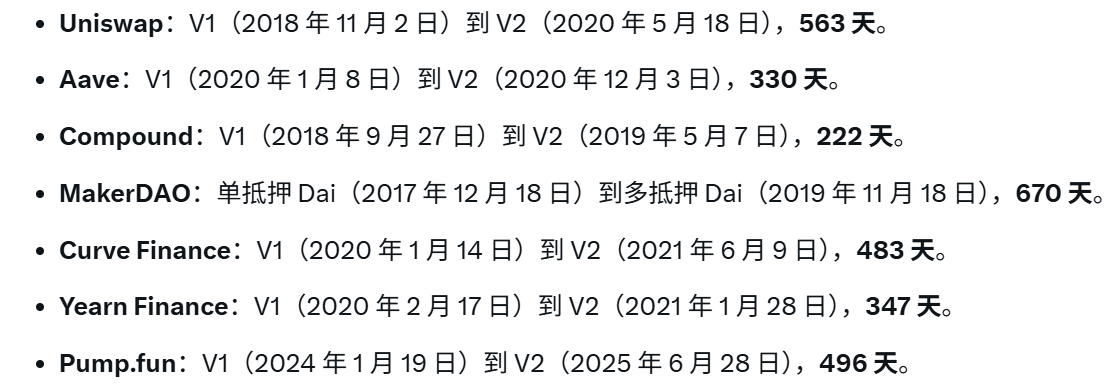
It can be said that the evolution speed of the PPP protocol is quite fast. So, what exactly is the new gameplay?
As a community member who participated in the co-creation of the V2 design concept throughout, today Jimi will interpret the gameplay of V2 from the perspective of an ordinary participant.
As for the creator's perspective, it may require further observation and learning for some time.
I. Minting Phase
After the creator creates the project, it enters the minting phase for project NFTs.
The minting phase has no time limit and is divided into two situations:
A 100% minting means a successful launch, and the project enters the internal market.
If the minting does not reach 100%, it remains in the minting phase, and the NFTs cannot be traded.
All funds spent on minting will be temporarily stored in the contract, waiting to be injected once the pool opens. If minting does not reach 100%, the funds will remain locked in the contract and cannot be moved.
If the project you mint is delayed and cannot complete the minting, and you want to rescue it, consider finishing the remaining NFTs. Based on the design of version V2, once the project successfully mints, it will definitely graduate, at which point you can retrieve some funds through the external market.
However, how much you can get back still depends on the parameters set by the creator. It’s possible that in your attempt to save yourself, the new funds you invest could be less than what you can get back, so self-rescue also requires careful consideration.
If you are unfamiliar or unable to bear the risk of occupying funds, Jimi suggests you prioritize participating in projects that have already entered the internal market.
II. Internal Market: NFT Trading Phase
Successfully launched PPP projects enter the internal market phase, which is centered around NFT trading, including: purchasing, selling, and splitting. It's divided into two situations: best-selling and unsold, let's take a closer look.
1. NFT Purchase
When purchasing NFTs, the core is to focus on two major indicators.
One is the selling time.
During the best-selling period, NFTs generally sell out quickly. If you want to participate, you need to closely monitor the selling time of the project's NFTs. This time depends on the project’s launch time and the interval time between each round.
Another is the profit from purchases.
The profit differences among NFTs of different projects are enormous, generally between 2-5%. Considering the differences in rounds, daily returns may vary by more than ten times. The net profit margin depends on the price increase set by the creator and the fees for the pool.
If you are too lazy to calculate, I recommend following the ecological tools produced by PPP community developers: https://www.hippp.fun/, where you can find the countdown and profit rates for each internal market project.
It is particularly worth mentioning that in the PPP protocol V2, as long as you purchase any NFT, you can receive an airdrop of the PPP protocol platform token DFS. This reflects the concept of co-construction and sharing in the PPP protocol.
2. NFT Sale
Once you purchase an NFT, selling it becomes much simpler. The key term is: unlimited price increase, automatic listing.
In terms of pricing, according to the creator's settings, the price increases indefinitely.
Each project parameter includes a price increase parameter, which is the selling price of the project's NFT. Each round will automatically increase based on the previous round's price, following this price increase parameter, becoming the quote for the new round of NFT sales.
Buyers cannot decide NFT pricing; enjoy the pleasure of passive price increases.
Regarding automatic listings, there is no need for the holder to operate; it’s automatic.
From the moment you purchase the NFT, it has already entered the sale list for the next round. It's just that others cannot buy your NFT yet because the sale time has not arrived.
It can be said that if you bought an NFT during the best-selling period, you are essentially making money effortlessly.
What if the NFT is unsold?
Once the NFT remains unsold for longer than the destruction duration parameter set by the creator, you can destroy the NFT to obtain the project tokens and enter the external market for trading.
3. NFT Splitting
After you purchase the NFT, if the following conditions are met, you can choose to split the NFT:
NFT has not triggered a destruction event.
When the NFT price reaches 200% or more of the initial price.
NFT has not reached the issuance cap, with the initial cap defined by the creator.
Splitting requires paying GAS costs and must be performed manually by the holder. After splitting, the number of NFTs doubles, and the price is halved, making transactions easier.
You can also trade without splitting, but it will affect the number of tokens that can be exchanged for NFT destruction. The more rounds you do not split, the higher the cost of the contained tokens in the NFT.
It's important to note that within each trading cycle, the NFT can only be split once.
If the NFTs you purchased have accumulated many rounds without splitting, your opportunity to lower the cost of chips becomes less. Therefore, to make your NFTs sell better, and to allow buyers to bear lower risks, Jimi suggests that you should split as much as possible.
However, based on past practices, there will always be people who do not split, so you may see many different prices for NFTs of the same project. In this case, it is recommended that you prioritize purchasing the cheaper ones.
III. External Market: Token Trading Phase
When NFTs are unsold, it indicates that the PPP project is not far from the external market phase.
Once the holder's NFT remains unsold for longer than the destruction duration set by the creator, the holder can manually destroy it.
Once the holder triggers the first destruction event, the system will unlock three major events.
1. Destroy unissued NFTs, freeze NFT splitting and trading.
After the first destruction event occurs, the NFT quantity limit is locked, permanently prohibiting splitting and trading, and tokens will enter full circulation, with no further issuance, conforming to the conventional settings of memes.
Another key point is that all tokens in the PPP protocol V2.0 are fixed at a total of 1 billion, aligning with industry standards. The cost of a single token will significantly decrease, so much so that it’s almost negligible.
2. Destroy images to obtain tokens, the exchange rate for a single image token is fixed.
The number of tokens obtained from NFT destruction = 500 million divided by the number of issued NFTs.
The cost of tokens contained in the NFT = NFT unit price / number of tokens obtained from NFT destruction.
If the NFT price reaches the splitting condition but is not split, the cost of the contained tokens will be marked up, so I again suggest that you should split as much as possible. By the way, all splits currently require the holder to perform them manually.
3. External market opens, pool migration, system discards permissions.
The pool for the external market in version V2 is paired with 500 million tokens and the funds deposited in the project contract (minting + trading pool portion, minus migration fees), representing a qualitative improvement over version V1.
A larger pool is more resistant to price crashes and more likely to attract large funds; all repurchases go into the pool, avoiding arbitrage risks. If it’s a popular project, many real addresses may emerge after migrating to the external market, attracting more on-chain funds.
As usual, the pool after migration is burned, there will be no scams or crashes. The more transactions, the more tokens and SOL are locked. Thus, the external market opens, and the PPP project enters the phase of trading tokens.
The above is an introduction to the core gameplay of the PPP protocol version V2. There is one last detail: whether participating in NFT minting, internal or external market, currently requires using SOL.
To help everyone understand, Jimi attempts to organize a complete flowchart:
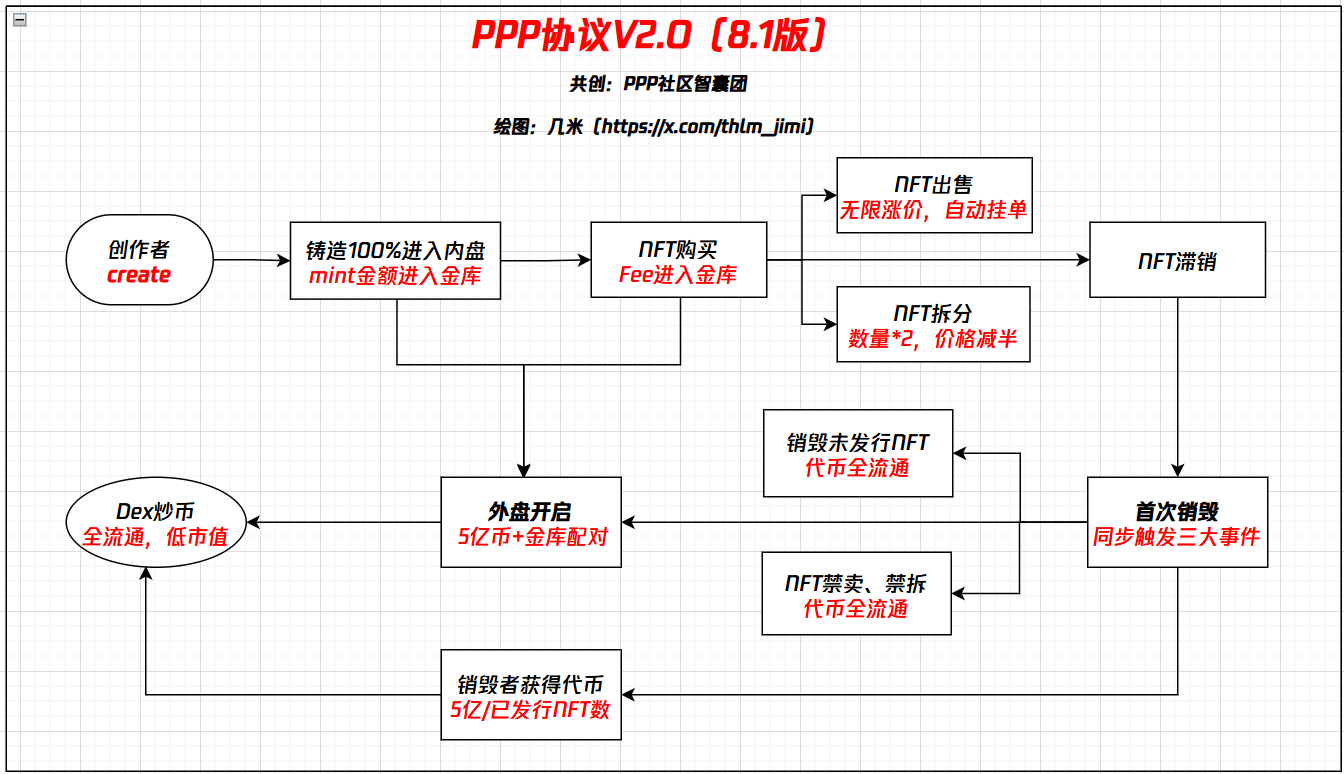
It is important to note that the PPP protocol is still in the early verification phase, and specific details may be iterated at any time; please refer to the official real-time rules.
Finally, let me conclude with my understanding of the PPP protocol V2 from a few days ago.
PPP protocol 2.0, each round of NFT sales can be compared to the ABCD rounds of original shares in the traditional primary market, with the external market being equivalent to going public.
The internal market has limited liquidity and participants but makes it easier to grab a larger share of chips. If you are confident in the project, you will premium acquire chips in each round.
When the NFT is unsold, it indicates that the project has matured, and it will go to the secondary market, which is the external market, to verify the quality of the project.
PPP 2.0 redefines early project investment.
Let ordinary people become angel investors, having the opportunity to invest in good projects during undervalued stages.
Of course, early investment also means high risk; otherwise, how could there be a possibility of a hundred or thousand times return, right?
Interestingly, in the PPP protocol, if you want to invest large sums, there is actually a threshold, thereby indirectly realizing the concept of small investments yielding large returns.
And this is the correct way to approach primary investments.
This article is quite long, and being able to read this far, you must be an explorer interested in on-chain web3 products. If this article is helpful to you, I hope you will experience it through my invitation link; Jimi can receive a small invitation reward. ❤️
Link version: https://ppp.fun?ref=19YRGBHA
Invitation code to enter: 19YRGBHA
Let's embark on the early investment journey of the PPP project together.