Concerns about the centralization of the Pi network are growing as the core team holds 82.8 billion Pi Coins
According to data from PiScan, the core team of the Pi network currently holds the majority of the total supply of Pi Coin (PI).
While such concentration may be necessary during the early stages of network development, it also raises significant concerns regarding the future decentralization of the project.
Concentration of Pi Coin supply: control by the core team raises concerns
Latest data reveals that the core team of the Pi network controls about 62.8 billion Pi Coins spread across six wallets. Additionally, around 20 billion PI are located in approximately 10,000 unlisted wallets belonging to the team.
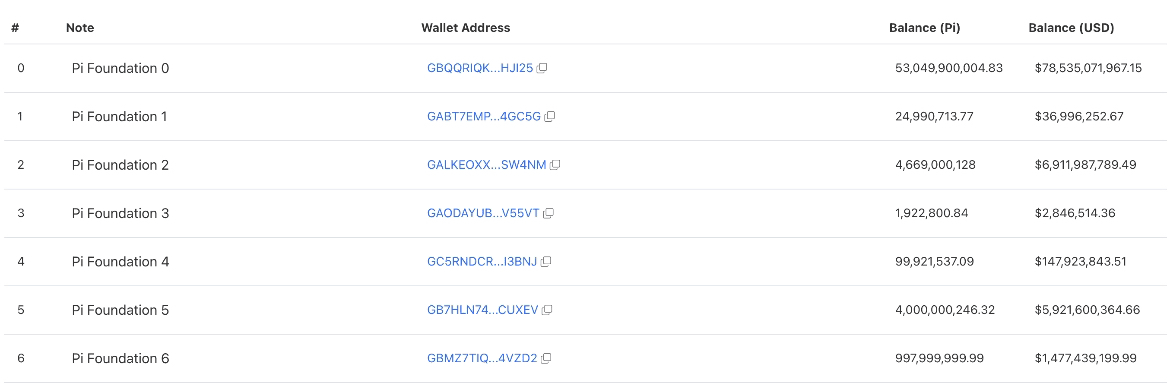
The Pi Coin holdings of the Pi network. Source: PiScan
This brings the total supply held by these entities to approximately 82.8 billion PI. This represents a significant share of the total maximum supply of 100 billion.
Further complicating the issues of centralization, the Pi network currently operates with only 43 nodes and three validators worldwide. In stark contrast, more established layer 1 networks, such as Bitcoin (BTC), operate with over 21,000 nodes. Additionally, Ethereum (ETH) has more than 6,600 nodes, and Solana (SOL) has around 4,800 nodes.
The limited number of nodes and validators means that control of the network is concentrated in the hands of a few entities. Consequently, this makes the network much more centralized than its more established counterparts.
That's not all. This lack of transparency adds another layer of uncertainty.
"Analyzing the source code of the Pi network and on-chain data is currently difficult due to its incomplete openness," PiScan posted on X.
Meanwhile, the Pi network has also raised doubts about privacy and the involvement of third parties. In the 2025 privacy policy update, the Pi network revealed that it uses ChatGPT for its Know Your Customer (KYC) process. This feature was not mentioned in the previous version of the policy.
"We use ChatGPT, as a trusted AI partner, to automate identity verification and enhance security measures. By using our KYC services, users consent to the use of ChatGPT and other AI providers that may be implemented later, as part of our KYC process," the document states.
The introduction of artificial intelligence (AI) into the KYC process adds a new layer of complexity to how user data is shared and processed.
These concerns add to a growing list of problems surrounding the Pi network. The community has previously highlighted technical difficulties during the migration to the mainnet. Additionally, many users, frustrated by the long lock-up period and limited immediate access to their tokens, have attempted to sell their accounts.
This dissatisfaction has led to a significant decline in the popularity of the Pi network. According to Google Trends, search interest for 'Pi Network' has considerably decreased since the mainnet launch on February 20.