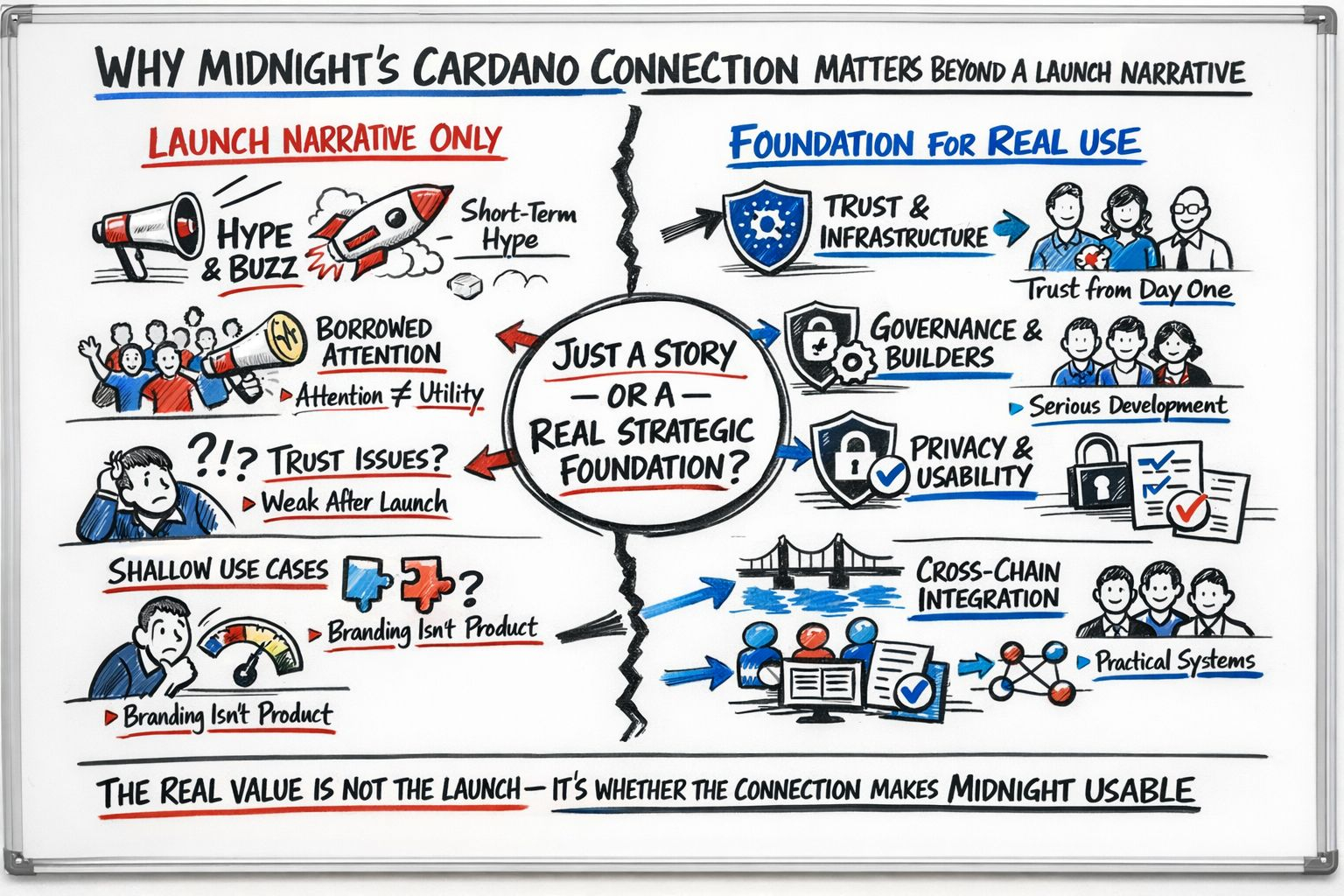
I keep coming back to this thought: is Midnight’s connection to Cardano just a useful launch narrative, or is it actually part of what could make the network more credible and usable over time?
@MidnightNetwork #night $NIGHT
That question matters more than it first appears. In crypto, ecosystem proximity is often treated as substance. A project launches close to a larger network, borrows attention, inherits some goodwill, and the market fills in the rest of the story. But that kind of connection is usually strongest at the moment of announcement and weakest when real users, builders, and operators start asking harder questions. Can I trust this system? Can I plan around it? Does it solve a real operational problem, or does it just sit neatly inside ecosystem branding?
That is the more interesting way to think about Midnight.
Imagine a team building a privacy-sensitive application for health data or internal enterprise workflows. They are not choosing infrastructure because the narrative sounds elegant. They are trying to reduce legal exposure, protect sensitive information, and still preserve enough transparency for coordination, auditing, or compliance. From that angle, Midnight’s relationship with Cardano looks less like a marketing accessory and more like a strategic foundation in trust, maturity, and entry. It does not guarantee adoption, but it changes the starting position in a meaningful way.
The contradiction in crypto is familiar by now. Projects talk constantly about long-term utility, yet many ecosystem relationships are valued mostly for short-term narrative momentum. In theory, an ecosystem connection sounds powerful. It suggests alignment, shared incentives, and a smoother path to growth. In practice, many of those links turn out to be thin. They do not automatically improve developer experience, user confidence, or product reliability. Once launch attention fades, the real test begins.
That is why Midnight’s Cardano connection feels more meaningful to me than a typical launch story.
What stands out is that Midnight was not framed as simply orbiting Cardano for attention. The connection appears more structural than symbolic. Cardano gives Midnight a mature network environment, an existing base of users and builders, and a governance culture that already leans toward patience, seriousness, and long-term system design. Those things matter more than people sometimes admit, especially for a privacy-focused network that will need to earn trust from both institutions and developers.
If Midnight were entering the market as a standalone privacy chain with no deeper strategic anchor, the trust burden would be much heavier. Privacy networks often face two layers of skepticism at the same time. Institutions worry about oversight, compliance, and integration. Regular users and builders worry about ecosystem isolation, usability, and whether the product will actually be supported over time. Cardano cannot remove those concerns, but it can reduce the friction of proving credibility from zero.
And credibility in crypto is not only technical. It is cultural.
Cardano brings more than infrastructure. It brings a research-heavy identity, a governance-minded community, and an audience already used to thinking in longer development cycles. I think that matters because Midnight’s design is not simple in the way many speculative token stories are simple. It deals with privacy, selective disclosure, and cross-chain utility in a form that asks users to understand more than just token ownership. Starting from an ecosystem that can tolerate a more structured and deliberate design path may be a real advantage.
But the deeper point is not that Cardano gives Midnight visibility.
It is that Cardano may give Midnight enough initial structure to focus on becoming useful.
Midnight’s design is interesting because it is trying to make privacy more practical, not just more absolute. The network is built around programmable data protection and selective disclosure, which suggests a system where privacy is not just about hiding information but about controlling what should be revealed, to whom, and under what conditions. That moves Midnight beyond the usual privacy-chain framing and toward something more applicable to real product environments.
That is where the Cardano connection starts to matter beyond launch.
If Midnight can build on an existing base of trust and infrastructure, it has a better chance of being understood as a usable product layer rather than just a privacy narrative. That matters for builders. It matters for operators. And it matters for anyone trying to deploy blockchain systems in places where full transparency is often too blunt and full secrecy is too difficult to govern.
Its token design also supports that more practical direction. Midnight separates the role of the main token from the resource used for transaction execution, which points toward a model built around clearer operations and more predictable usage. To me, that is important because serious users do not only ask whether a network is private. They ask whether costs are understandable, whether activity can be planned, and whether the privacy model creates new friction elsewhere. In that sense, Midnight’s Cardano link matters because it may help turn a technically ambitious design into something that feels operationally credible.
This is not just ecosystem logic. It is product logic.
A builder deciding whether to use Midnight will probably care less about inherited narrative and more about whether the network feels usable from day one. Can it fit into existing systems? Can developers work with it without unnecessary friction? Can privacy be handled in a way that feels compatible with real organizational needs? If Cardano helps Midnight answer those questions with more confidence, then the connection is doing something far more important than supporting a launch story.
Still, this is where the tradeoffs become real.
Inherited credibility can become a strength, but it can also become a crutch. If Midnight leans too heavily on Cardano’s identity, it risks delaying the moment when it has to prove independent value on its own terms. There is also a user-understanding problem here. Dual-resource systems, selective disclosure, native cross-chain design, and privacy-sensitive compliance models may be intellectually compelling, but they are not instantly intuitive. Complexity may be justified, but justified complexity is still complexity.
And adoption rarely rewards complexity unless the benefit is obvious.
That is why I do not think Midnight’s Cardano connection should be romanticized. It is not valuable because it sounds prestigious. It is valuable only if it helps Midnight become more predictable, more understandable, and more credible as a place to build privacy-sensitive applications that still need interoperability and practical realism.
To me, that is the real meaning of the connection. Cardano may matter not because Midnight launched near it, but because Midnight can use that foundation to move faster toward actual usefulness than a standalone privacy network probably could. The story gets stronger if the connection becomes less important over time, not more, because what remains is a network people choose for its design, not just its association.
That is a much harder achievement than a launch narrative.
And maybe that is the real test: will Midnight’s Cardano connection remain just a powerful story people tell at the beginning, or will it become part of the reason Midnight grows into a genuinely credible and useful privacy-focused network over time?
@MidnightNetwork #night $NIGHT