

I keep coming back to this thought: if blockchains are supposed to be open systems, why do their economic designs still behave like gated ecosystems? That tension feels more important than people usually admit. A network can call itself permissionless, but if its token model mainly rewards people for staying inside one economic loop, interoperability starts to look more like a slogan than a lived reality. That is what makes Midnight interesting to me. Can cooperative tokenomics actually move Web3 toward real cross-chain coordination, or does it just sound elegant on paper?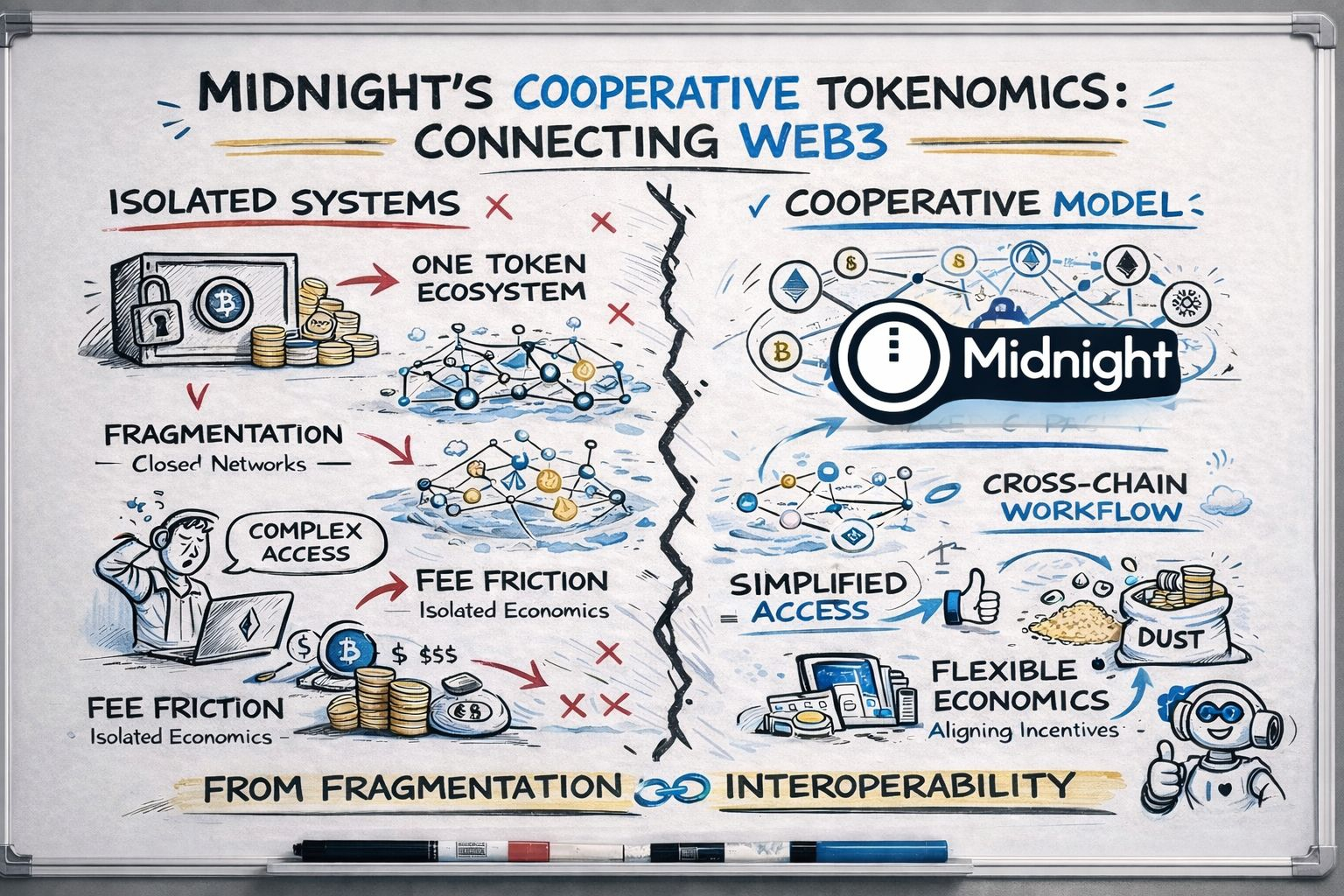
I picture a team building something practical, not flashy. Maybe it is a privacy-sensitive enterprise workflow, or a health-data application that needs secure logic, verifiable execution, and connections to more than one chain. In theory, crypto offers composability. In practice, that team quickly runs into fragmentation. Different chains come with different fee models, different token dependencies, different assumptions about access, and different economic boundaries. The system may be technically connected, but economically it still feels like a set of islands.
That, to me, is one of the quiet contradictions at the center of crypto design. Most public networks are open in the sense that anyone can join, verify, or transact. But the tokenomics often pull in the opposite direction. They encourage participants to remain inside one environment, use one token, and deepen one ecosystem’s internal activity. The design looks neat from an incentive perspective because it creates focus, loyalty, and self-reinforcing demand. But it also reduces the reason to cooperate across networks. A lot of what gets called interoperability ends up being little more than technical passage between economic silos.
The more I look at Midnight, the more it seems to be responding to that exact problem from the incentive layer, not just the infrastructure layer. What stands out to me is that Midnight does not seem to treat interoperability as only a matter of bridging assets or passing messages. It appears to treat it as an economic coordination problem. That is a deeper claim. If the incentives remain chain-specific, then the architecture may be multichain while the behavior stays tribal. Midnight’s cooperative tokenomics seems to push against that by imagining a system that benefits when other networks and non-native users interact with its capacity rather than only when they fully migrate into its ecosystem.
That is where the idea starts to feel like more than branding. Midnight seems to position itself less as a closed destination and more as connective infrastructure. That is a subtle but important difference. A lot of networks compete to become the place where all activity happens. Midnight, at least in this framing, feels closer to becoming a layer that supports activity across environments. If that works, the economic center of gravity shifts. Instead of forcing every user and builder to become a fully native participant first, the network can create value by serving broader coordination needs.
The clearest expression of that is the capacity marketplace. At first, the phrase can sound abstract, but the core idea is fairly intuitive. Midnight network capacity refers to the amount of on-chain work the network can perform over time, limited by what can be processed in each block. That capacity is measured in DUST and dynamically priced. In simple terms, DUST is the resource used to secure network capacity and execute transactions. So instead of thinking only in terms of token ownership, Midnight introduces a way of thinking in terms of access to useful computation and execution.
That shift matters.
In many crypto systems, participation assumes direct token management from the start. Users are expected to hold the right asset, understand the fee logic, and manage the mechanics themselves. Midnight opens another possibility: capacity can be accessed directly by holding and using DUST, or indirectly through sponsorship by a DUST holder. That may sound like a small design detail, but from a product and adoption perspective it is a serious one. Ownership and usage are not the same thing, and systems often become more usable when those two things are allowed to separate.
I think this distinction could matter a lot in the real world. Most users do not want to think about resource pricing, token acquisition, or wallet complexity just to use an application. They want the service to work. If Midnight allows developers or intermediaries to abstract some of that complexity away, the network becomes easier to integrate into normal user flows. Someone using a privacy-preserving service may never need to directly manage DUST at all. They may simply use an application whose backend has already secured the needed capacity. That does not remove the economic model. It makes it more adaptable to actual product design.
Take something like a health-data workflow. A patient, provider, or institution may need to verify eligibility, process sensitive records, or execute privacy-aware logic across systems without exposing more than necessary. In that context, the user gains nothing from being forced to understand Midnight’s underlying resource model. What matters is secure access, reliable execution, and a predictable experience. If a developer or service layer can sponsor the required capacity, Midnight’s infrastructure can be used without turning every participant into a token operator. That is where the capacity marketplace begins to feel practical rather than theoretical.
Economically, this is also where Midnight starts to look different from standard single-network token designs. Traditional tokenomics usually reward deeper engagement inside one system. That can be effective, but it also encourages ecosystem lock-in. Midnight’s cooperative approach seems to imagine value flowing from broader usage, including from participants who are not fully native to the ecosystem. In that sense, the network starts to resemble shared infrastructure rather than a closed market. The goal is not only to capture activity, but to coordinate it.
Still, I do not think this is easy or guaranteed.
A model like this brings its own complications. Cooperative tokenomics may be stronger in theory, but also harder to explain. Dynamic capacity pricing can be elegant from a resource-allocation perspective, yet less intuitive for users and even developers. Sponsored access can improve usability, but it can also make the system feel more opaque. And the broader the coordination ambition becomes, the harder adoption may be. Builders need to understand why this model is worth integrating. Users need to feel the benefits without being overwhelmed by abstraction. Markets need to trust that cooperative incentives will actually hold up under real demand, not just in whitepaper logic.
That is why Midnight’s design looks promising to me, but also demanding. It asks people to think about blockchain value in a less familiar way. Not as a fortress economy that captures users inside one token boundary, but as an interoperable service layer with incentives designed to work across systems. I think that is a more mature direction for Web3, especially if the industry wants to move beyond isolated ecosystems and toward infrastructure that can support real business, privacy, and coordination needs.
But the real test is not whether the idea sounds intelligent. It is whether Midnight’s cooperative tokenomics can make cross-chain coordination feel natural, useful, and economically durable in practice.
Can it really become Web3’s coordination layer, or will it remain one of those designs that looks better in theory than it feels in use?
