
Today 2026 Pricing transactions in blockchain systems has always been tricky networks want efficiency,but they don’t want to make things unusable for regular people.Most blockchains go with auction style fee markets,so users end up bidding for block space.When things get busy,fees shoot up,and small users get pushed out.Costs become unpredictable.When things go quiet,fees drop,and suddenly miners or validators aren’t getting paid enough.It’s a mess for anyone building or using applications that need steady transaction costs.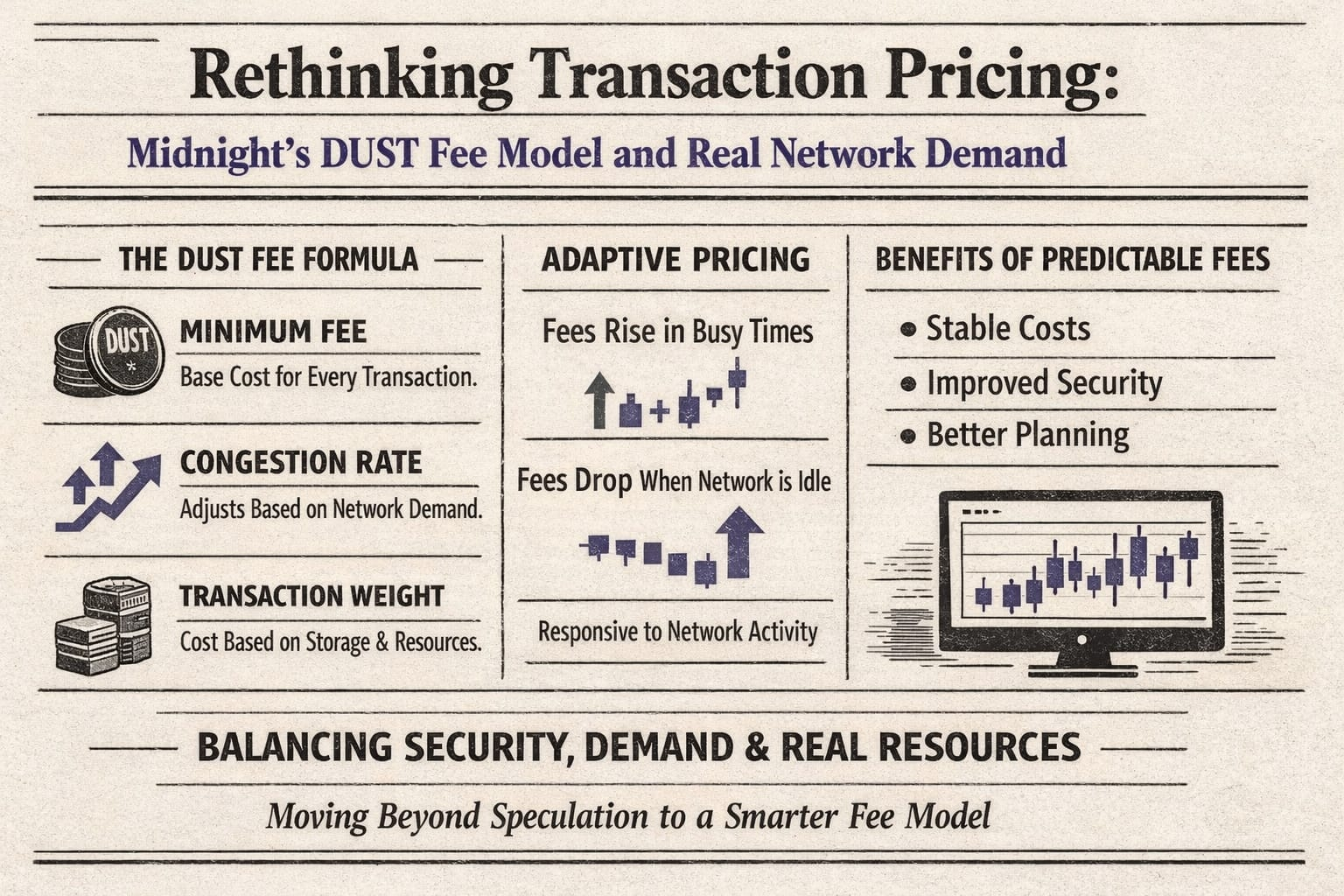
Midnight aims to sidestep some of these problems.It uses a system based on DUST a resource connected to the NIGHT token.Transaction fees aren’t just speculations;they’re structured and tied to actual network activity.The fee has three parts:a minimum fee,a congestion rate,and transaction weight.
The minimum fee sets a base you pay it for every transaction,no matter how busy things are.This isn’t just about price;it’s about security.If sending a transaction costs nothing,attackers could flood the network with spam and grind it to a halt.Midnight forces a small DUST payment every time,so launching a big spam attack gets expensive fast.
But the real action is in the congestion rate.This is the piece that changes with network demand.Instead of reacting to just the current block,Midnight looks at the previous block too,so it catches short term shifts.If blocks start filling up,the congestion rate bumps fees higher.When things slow down,fees drop,and users are encouraged to send more transactions,keeping the network healthy.It’s a simple feedback loop prices rise and fall based on demand,not random spikes.
Transaction weight is the third lever.At launch,it’s based on how much storage a transaction needs,measured in kilobytes.Midnight blocks have fixed size limits,so big transactions take up more space and cost more.Storage isn’t the whole story,though.Over time,Midnight plans to factor in compute and disk reads moving toward fees that genuinely match the real resources a transaction consumes.
Put these pieces together,and Midnight’s fee system becomes more predictable than classic gas markets.Instead of wild bidding,costs depend on a formula balancing security,network demand,and real resource use.The final DUST fee shows both the technical impact of the transaction and current network conditions.
For developers and anyone building on Midnight,this matters.Predictable fees make it easier to set up decentralized apps and automated trading tools they aren’t constantly worried about cost swings.Stability supports growth.Still,no system is perfect.Dynamic fees mean some variability.And tying fees to resources sets limits if an app needs a sudden burst of activity.How well transaction weight measures real cost will matter as usage grows.
Midnight’s model is a shift from speculative fee auctions to adaptive infrastructure.By blending a minimum floor,congestion pricing,and resource based fees,it tries to keep the network open and protected.Whether this works as Midnight scales up that’s the real test.
For investors,developers,and operators looking at these systems,it’s not just about chasing low fees.The real question is whether the network stays economically stable as demand changes.Midnight’s DUST fee model offers one path forward,but its ability to balance efficiency,security,and flexibility will decide its fate as real world use ramps up.