
 When I first started exploring blockchain technology, the idea that attracted most people was transparency. Public blockchains allow anyone to see transactions, wallet balances, and network activity. At first this sounded revolutionary — a system where everything can be verified by anyone.
But the more I researched blockchain infrastructure, the more I noticed a problem. Complete transparency does not always work in the real world. Many systems require a certain level of privacy to function properly.
Businesses handle confidential financial data. Hospitals manage sensitive medical records. Even individuals may not want their entire financial history visible to the public internet.
This creates a major challenge for blockchain technology. How do you maintain trust and verification while still protecting sensitive information?This is exactly the problem that Midnight Network is trying to solve.
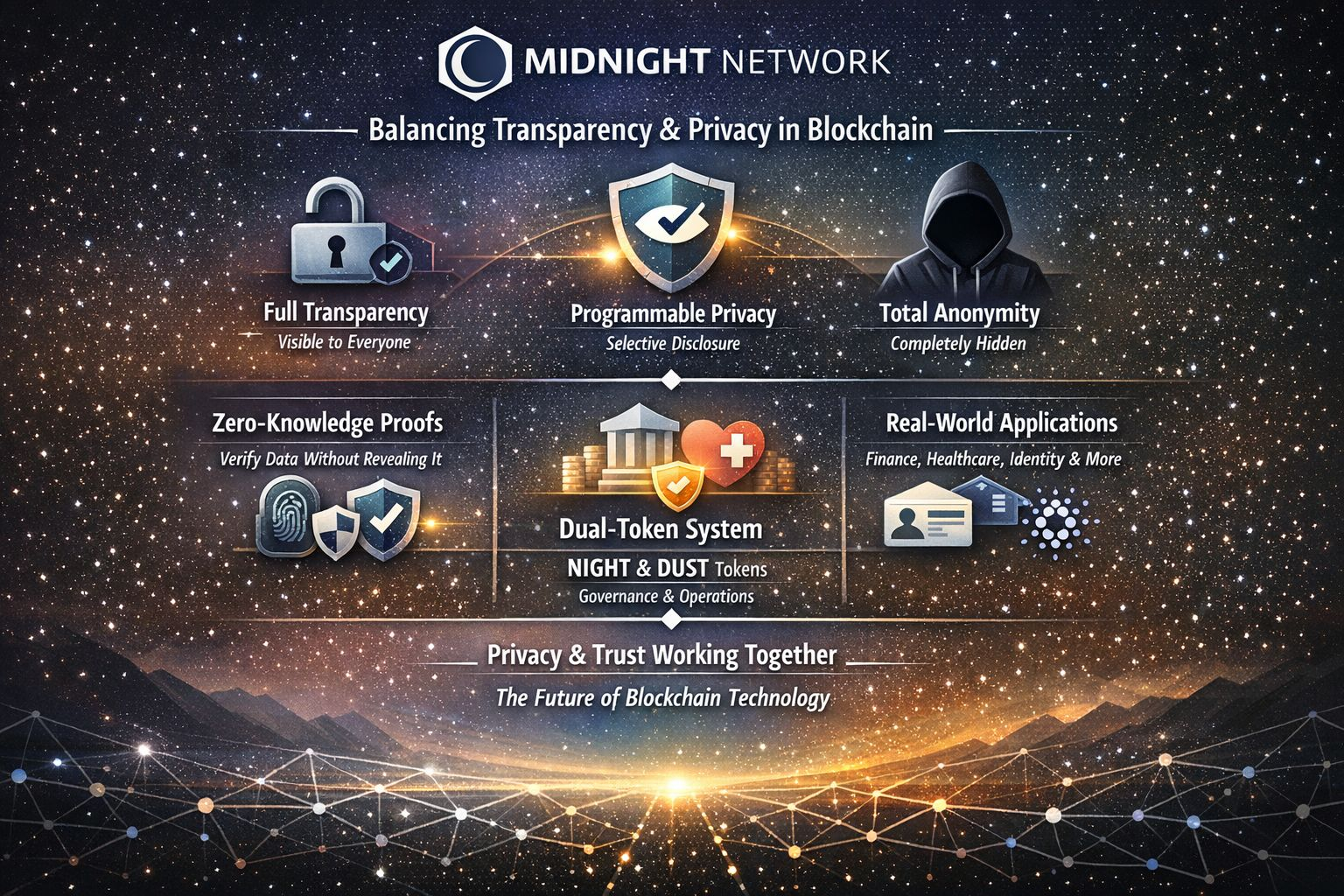
Midnight is a privacy-focused blockchain designed to introduce what many developers call programmable privacy. Instead of forcing users to choose between full transparency or total anonymity, the network allows information to be selectively revealed when necessary.
In simple terms, a transaction can be verified as valid without exposing the actual data behind it.
This idea becomes extremely important when thinking about large-scale adoption of blockchain. Most companies and institutions cannot operate on systems where every detail is publicly visible.
Imagine a company processing payroll on a fully transparent blockchain. Every employee salary would become public information. That kind of system would be difficult for most organizations to accept.
The same issue appears in healthcare. Storing medical data on a completely transparent network would create serious privacy concerns and regulatory problems.Midnight approaches this challenge through advanced cryptographic technology known as zero-knowledge proofs.
Zero-knowledge cryptography allows someone to prove that a statement is true without revealing the underlying information. The network can confirm that rules were followed while the sensitive data remains private.
This means a user could prove they meet certain requirements, own a credential, or completed a valid transaction without exposing personal or confidential details.
In many ways, this changes how privacy can exist inside blockchain systems.
Instead of thinking about privacy as hiding everything, Midnight treats privacy as a programmable feature. Developers can design applications where certain information stays hidden while other information can still be verified publicly.Another interesting element of Midnight is its economic structure.
The network introduces a dual-token model designed to separate governance from operational usage.
The main token, often referred to as NIGHT, is connected to network participation and governance. Alongside it is another resource called DUST, which is used to execute transactions and smart contracts inside the privacy environment.What makes this system unique is that holding NIGHT generates DUST over time.
This design means developers and users do not always need to constantly spend the main token to operate on the network. Instead, the operational resource is gradually produced, which creates a different economic dynamic compared to traditional gas fee systems.Midnight is also closely connected to the broader Cardano ecosystem.
Rather than existing as an isolated blockchain, it is designed as a partner network that expands Cardano’s capabilities. The goal is to add privacy infrastructure that developers can use when building decentralized applications.
This connection could allow future applications to combine Cardano’s security and decentralization with Midnight’s confidentiality features.
For developers, this opens the door to new types of blockchain applications that were previously difficult to build.Confidential financial transactions could become possible without sacrificing verification.
Identity systems could allow users to prove who they are without exposing unnecessary personal data.Businesses could share information with regulators or partners without revealing it to the entire network.
Healthcare providers could potentially manage medical data in a way that protects patient privacy while still allowing secure verification.
These types of applications show why privacy infrastructure may become one of the most important layers of blockchain technology.
The first generation of blockchain focused mainly on digital money. The second generation introduced programmable smart contracts.Now a new phase is emerging where the focus is shifting toward usable infrastructure that can support real-world systems.
For blockchain to move beyond experimentation and into everyday use, it must work within existing legal, financial, and institutional frameworks. Privacy is a key part of that transition.
Systems that allow selective disclosure could make it possible for organizations to use blockchain without exposing sensitive information.
Midnight Network represents an attempt to build that balance.Instead of treating transparency and privacy as opposites, the network approaches them as tools that can work together.
Trust still comes from verification, but privacy protects the information that should not be publicly exposed.
If blockchain technology continues to evolve toward real-world adoption, infrastructure like Midnight could play an important role
It introduces the idea that the future of decentralized systems may not be fully transparent or fully private.
Instead, the most useful systems may be the ones that allow both to exist at the same time.