
I remember the first time zero-knowledge proofs were explained to me in a way that was supposed to sound simple. The sentence was something like: you can prove something is true without revealing the information behind it. I understood the words, but not the logic. It sounded like one of those ideas crypto likes to repeat because it feels futuristic, even when most people hearing it are quietly pretending they understand more than they do.
What made the concept click for me was not the mathematics, but the discomfort of the normal alternative.
In most systems, if you want to prove something, you show the evidence. If you want to prove who you are, you hand over documents. If you want to prove a transaction is legitimate, you expose the details. If you want to prove eligibility, compliance, or ownership, the proof usually comes bundled with more information than the other side actually needs.
That is the habit zero-knowledge proofs interrupt.
A ZK proof is, at its core, a way of convincing a system that something is true without handing over the underlying data that makes it true. The network does not need to see the full record, the secret, or the private input. It only needs to verify a cryptographic proof showing that the condition was satisfied.
That sounds abstract until you reduce it to the real question underneath: what if a blockchain could verify truth without forcing exposure?
That is where the idea becomes much more practical.
A person could prove eligibility without publishing private identity details. A company could prove that a transaction followed the rules without exposing the transaction itself. An application could prove compliance without revealing the full dataset behind it. The system still gets verification. What it stops demanding is unnecessary disclosure.
This is exactly why ZK proofs matter for blockchain adoption.
Public blockchains built trust by making everything visible. That worked for open systems, but it also created a ceiling. The closer blockchain moves toward finance, enterprise processes, healthcare, identity, and regulated environments, the more visible that ceiling becomes. Most real-world systems cannot function if every interaction leaves a fully transparent trail behind it.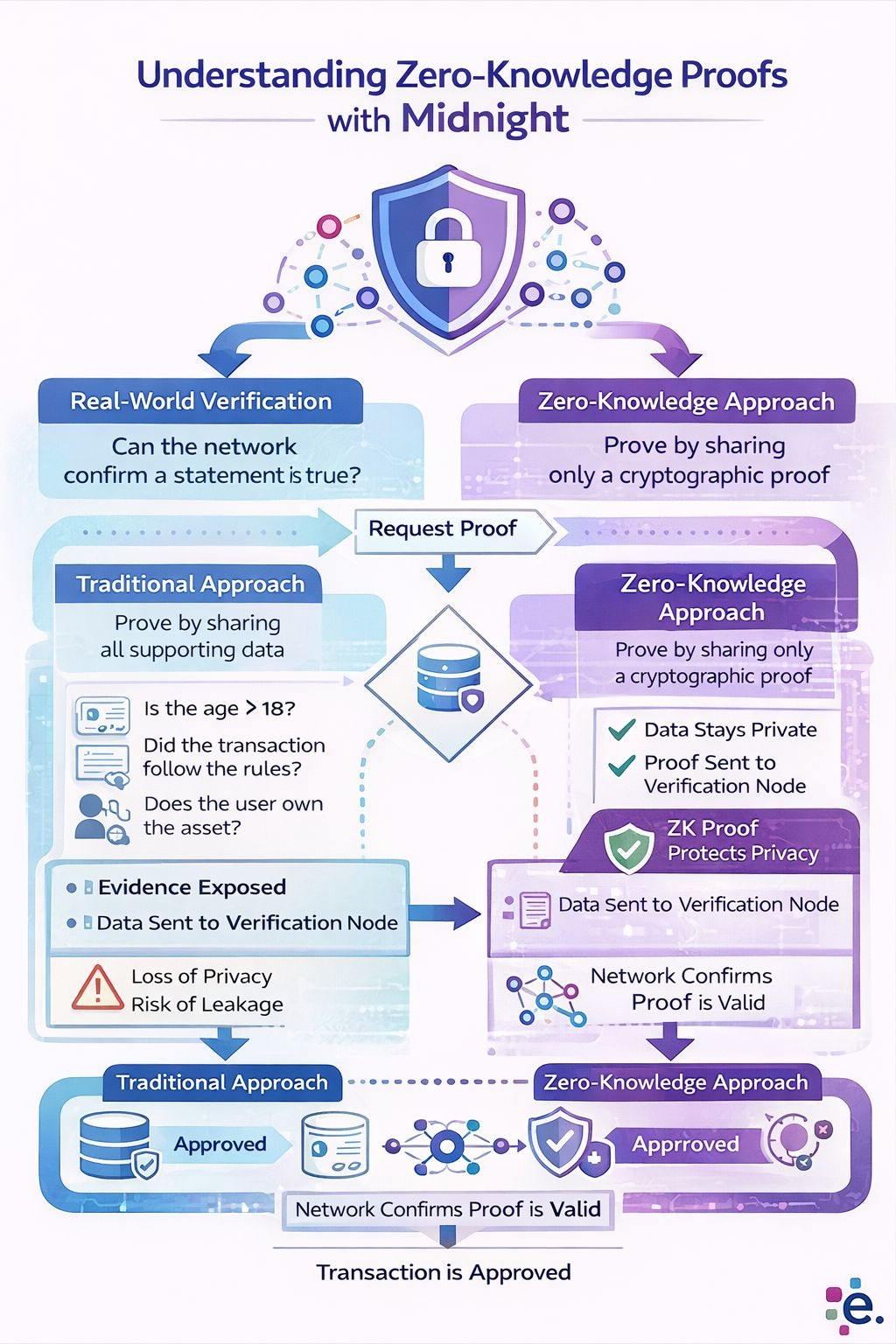
Midnight is interesting because it takes that ceiling seriously.
Instead of treating zero-knowledge proofs like an abstract research concept, it uses them as part of the network’s practical design. The point is not merely to say privacy is valuable. The point is to let applications prove that something is valid while keeping the original data private. That is what makes Midnight a useful example here. It shows what ZK proofs look like when they stop being a theory and start becoming infrastructure.
The deeper shift is not technical so much as philosophical. Traditional blockchain logic assumes the network must see the data in order to trust the result. Zero-knowledge proofs suggest another path. The network may not need to see everything. It may only need enough proof to know that the truth has been preserved.
And if that idea continues to mature, then blockchain adoption may depend less on how much information a system can expose and more on how little it needs to reveal while still remaining trustworthy.
$NIGHT #night @MidnightNetwork
