

A new technological era is slowly beginning to unfold—one where robots are no longer isolated machines performing tasks in silence, but active participants in a connected and verifiable digital ecosystem. For many years, robotics systems have operated inside closed environments. Factories rely on proprietary machines, hospitals use specialized robotics platforms, and many intelligent systems run on software that only a single company can control or understand. While these systems may function well individually, they often lack transparency. When a robot makes a decision or performs an action, the outside world rarely has a way to verify what happened or why.
As robotics becomes more integrated into daily life, this lack of transparency becomes a real concern. Imagine robots assisting surgeons in hospitals, managing warehouse logistics, controlling delivery drones, or maintaining public infrastructure. In such environments, trust is critical. People need to know that machines are functioning correctly, that their actions are traceable, and that mistakes can be audited and understood. Without transparency and accountability, the rapid expansion of robotics could create new risks.
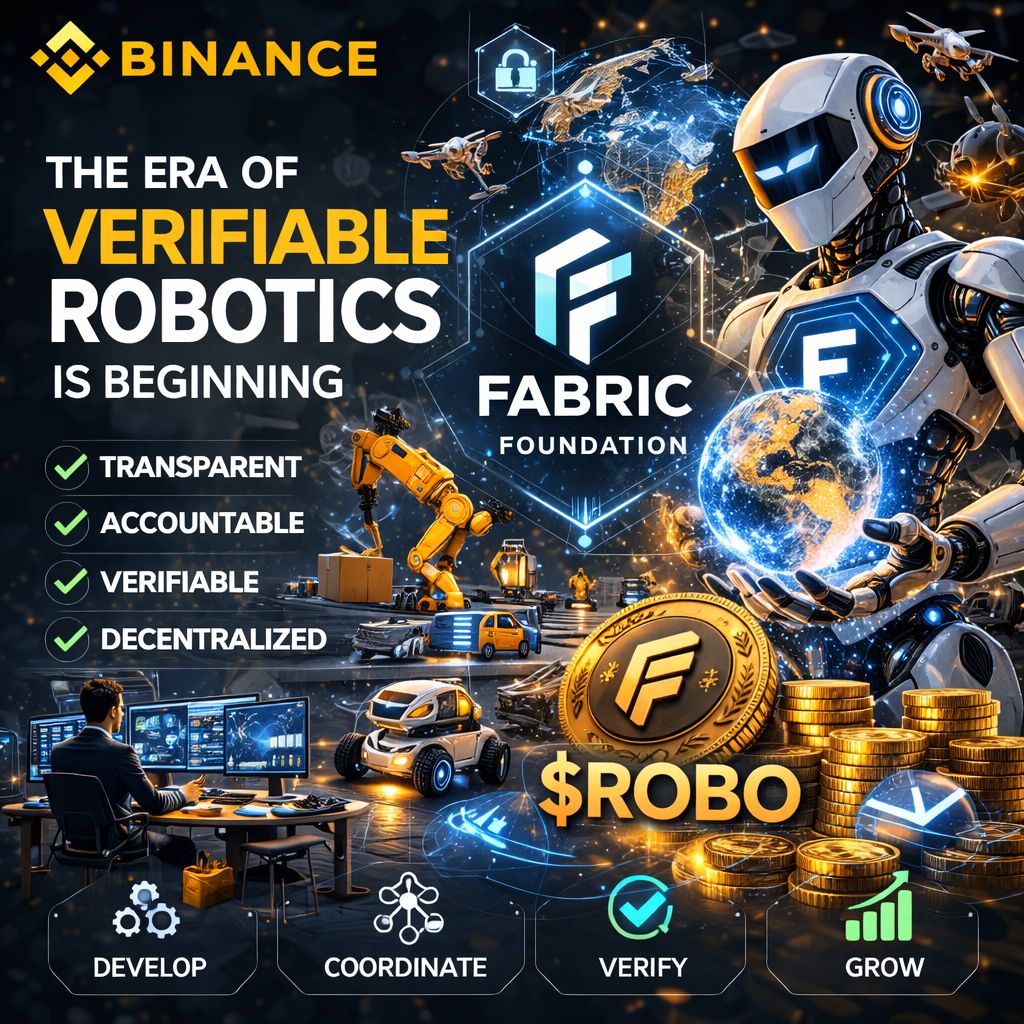
This is where the Fabric Foundation introduces a new idea: building an open and verifiable infrastructure for robotics and physical AI. Instead of allowing machines to operate inside closed corporate systems, Fabric proposes a global network where robotics development, data exchange, and operational coordination can be recorded and verified through decentralized technology. In simple terms, it aims to create a shared digital layer where the actions of robots and AI agents can be transparent, traceable, and governed collectively.
At the heart of this ecosystem is the $ROBO token, which acts as the economic engine of the network. In any decentralized system, incentives are necessary to encourage participation and ensure honest behavior. Developers contribute software modules, node operators provide computing power, data providers supply real-world information, and validators verify the actions recorded on the network. The token helps coordinate these roles, rewarding participants who contribute to the reliability and growth of the system.
To understand why this approach matters, it helps to imagine the current robotics landscape. Today, a robot deployed in a warehouse might use sensors to track inventory, move packages, and coordinate with other machines. However, all the data about its actions usually remains inside a private system controlled by a single company. If something goes wrong—an item is misplaced, a route is miscalculated, or an error occurs—investigating the issue can be complicated. Logs must be checked, internal databases reviewed, and engineers consulted.
Fabric’s vision is different. By using a public ledger and verifiable computing, every robotic action can be recorded in a transparent way. This does not mean exposing sensitive data publicly, but rather ensuring that the system provides proof that actions occurred as expected. Each movement, decision, and interaction can be cryptographically verified, making robotic operations auditable and trustworthy.
This concept can be thought of as a blockchain layer for real-world machines. Just as blockchain technology allows financial transactions to be verified without a central authority, Fabric explores how robotic actions and machine interactions can also be verified. Instead of relying on a single corporation to manage and control robotics infrastructure, the network distributes responsibility across a global community of developers, operators, and participants.
Another important aspect of this model is modular development. Robotics systems are incredibly complex, combining hardware, sensors, AI models, and software components. Traditionally, these components are tightly integrated and controlled by the manufacturer. Fabric’s approach encourages modular innovation, allowing developers to create specialized modules that can plug into the network. A developer might build a navigation algorithm for delivery robots, while another might design a verification tool for industrial automation.
By allowing these components to interact through an open infrastructure, innovation can accelerate. Developers no longer need to build entire robotics ecosystems from scratch. Instead, they can contribute individual pieces that improve the overall system.
The importance of this idea becomes clearer when considering the future of automation. Robotics adoption is growing rapidly across multiple industries. Factories increasingly rely on automation to increase efficiency and reduce costs. Hospitals are exploring robotic systems for surgery assistance and patient care. Autonomous vehicles and drones are being tested for logistics and transportation. Even public infrastructure may soon rely on robots for inspection, maintenance, and environmental monitoring.
As these technologies scale, the need for reliable coordination becomes critical. Thousands—or even millions—of machines may need to interact with each other and with human operators. Without a shared coordination layer, managing these interactions could become extremely complex.
Fabric Foundation’s infrastructure attempts to solve this coordination challenge. Through programmable rules and transparent verification, machines can interact within a structured environment where actions are recorded and validated. This makes it easier for humans to trust robotic systems, because the system itself provides evidence of how machines behave.
Regulation is another factor pushing the importance of verifiable systems. Governments around the world are beginning to introduce stricter rules for AI and robotics. When machines operate in public spaces or perform sensitive tasks, regulators often require detailed records of operations, safety procedures, and compliance measures. Systems that can provide verifiable proof of actions may become extremely valuable in meeting these requirements.
For example, a city deploying autonomous delivery robots might require proof that those robots follow safety protocols and remain within designated areas. A healthcare provider using robotic systems might need verifiable logs showing how machines assisted during medical procedures. Infrastructure built around verifiable computing could simplify compliance by providing transparent records automatically.
Of course, the development of such systems is still in its early stages. Building a global network capable of coordinating robotics development and operations is an ambitious goal. It requires strong technology, active communities, and real-world adoption. Many projects attempt to tackle big ideas, but only a few succeed in creating infrastructure that becomes widely used.
However, the direction of the concept itself reflects a broader trend in technology. As intelligent systems become more powerful, society increasingly demands transparency, accountability, and shared governance. Closed systems controlled by single corporations may struggle to meet these expectations. Open and verifiable infrastructures could provide an alternative path forward.
This is why observers are watching the growth of the $ROBO ecosystem closely. Metrics such as the number of active node operators, the participation of developers, the amount of data shared within the network, and the involvement of governance participants can offer insight into the health and expansion of the protocol. Strong participation suggests that the ecosystem is evolving beyond theory into practical infrastructure.
Ultimately, the rise of robotics is inevitable. Machines are becoming more capable, more autonomous, and more integrated into the physical world. The real question is not whether robots will transform industries and societies—they almost certainly will.
The deeper question is how that transformation will be managed.
Will robotics remain controlled by isolated corporate systems with limited transparency?
Or will it evolve into an open ecosystem where machines collaborate under verifiable and accountable rules?
Fabric Foundation is exploring the second path.
By combining decentralized technology, verifiable computing, and community governance, the project aims to create a foundation for a world where intelligent machines can operate safely, transparently, and collaboratively.
In such a future, robots would not simply perform tasks in the background.
They would operate within systems that humans can understand, verify, and trust.

And that could be the difference between a world where automation creates uncertainty—and a world where it builds confidence in the technologies shaping our future.
