
When I first heard the phrase “machines paying machines,” I’ll be honest — I rolled my eyes a little.
It sounded like one of those phrases that appears in crypto whitepapers and marketing threads but doesn’t really mean anything once you try to imagine it in real life. Crypto has a long history of ideas that sound revolutionary until you ask a simple question: who would actually use this?
But after thinking about it more carefully, something obvious started to stand out.
Robots already pay for things. Humans just handle the transactions for them.
A delivery robot consumes electricity, but a human pays the charging bill. A warehouse robot eventually needs repairs, but a human contacts the maintenance provider. An autonomous drone might rely on cloud computing for navigation, but the payment still comes from a human account somewhere.
The machines are doing the work and using the resources. Humans are simply acting as the payment layer between systems.
That’s the gap Fabric is trying to remove.
Instead of humans coordinating every transaction, the idea is simple: machines can request services, negotiate prices, and settle payments directly using $ROBO.
To see whether that idea actually holds up, I started thinking through situations where it might make practical sense. Not in some distant future, but in environments that already exist today.
One of the clearest examples is energy.
Imagine a delivery robot finishing its route and realizing its battery is almost empty. Normally it would need to travel all the way back to its own depot to recharge. But what if a charging station owned by another fleet is closer?
In a system built around Fabric, the robot could simply request power directly from that station. The station responds with a price in $ROBO, the robot accepts the quote, and charging begins automatically. When the session ends, the payment settles immediately.
No human approval, no invoicing, and no corporate billing process in the background. Just two machines exchanging a service and a payment.
Another situation appears when robots need additional computing power.
Autonomous machines sometimes encounter problems that require heavier calculations than their onboard systems can handle. A drone mapping a construction site, for example, might suddenly need to analyze terrain or optimize a complex route.
Instead of aborting the mission, the drone could request external computing resources from nearby nodes. Those nodes would quote a price, the drone would pay using $ROBO, and the calculations would run remotely before returning the result.
In that moment, the drone effectively purchased computing power from another machine.
Insurance is another interesting example once you start thinking about it differently.
Today insurance systems are designed around long-term contracts and monthly premiums. But robots don’t necessarily operate on fixed schedules or predictable environments. They often take on individual tasks that carry their own risks.
Imagine a delivery robot entering a dangerous area during bad weather. Instead of relying on a year-long insurance policy, the robot could request short-term coverage just for that mission.
Insurance providers could evaluate the risk and offer pricing for the next two hours of activity. The robot pays a small premium in $ROBO, the coverage activates immediately, and if something goes wrong the claim can be verified through the robot’s operational data.
Insurance becomes something purchased per task instead of per year.
Maintenance is another area where automation could change things dramatically.
Modern robots already run diagnostics on themselves. Sensors can detect mechanical wear, overheating components, or calibration problems long before a human technician notices anything.
Right now, though, those alerts still go to humans who schedule repairs.
In a Fabric-style system, the robot could broadcast its own repair request. It describes the issue, offers payment in $ROBO, and nearby service providers respond with availability. Once a provider accepts the job, the repair happens and payment settles automatically after verification.
The robot effectively organizes its own repair.
The last scenario might actually be the most interesting because it creates an entirely new type of market.
Robots constantly collect data. Cameras, environmental sensors, navigation systems, and monitoring equipment generate enormous amounts of information about the physical world.
Some of that information is valuable to other machines.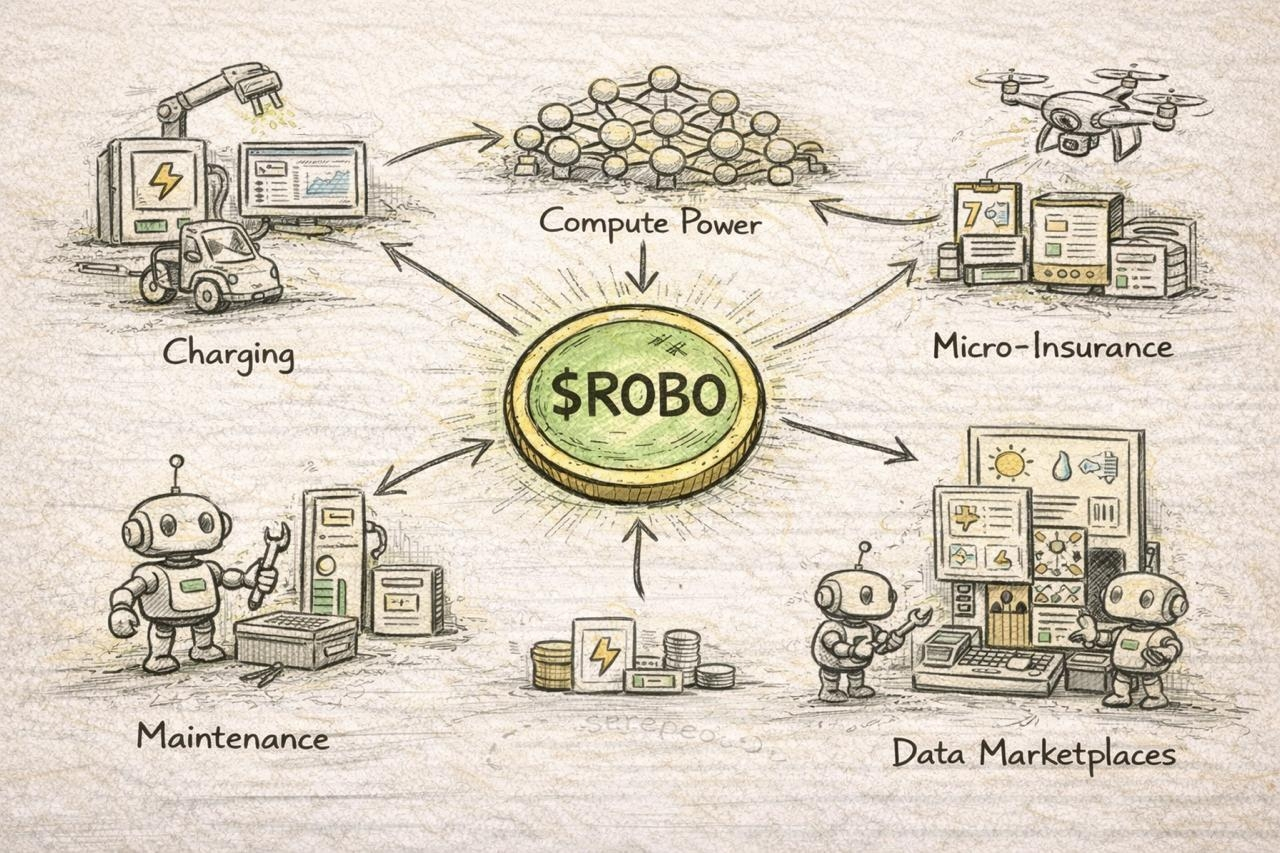
A traffic monitoring robot might know which streets are congested in real time. A delivery drone could use that data to adjust its route. Agricultural robots might measure soil moisture across large areas, data that other machines could use when deciding where to plant crops.
Instead of sending all that data to centralized platforms, robots could simply sell it.
A machine broadcasting environmental observations could offer access for a small price in $ROBO, and other machines could purchase that information instantly. Over time this creates a network where machines earn tokens by sharing what they observe and spend tokens to improve their own decisions.
Once you start looking at these examples together, a common pattern appears.
Machines need resources. Other machines provide those resources. Payments happen automatically between them.
Humans are no longer required to coordinate the exchange.
That’s the core idea behind Fabric. It treats robots as economic participants rather than tools that always require human financial control.
Machines can request services. Machines can pay for resources. Machines can verify completed work.
And $ROBO becomes the settlement layer for those interactions.
When I first started thinking about this idea, I assumed it was mostly marketing language. But once you start mapping out situations where machines already depend on energy, compute power, maintenance, insurance, and data, the concept becomes easier to understand.
Autonomous systems are growing quickly across logistics, agriculture, infrastructure, and transportation. As those systems expand, the number of machine-to-machine transactions could grow just as quickly.
If that happens, the infrastructure that allows machines to exchange services directly may become far more important than most people expect today.
This doesn’t mean everything changes overnight. There are still technical challenges and adoption hurdles ahead. But the direction is fairly clear.
Machines are slowly becoming participants in the economy, not just tools within it.
And if that trend continues, systems that allow machines to transact directly — using assets like $ROBO — could become an essential layer of future infrastructure.
For now it’s still early.
But it’s no longer difficult to imagine how it might work.
Which situation makes the most sense to you? Or is there another use case for machine-to-machine payments that people aren’t talking about yet?
$ROBO #ROBO @Fabric Foundation
