

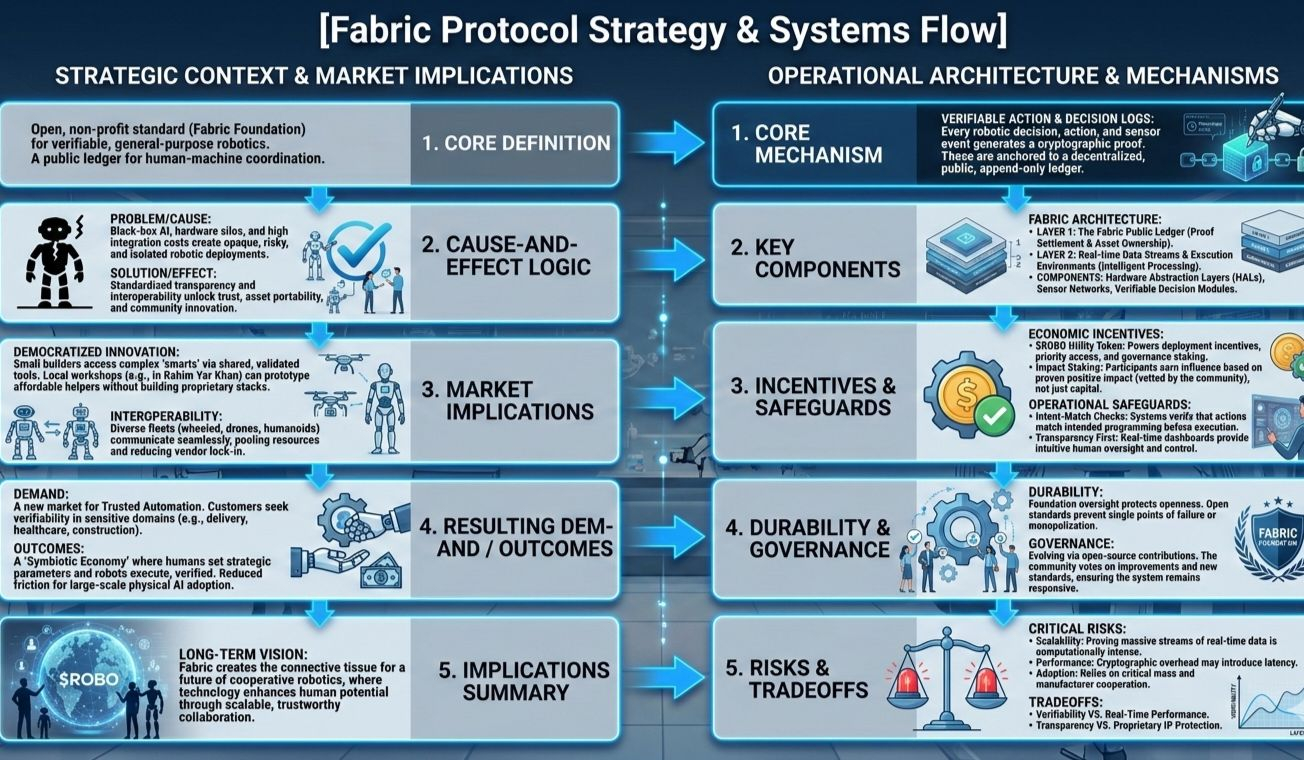
Lately, I've found myself lost in thought about Fabric Protocol, this intriguing open network that's quietly reshaping how we imagine robots fitting into our lives. Born from the non-profit Fabric Foundation in late 2025, it's a framework designed to let anyone—from indie developers to big manufacturers—build and refine general-purpose machines that operate on shared principles of safety and transparency. What strikes me most is its elegant fusion of real-time data flows, intelligent processing, and oversight mechanisms, all etched into a public ledger that anyone can verify. Living here in Rahim Yar Khan, I can't help but envision local workshops prototyping affordable helpers for harvests or deliveries, all plugged into this global grid without the usual tech silos holding them back.The magic lies in its approach to proof—every robotic decision, from navigating a crowded market to assembling parts, leaves a cryptographic trail that's impossible to fake. This isn't about spying on machines; it's about creating confidence that they stick to their programming, even in unpredictable environments like dusty fields or bustling hospitals. I've always worried about those viral clips of bots malfunctioning spectacularly, but Fabric's design sidesteps that by baking in checks that confirm actions match intent, all while keeping proprietary edges private. It's a subtle shift that could make everyday automation feel less like a gamble and more like a reliable teammate.At the heart of it all is the Foundation's commitment to openness, steering clear of the profit-chasing that dooms so many projects. They facilitate without dictating, encouraging a marketplace of ideas where contributions—be it new algorithms or hardware tweaks—earn real sway in how the system grows. This collaborative spirit reminds me of early internet days, when shared protocols sparked explosive creativity, and I see Fabric sparking something similar for physical AI, drawing in talent from overlooked corners of the world.Interoperability jumps out as a quiet revolution too; picture diverse robot fleets—wheeled scouts, aerial drones, humanoid aides—handshaking seamlessly across makers. Fabric's layered tools make this feasible, pooling resources like processing power or environmental maps to boost efficiency without forcing lock-ins. For regions like Punjab, this could mean small-scale farmers accessing high-end smarts through community-shared networks, leveling the playing field against wealthier players and sparking grassroots innovation.Then there's the human element, where Fabric truly humanizes the machine age. It enables fluid handoffs: you set parameters for a task, and the system enforces them transparently, letting people oversee fleets intuitively via simple dashboards. In education, kids could program class projects with built-in safeguards; in construction, crews direct heavy lifters knowing deviations trigger alerts. This isn't cold automation—it's augmentation that frees minds for strategy and spark, building a symbiosis that's as intuitive as chatting with a skilled colleague.Utility tokens like $ROBO ground the economics sensibly, funding expansions through practical uses such as priority access or deployment incentives, steering clear of hype-driven bubbles. Glimpses from early 2026 suggest pilots are underway, with quiet alliances forming around real deployments—think urban cleanup squads or remote monitoring rigs—proving the concept in the wild. As components like sensors and batteries keep improving, Fabric emerges as the connective tissue, ready to weave robotics into daily fabrics worldwide.On a deeper level, it promotes a sense of shared stewardship; participants stake claims through proven impacts, evolving the protocol like a living document co-authored by its users. This counters the opacity of corporate AI empires, offering a model where accountability is the default, not an add-on. It's refreshing in an era of skepticism, restoring a sense of agency over our automated future.Challenges like optimizing proofs for massive scales loom large, demanding clever optimizations in bandwidth and energy—yet the groundwork feels robust, backed by a Foundation laser-focused on sustainable progress. Their ethos of accessible standards could ripple into unexpected areas, from environmental patrols to artisanal crafting aids, broadening tech's reach.For me, Fabric embodies tech's sunnier possibilities: inventive, equitable, and grounded in mutual benefit. It's the kind of initiative that doesn't shout its virtues but earns them through thoughtful execution, inviting us all to co-create a world where robots enhance rather than eclipse human endeavor.
@Fabric Foundation #ROBO $ROBO
