What if tomorrow an AI system makes a critical decision about your health, your money, or even your safety—but you have no way to verify whether that decision was correct?
As artificial intelligence and robotics rapidly take control of real-world operations, trust is becoming the biggest challenge. The world is entering an era where machines will not only assist humans but also make autonomous decisions. From diagnosing diseases to managing financial systems and operating smart cities, AI is moving beyond theory into everyday life. But without transparency, accountability, and verifiable processes, this progress could also create serious risks. This is exactly the problem that Fabric Protocol is aiming to solve.
Artificial Intelligence is transforming industries such as healthcare, logistics, manufacturing, and finance at an unprecedented pace. However, issues like hallucinated outputs, biased data, security vulnerabilities, and centralized control continue to slow large-scale adoption. Many current AI systems operate as “black boxes,” where users cannot understand or audit how decisions are made. This lack of trust limits their impact in critical environments. Fabric Protocol introduces a decentralized and verifiable infrastructure designed to bring transparency, reliability, and security to intelligent machines.
Fabric combines public ledger technology with modular infrastructure to coordinate data, computation, and governance across a global open network. By using verifiable computing, every step in the decision-making process can be validated and audited. This ensures that outputs are not only accurate but also traceable. As a result, humans and machines can collaborate with confidence, reducing the risks of manipulation, misinformation, or hidden control.
One of the strongest advantages of the Fabric ecosystem is its collaborative and modular approach. Instead of relying on centralized organizations, the protocol connects developers, researchers, data providers, and robotic systems in a shared environment. This encourages innovation while maintaining high security and reliability standards. Such a system is essential as autonomous agents and robots become more common in industries where accuracy and safety are critical.
The $ROBO token plays a key role in this ecosystem by aligning incentives across participants. It rewards contributors who provide valuable data, computing power, or reliable models. This creates a sustainable economy that supports long-term innovation. In addition, decentralized governance allows the community to shape the future of the protocol, promoting transparency and global participation.
Looking ahead, the potential applications of Fabric are enormous. Verified AI could transform healthcare by improving diagnosis accuracy and treatment planning. Supply chains and logistics could become more efficient and trustworthy. Financial systems could benefit from transparent and secure AI-driven decision-making. As humanoid robots and autonomous systems expand across the world, a trusted coordination layer will become essential.
In the long term, the success of AI will depend not only on its power but also on its reliability and accountability. Fabric Foundation is building the infrastructure that could become the backbone of safe human-machine collaboration. By supporting this vision, developers, investors, and early adopters have the opportunity to be part of a movement shaping the next technological revolution. 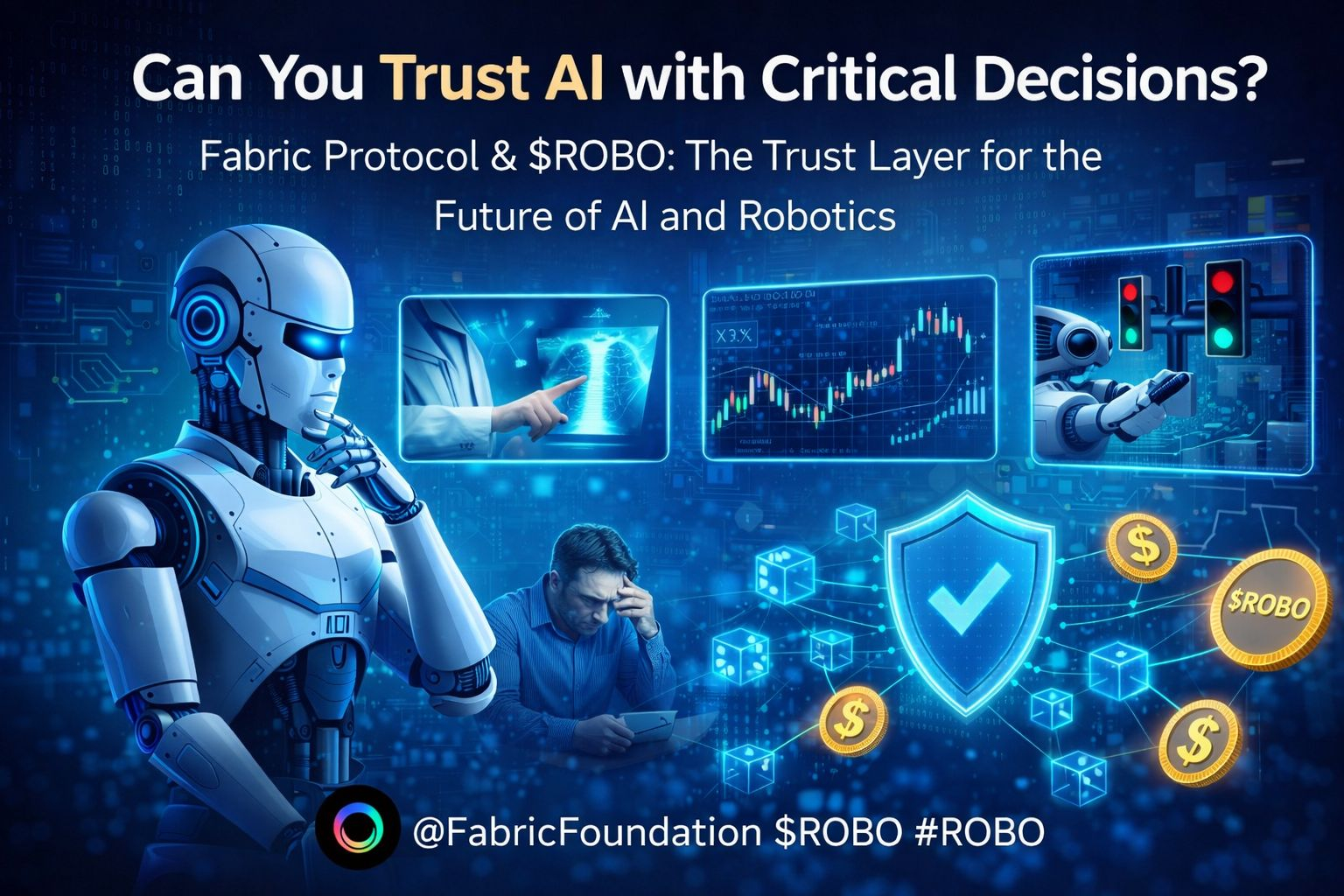
$ROBO #ROBO @Fabric Foundation