
Understanding the Need for Context Synchronization in AI
Artificial intelligence models are becoming more powerful every day. From chatbots to automated trading systems, AI is shaping how we interact with digital platforms. But as models grow larger and more specialized, one major challenge appears: keeping context consistent across different systems.
Imagine explaining a complex idea to two different friends. If both understand it exactly the same way, your message stays intact. But if one misunderstands key details, confusion spreads quickly. AI models face a similar issue when they operate independently without shared context.
In large-scale verification environments, especially within blockchain ecosystems, maintaining identical context is critical. If two models analyze the same transaction but interpret the background data differently, results can vary. That inconsistency can slow down processes and reduce reliability.
Mira addresses this challenge by enabling seamless synchronization of context across multiple AI models. Instead of each system working in isolation, they operate with shared understanding. This creates stronger alignment and more dependable outcomes at scale.
For crypto communities and digital infrastructure builders, synchronized intelligence means higher transparency and improved validation processes. And in a world where verification matters more than ever, that alignment becomes a foundational layer of trust.
What Does Cross-Model Context Synchronization Really Mean?
Let’s break this down in simple terms. Context is the background information a model uses to make decisions. It includes prior data, rules, assumptions, and references. Without context, a model is just reacting to isolated inputs.
Cross-model synchronization means multiple AI systems share the exact same contextual understanding. Think of it like multiple referees watching a football match with identical rulebooks and instant replay feeds. When they review a decision, they reach the same conclusion because their reference points match perfectly.
In traditional setups, models often operate with slight variations in data snapshots or configurations. Even tiny differences can lead to diverging results. Over time, these inconsistencies grow and create verification bottlenecks.
Mira eliminates these variations by maintaining identical context layers across models. This ensures that when verification occurs at scale, each system is referencing the same foundation. The output becomes consistent, predictable, and auditable.
For everyday users, this might sound technical. But the benefit is simple: stronger reliability. Whether verifying smart contracts or validating data streams, synchronized models reduce friction and enhance ecosystem confidence.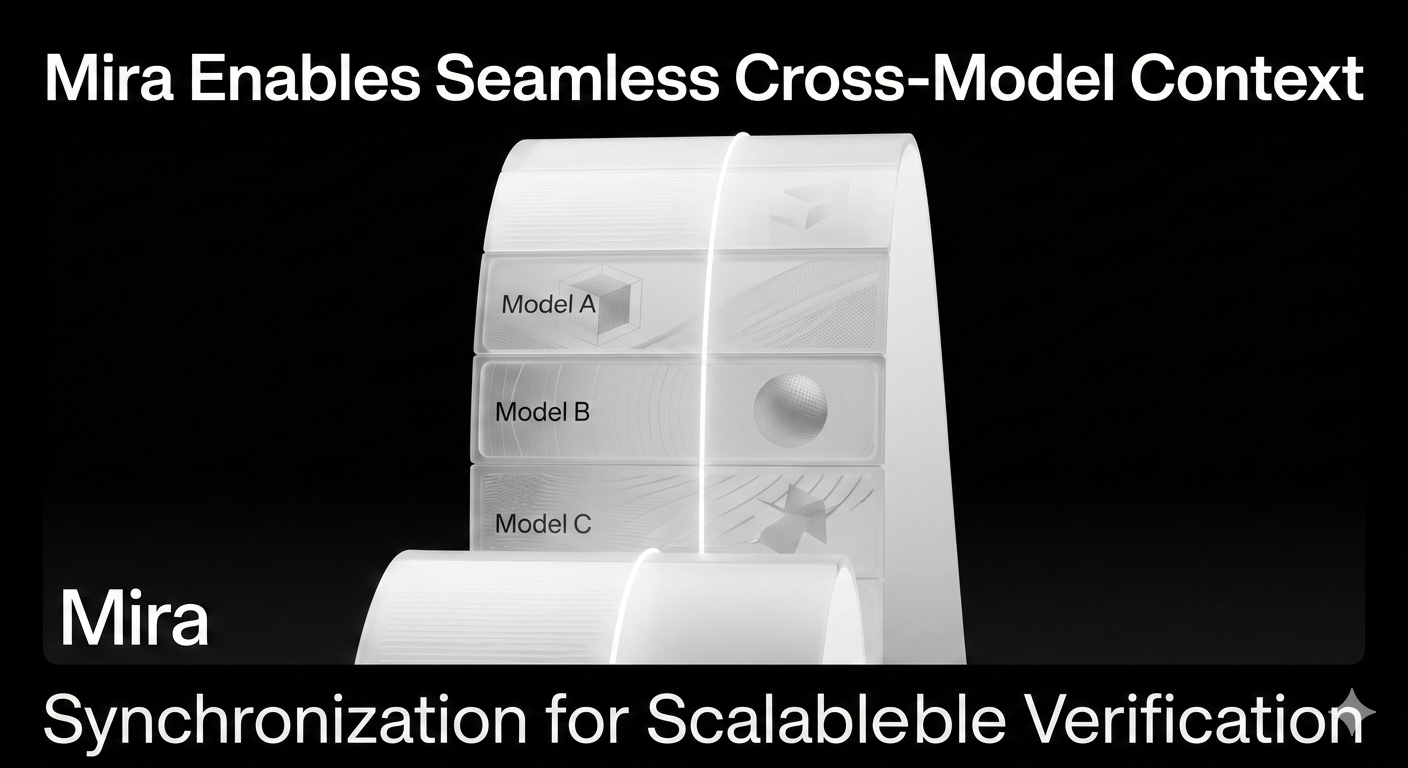
Why Scalable Verification Matters in the Crypto Era
Blockchain technology is built on verification. Every transaction, smart contract execution, or governance vote requires validation. As networks expand, the volume of data increases dramatically.
Think of a small local shop compared to a global online marketplace. The verification process that works for ten customers per day will not handle ten million. Scalability becomes essential.
In crypto ecosystems, verification must be both fast and accurate. Speed without accuracy creates risk. Accuracy without scalability creates delays. The balance is delicate.
Mira supports scalable verification by aligning context across models so they can process large datasets without misinterpretation. When AI systems agree on their foundational knowledge, they validate information more efficiently.
This is especially important for decentralized infrastructures. In distributed environments, multiple nodes or agents must reach consensus. If their contextual understanding differs, disputes increase. With synchronized context, consensus becomes smoother.
The result is an ecosystem that grows confidently. Communities can build applications knowing that verification systems remain stable under heavy demand. And as adoption expands globally, scalable verification transforms from a luxury into a necessity.
How Mira Strengthens Trust Through Identical Context
Trust in digital systems is not built on promises. It is built on repeatable outcomes. If the same input consistently produces the same verified result, confidence grows naturally.
Mira strengthens trust by ensuring identical context across models. When multiple AI agents evaluate data, they are not guessing independently. They operate like synchronized swimmers, moving in coordinated precision.
Consider a classroom where students take the same exam with the same instructions. If each student receives slightly different rules, grading becomes chaotic. But if the rules are identical, evaluation remains fair and transparent.
In blockchain environments, transparency is everything. Verification systems must demonstrate that results are reproducible. By synchronizing context layers, Mira allows independent models to confirm each other’s findings seamlessly.
This structure also enhances auditability. If regulators or developers need to review decisions, they can trace outcomes back to a unified contextual framework. That clarity reduces uncertainty and supports responsible innovation.
For the community, this means fewer unexpected discrepancies. It encourages collaboration because participants know that validation mechanisms operate on shared ground. Trust becomes embedded in infrastructure rather than dependent on centralized oversight.

Practical Applications and Real-World Impact
Let’s explore how this works in practical terms. Imagine a decentralized finance platform processing thousands of transactions per minute. AI systems monitor activity for anomalies, compliance checks, and performance optimization.
If one model flags a transaction as valid while another questions it due to contextual mismatch, delays occur. Developers must manually investigate. Over time, these inconsistencies reduce efficiency.
With Mira’s synchronized context, both models analyze transactions under identical assumptions. Their conclusions align more consistently, allowing automation to function smoothly. This improves operational flow without sacrificing integrity.
Another example involves cross-chain data verification. As ecosystems become interconnected, models must interpret information from multiple sources. Without consistent context, misinterpretations increase.
Mira enables models to share unified contextual frameworks across these interconnected systems. The outcome is smoother interoperability and stronger data validation across networks.
For builders, this means less time troubleshooting mismatched outputs. For users, it means a more seamless experience. And for communities, it strengthens the perception that decentralized systems can operate at global scale without compromising reliability.
Importantly, this approach remains neutral and technology-focused. It does not promise profits or guarantee outcomes. Instead, it enhances structural efficiency, which supports healthier ecosystems overall.
The Future of AI Verification in Web3
As Web3 evolves, AI will play an increasingly central role. From governance analytics to automated compliance monitoring, intelligent systems will assist communities in making informed decisions.
However, intelligence without alignment creates fragmentation. Multiple powerful models operating without shared context can introduce confusion rather than clarity.
Mira’s approach signals a forward-thinking solution. By ensuring seamless cross-model context synchronization, it prepares verification systems for the next wave of growth. The foundation becomes robust enough to support expanding ecosystems.
Think of it like building a skyscraper. The taller the structure, the stronger and more aligned the foundation must be. Context synchronization acts as that structural reinforcement for AI-driven verification.
In a rapidly changing digital landscape, adaptability matters. Systems must scale without losing coherence. Mira’s identical context framework ensures that expansion does not compromise accuracy.
For Binance communities and the broader crypto space, this reflects a larger trend toward responsible infrastructure development. Innovation is exciting, but sustainable growth depends on reliability and transparency.
By aligning AI models at the contextual level, verification becomes not just scalable, but resilient. And resilience is what transforms emerging technology into long-term global infrastructure.
In the evolving world of crypto and AI, synchronized intelligence is not just an upgrade—it is the foundation for building trust at scale and powering the next generation of decentralized growth.
