
Right now one of the hottest trading conversations around Fogo isn’t just performance, latency, or infrastructure.
It’s the airdrop unlock dynamics.
Because in crypto price doesn’t move on technology alone. It moves on supply, expectations, and behavior.

Fogo’s community focused distribution leaning heavily on airdrops instead of a traditional token sale created a powerful narrative of decentralization. But for traders, airdrops introduce something even more important:
Immediate circulating supply.
And supply shock always brings volatility.
Free Tokens, Real Sell Pressure
When users receive tokens through an airdrop, they didn’t deploy capital to buy them. Psychologically, that matters.
Behavioral finance shows that people treat windfall gains differently from purchased assets. Tokens received “for free” are easier to sell.
That often leads to:
Early profit taking
Fast volatility spikes
Weak hands exiting quickly
Aggressive price discovery

For Fogo the early post airdrop phase became less about long term vision and more about one simple question:
Can the market absorb the supply?
Liquidity Absorption Test
Almost Every newly distributed token faces what traders calls it liquidity absorption test.
If early sellers flood the market buyers must step in and capital to stabilize price.
This depends on:
Exchange depth
Market maker support
Community strength
New capital inflows
If price holds despite heavy selling, that signals strength.
If minor selling causes breakdowns, confidence weakens.
This is where perception forms.

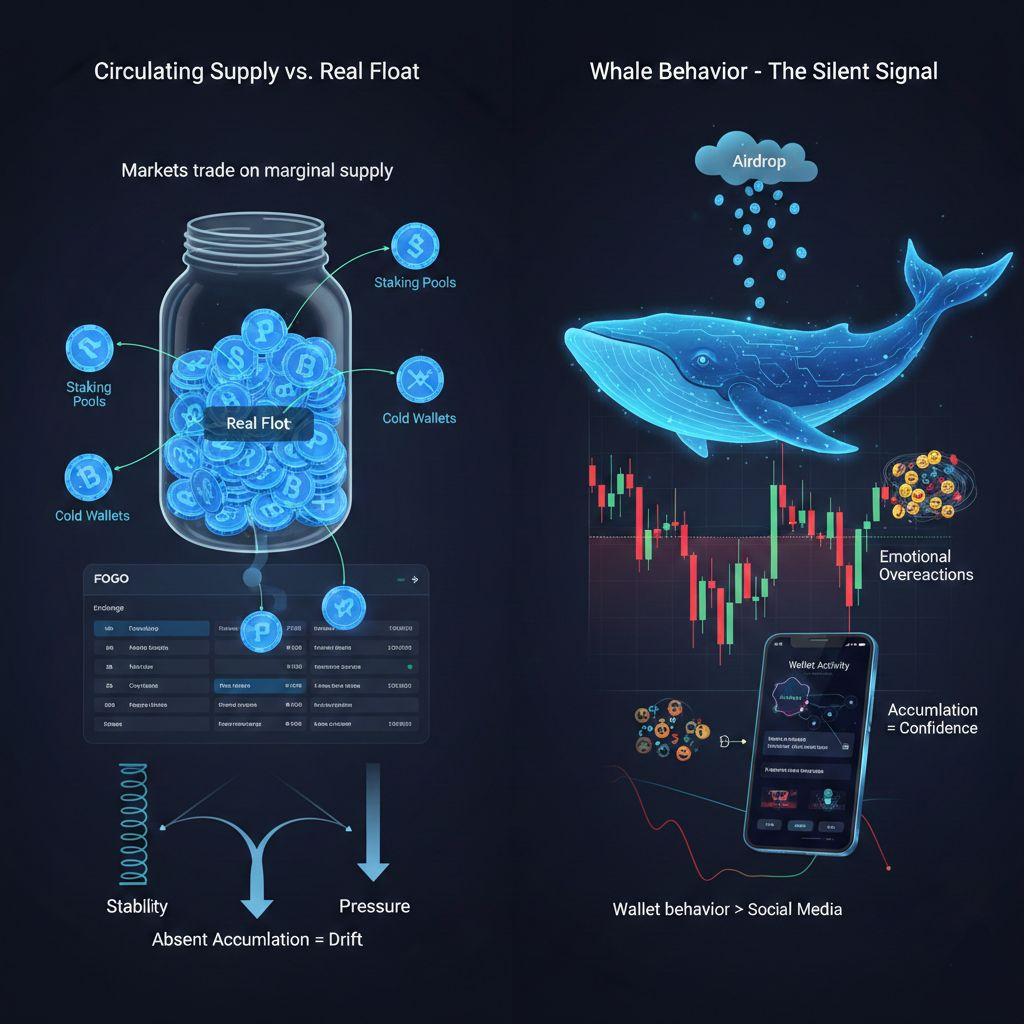
Circulating Supply vs. Real Float
Another layer traders analyze is the difference between official circulating supply and actual tradable float.
Not every unlocked token hits the market immediately. Some holders stake. Some hold long term. Some are inactive.
Markets trade on marginal supply the tokens actively being sold.
If Fogo’s effective float remains tighter than expected volatility may stabilize faster than skeptics predict.
If float expands aggressively pressure persists.
Understanding that distinction separates emotional reactions from strategic positioning.
Whale Behavior The Silent Signal
Airdrops often distribute tokens widely but consolidation begins quickly.
Large players watch for:
Panic selling
Thin liquidity zones
Emotional overreactions
If whales accumulate during weakness it suggests confidence in Fogo’s long term infrastructure thesis.
If accumulation is absent, markets drift lower until value is found.
In early ecosystems, wallet behavior tells you more than social media.
Narrative vs. Structure
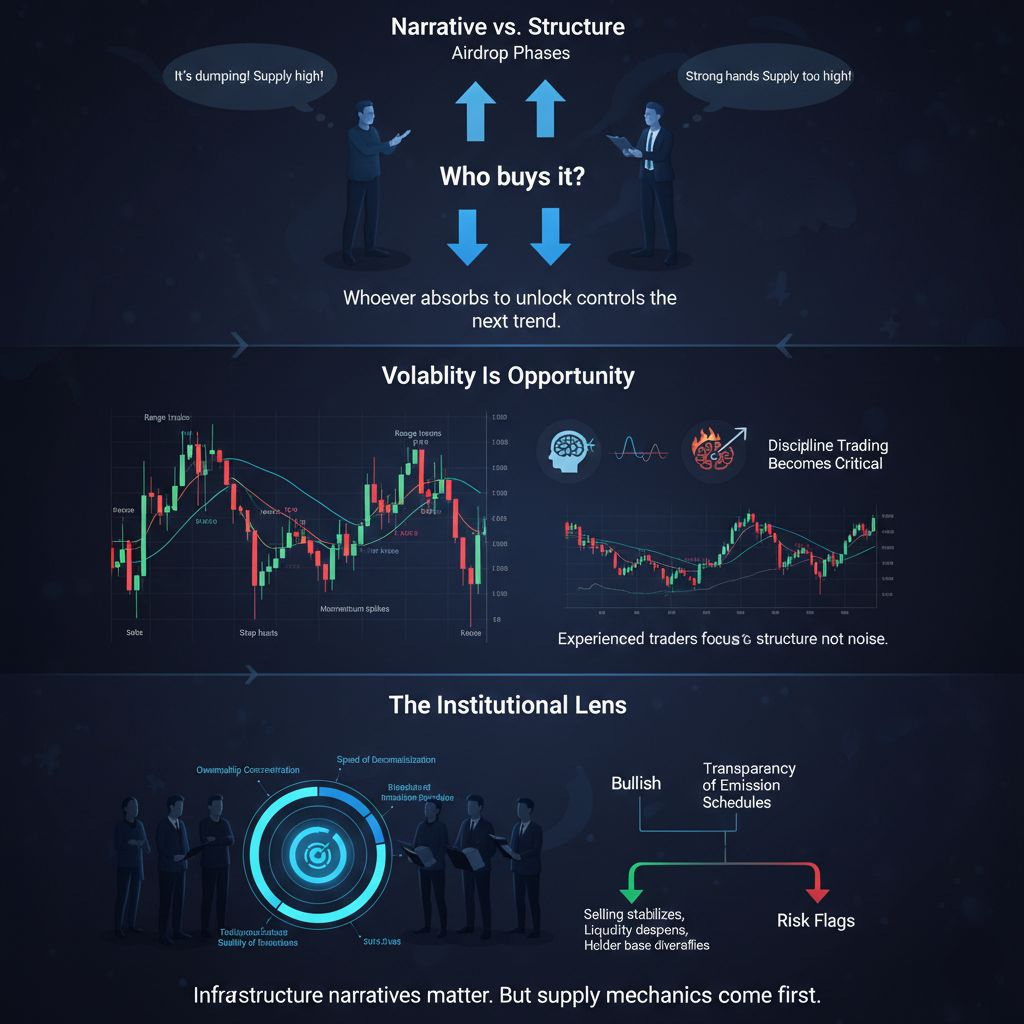
Airdrop phases always split the market into two camps.
Camp One: “It’s dumping supply is too high.”
Camp Two: “Strong hands are accumulating this is distribution.”
Both perspectives can be true at different stages.
The key question isn’t whether selling happens. Selling always happens.
The real question is:
Who buys it?
Because whoever absorbs the unlock controls the next trend.
Volatility Is Opportunity
For traders volatility isn’t a flaw it’s opportunity.
Unlock driven movement creates:
Range trades
Liquidity sweeps
Stop hunts
Momentum spikes
But discipline becomes critical.
During high unlock phases:
Fake breakdowns increase
Emotional trading amplifies
Short term narratives dominate
Experienced traders focus on structure not noise.
The Institutional Lens
As crypto matures token distribution is viewed differently by serious capital.
Institutions look at:
Ownership concentration
Speed of decentralization
Transparency of emission schedules
Stability of float
Airdrop heavy distribution can be bullish if Selling stabilizes quickly and Liquidity deepens organic, Holder base diversifies, But prolonged instability raises risk flags.
Fogo’s early supply dynamics will shape how long term capital perceives it especially as it competes architecturally within the high performance ecosystem pioneered by Solana and indirectly challenges liquidity dominance models shaped by Ethereum.
Infrastructure narratives matter. But supply mechanics come first.
The Bigger Picture
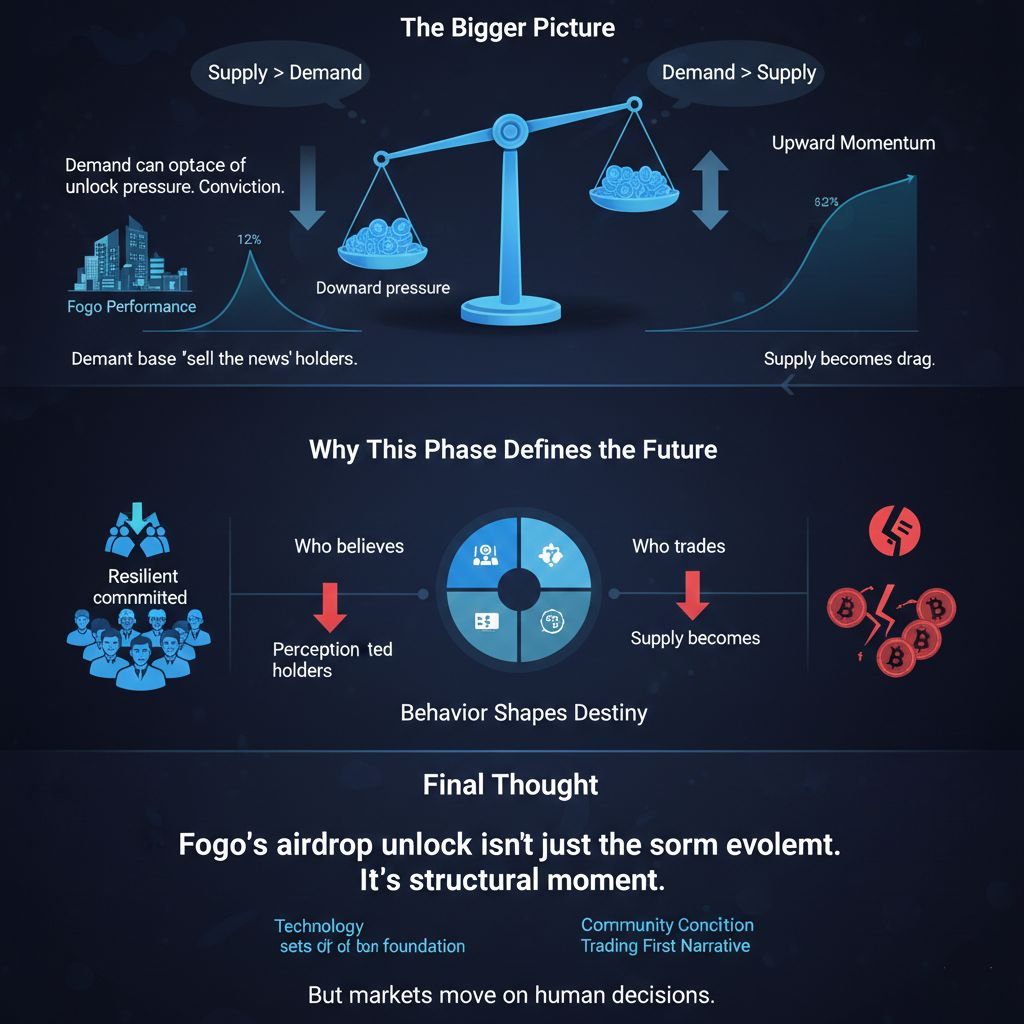
Even the most technically advanced chain cannot escape the basic equation:
Supply > Demand = Downward pressure
Demand > Supply = Upward momentum
Airdrop phases force this equation into the open.
If Fogo’s performance first thesis attracts builders, traders, and liquidity quickly, demand can outpace unlock pressure.
If ecosystem growth lags, supply becomes drag.
This moment is a stress test.
Not just of price but of conviction.
Why This Phase Defines the Future
Early token distribution periods often determine a project’s long term reputation.
They either:
Establish a resilient base of committed holders
Or create the perception of a “sell the news” asset
The airdrop phase reveals:
Who believes
Who trades
Who accumulates
Who exits
And in markets behavior shapes destiny.
Final Thought
Fogo’s airdrop unlock isn’t just a short term volatility event.
It’s a structural moment.
It tests liquidity depth, community conviction and the strength of its trading first narrative.
Technology sets the foundation.
But markets move on human decisions.
Right now Fogo’s price action is less about code and more about psychology.
Distribution is pressure.
Absorption is strength.
And this chapter will determine whether early volatility becomes the base of long term growth or a prolonged supply overhang.
For traders watching closely, this isn’t noise It’s a signal.

