

When I first started digging into Fogo, I expected another “fastest L1” pitch. You know the type—big numbers, confident tone, the usual promise that this time, scalability is solved. But the deeper I went, the less it felt like a typical chain story. Fogo doesn’t read like it’s trying to win a TPS leaderboard. It reads like it’s trying to shrink the emotional distance between a trader’s click and the chain’s response.
That difference sounds subtle, but it changes everything.
There’s a kind of frustration that only active traders understand. You click “cancel,” and the system hesitates. You adjust an order, and a wallet popup interrupts you like a bureaucrat asking for a signature on every minor correction. Even if the delay is just a second, it feels like friction in your bones. Markets move faster than patience.
Fogo seems obsessed with that feeling.
The technical materials describe a design where validators can operate in high-performance data center “zones” to reduce round-trip latency. Instead of pretending geography doesn’t matter, Fogo leans into it. It acknowledges that physics exists. That’s unusual in crypto, where decentralization is often framed as a moral aesthetic rather than an engineering trade-off.
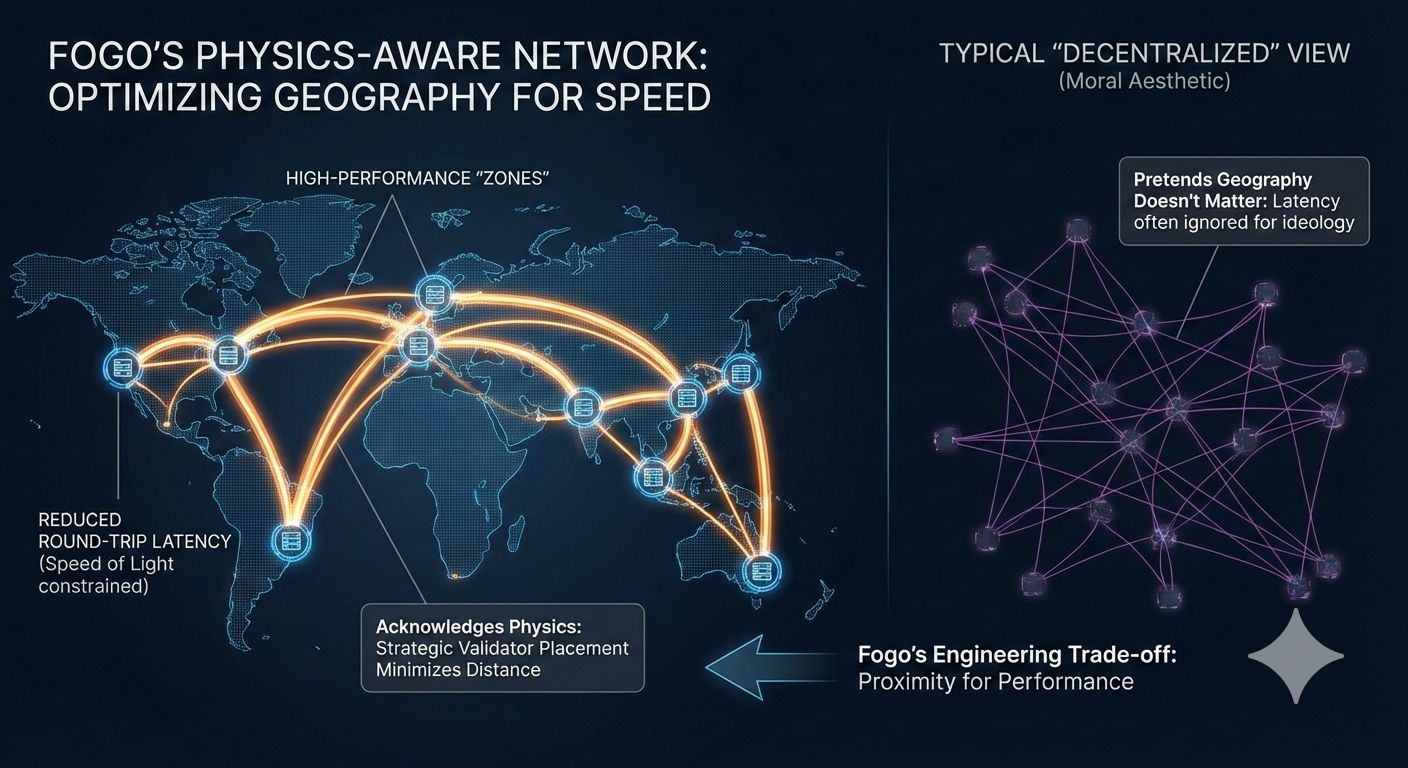
Paired with that is a validator architecture influenced by performance-heavy thinking—pipeline-style execution, minimizing overhead, squeezing more determinism out of hardware. It’s not glamorous language, but it signals intent. This isn’t about looking fast in a controlled demo. It’s about maintaining rhythm when the network is stressed.
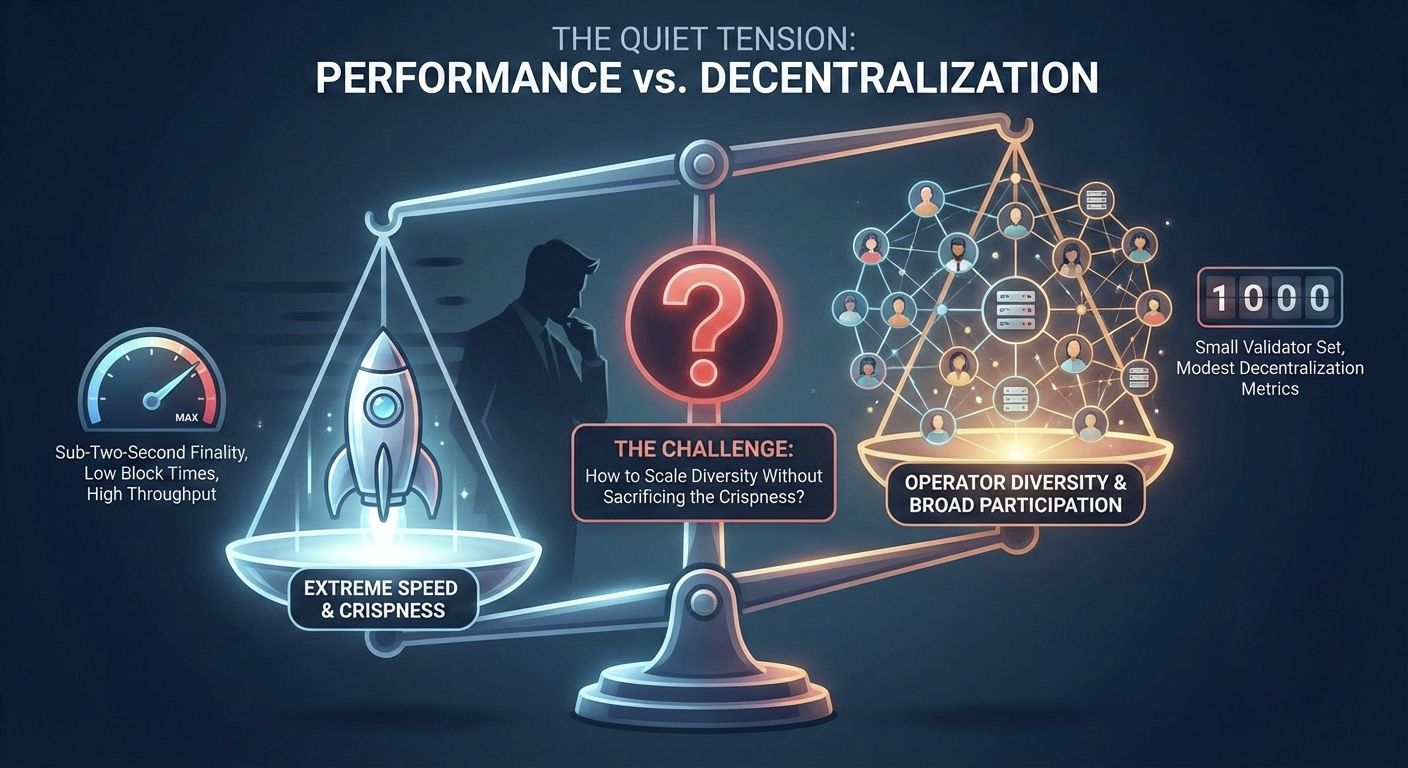
And the early network metrics are at least directionally consistent with that ambition. Independent tracking shows extremely low block times and sub-two-second finality, alongside billions of processed transactions. That doesn’t guarantee longevity, but it does suggest the chain is operating within a latency profile that actually aligns with rapid-fire interaction patterns.
Still, speed always has a shadow. The same snapshot shows a small validator set and modest decentralization metrics. That’s not unusual for a young network, but it’s something I can’t ignore. When you optimize for proximity and performance, you risk tightening the circle of participation. It’s the quiet tension underneath the whole design: how do you scale operator diversity without sacrificing the crispness that makes the system appealing in the first place?
What really made Fogo feel human to me, though, wasn’t the hardware philosophy. It was Fogo Sessions.
If you’ve spent time on-chain, you know the ritual: sign, confirm, approve, repeat. It’s safe, yes. It’s also exhausting. Fogo Sessions introduce a scoped-permission model with paymaster support so users don’t have to sign every single action or worry about gas for each micro-interaction. The idea is simple: give applications the ability to create a temporary, bounded trust envelope so users can move fluidly inside it.
That changes the emotional texture of the experience. Instead of feeling like you’re negotiating with your wallet every few seconds, you’re just… using an app.
There’s another subtle detail in the Sessions documentation that stood out to me: it envisions most user activity happening in SPL tokens, while the native FOGO token operates more behind the scenes, powering paymasters and lower-level mechanics.
That tells me something about the philosophy. Fogo doesn’t seem obsessed with forcing users to revolve around its native asset as the center of gravity. It’s more comfortable being infrastructure. That humility is rare.
On the economics side, the fee structure described in the litepaper differentiates base fees from priority fees, with priority fees going directly to the block producer. It’s a design that lets urgency become an explicit signal. If something matters now, you can pay for now.
But here’s where my analytical side kicks in: inflation parameters appear differently across technical documents—one referencing a higher annual rate and another describing a lower fixed rate. That may reflect revisions over time, but it’s not a trivial detail. Inflation is the security budget. It’s the background music of a token’s long-term value. If you’re serious about participating as a validator or delegator, clarity here matters.
Beyond the core protocol, I look for signs that an ecosystem can breathe. Fogo launched mainnet with interoperability powered by Wormhole, which means liquidity and assets can actually flow in. For a chain aiming at trading use cases, that’s oxygen. Without bridges, speed is just an empty runway.
There was also the Flames points program leading into the token distribution, a familiar mechanism but one that functions as a controlled onboarding ramp. Incentives shape behavior long before governance does.
And with liquid staking emerging through protocols like Brasa, users can stake FOGO while keeping a liquid derivative active in DeFi. That’s important because traders hate idle capital. If staking locks funds into stillness, participation drops. If staking stays composable, security and liquidity don’t have to compete.
When I step back, Fogo feels less like a “chain competing with chains” and more like a response to a very specific frustration: the gap between centralized exchange smoothness and on-chain transparency. It’s trying to close that gap without pretending the trade-offs don’t exist.
Will it succeed? That depends on whether it can widen participation without dulling its edge, clarify its economic parameters without confusing operators, and decentralize its auxiliary services—like paymasters—before they quietly become chokepoints.
But I’ll say this: for the first time in a while, I’ve looked at a new L1 and thought not “how fast is it?” but “how does it feel to use?”
That’s a different question. And sometimes, it’s the one that matters most.
