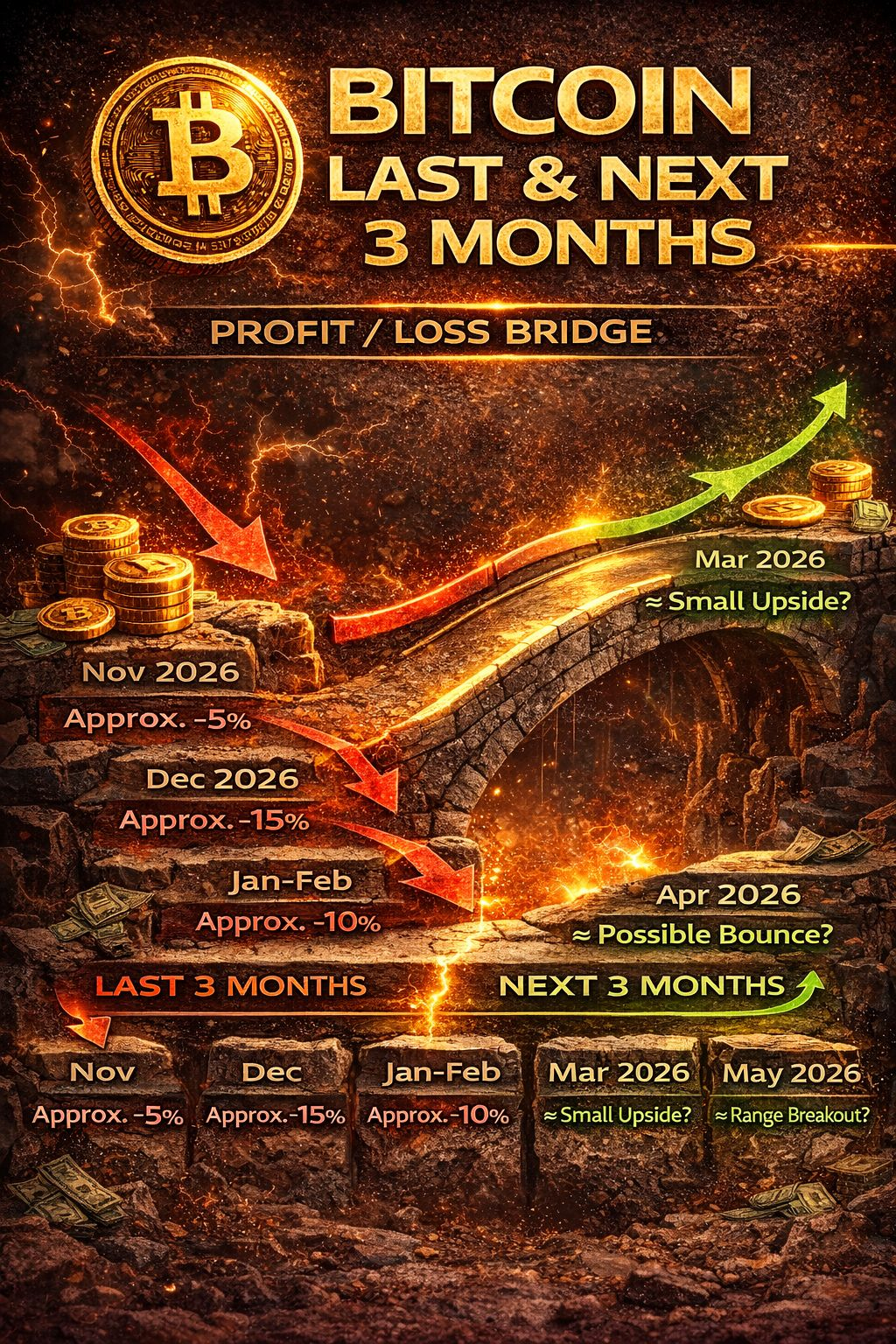
📉 Bitcoin Last 3 Months (Nov 2025 → Feb 2026)
According to price data, BTC has declined about –35% in the last 3 months, reflecting bearish market pressure.
Monthly Snapshot (approx):
📌 Nov 2025: Market started strong near higher prices → small loss as trend weakened
📌 Dec 2025: Continued downtrend and volatility hit BTC
📌 Jan–Feb 2026: Sideways to slightly lower range with lower liquidity & mixed sentiment
Key Reason: Macro volatility, profit-taking, and weaker retail demand pushed BTC lower recently.
📈 Next 3 Months Outlook (Mar → May 2026)
Analyst forecasts vary widely:
Bullish signals:
• Some institutional analysts see BTC entering a “slow bull” phase with steady gains if ETF inflows continue.
• Technical models show BTC could reclaim higher levels with strong buying pressure.
Bearish signals:
• Others warn BTC may test lower ranges near macro pressure (~$50k–$60k).
Expected range: BTC may trade between $60,000–$90,000+ over the next 3 months, depending on sentiment and macro catalysts.
🧠 BTC Strategy: Next 3 Months
Monitor key support zones: especially around $60k–$65k — ideal accumulation areas.
Use DCA instead of one-time buys to reduce risk in volatile dips.
Take partial profits near strong resistance levels.
Follow Bitcoin trend: if BTC breaks above resistance with volume, increase allocation.
Protect capital: use stop-loss or mental exits below strong support.
Watch macro news: rate decisions, ETF flows, inflation data impact BTC price.
Rebalance monthly: lock gains or reduce exposure after strong up moves.
Avoid leverage — volatility remains high.
Focus on strong coins: BTC and ETH first before altcoins.
Be patient: BTC structure changes slowly — avoid emotional trades.
📊 Profit/Loss Expectations Bridge (Illustrative)
Month Potential Outcome Notes
Mar 2026 👉 Small upside or sideways BTC consolidates after recent drop
Apr 2026 👉 Possible bounce If macro improves & ETF inflows rise
May 2026 👉 Range breakout possible Either bullish continuation or deeper correction
🧠 Key Takeaway
Even though BTC recently experienced a downtrend, the market now sits at a critical decision zone — gains can resume if institutional demand and macro catalysts align, but volatility remains high in the short term.