

Vanar through the louder story lines, the ones that naturally catch attention because they sit close to gaming, entertainment, and metaverse style experiences, yet when I look at what can actually scale into daily life without asking users to become crypto natives, the eco and brand solutions angle feels like the real quiet engine because it plugs into budgets and behaviors that already exist at massive scale and it does so in a way that feels familiar to regular people while still settling the truth onchain.
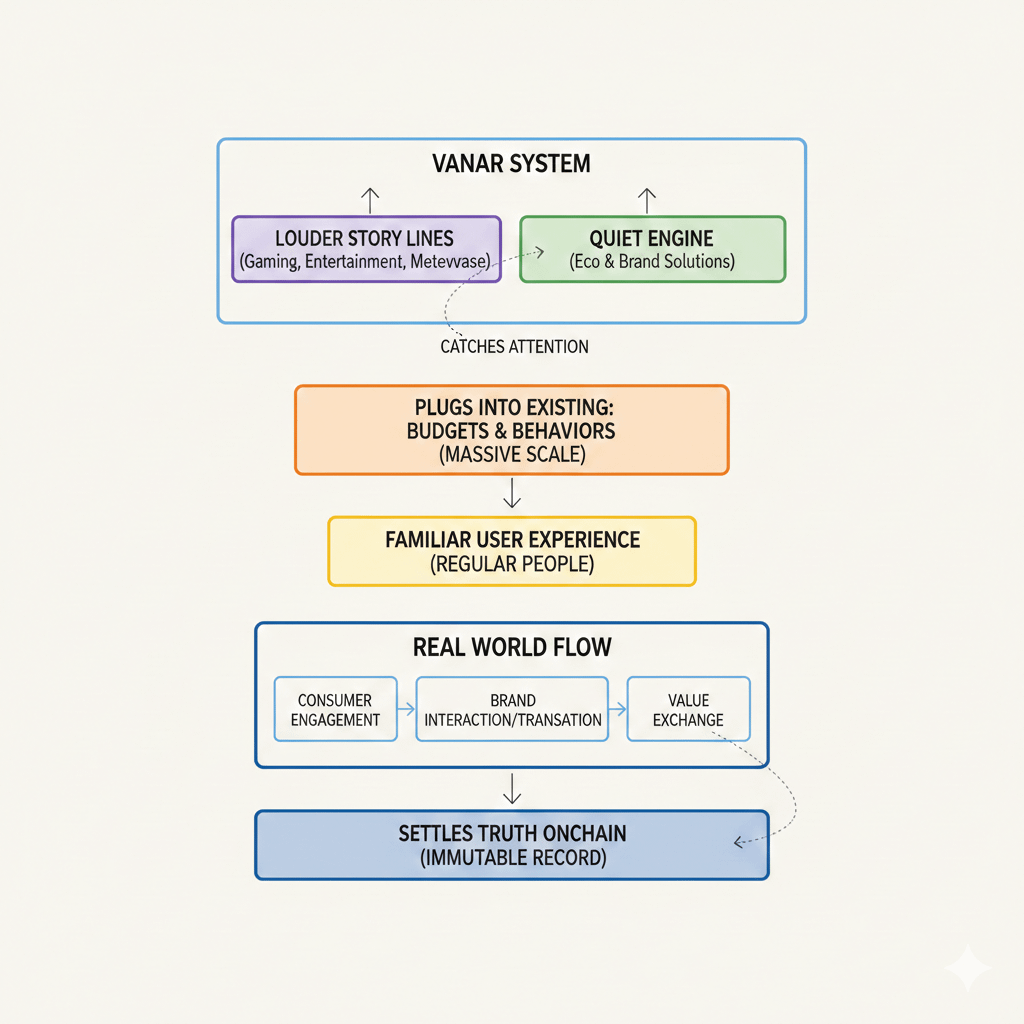
Brands already run loyalty systems, engagement programs, referral loops, community quests, seasonal drops, event activations, and cause campaigns, and they spend serious money doing it, but the part that breaks trust is not the creativity or the marketing reach because it is the accountability layer where users cannot truly prove what they did, rewards can feel selective or delayed, and reporting is trapped inside closed dashboards that ask everyone to accept the final numbers as truth, so the moment an L1 is designed to make consumer experiences normal rather than technical, it can become the rail for campaigns that produce verifiable receipts, transparent reward logic, and portable participation history that follows the user instead of staying locked inside one platform.
The simplest way to explain this is to focus on a single object that changes everything, which is the digital receipt of impact, because in the old model your participation is remembered only by the company running the campaign, but in the onchain model your action becomes a record that can be checked later, carried across experiences, and used to unlock future access without starting from zero, and that matters for eco focused campaigns even more than it matters for normal loyalty because sustainability claims collapse when proof is weak, while a system that can record participation and verification in a consistent way can turn a cause campaign from a branding story into something measurable that holds up when people ask what actually happened.
Once you treat participation as something that can be proven, reward distribution stops being a trust problem and becomes a rules problem, which is a healthier place to be because rules can be made clear, tested, and improved, while vague manual distribution always creates suspicion, and in practical terms this means campaigns can define who qualifies, what counts as completion, what the reward is, and when it is paid out, so the user is not left guessing and the brand is not left firefighting complaints, and because campaign behavior is not one big action but thousands of small actions across many days, the network has to support frequent low friction interactions so that rewarding people for small repeated behaviors feels natural instead of expensive or delayed.
This is where the eco and brand solutions path becomes more powerful than it looks on the surface, because it does not demand that users understand wallets, swaps, bridges, or any of the culture around DeFi, and instead it starts with what people already do, which is attending events, scanning codes, joining communities, completing checklists, sharing proof of participation, collecting points, and redeeming rewards, and when those actions quietly create onchain records, users develop a habit without even labeling it as blockchain usage, while brands get a cleaner measurement layer that does not rely on a closed platform being honest or competent.
The most underrated upgrade in this model is portable loyalty, because most loyalty points today are trapped inside one program and one database, so even when a person does everything right their history does not travel with them, yet when participation becomes a set of verifiable receipts that can be recognized across multiple experiences, a user can move from one activation to the next without losing progress, and that turns campaigns from one off stunts into a progression system, which is exactly how mainstream consumer products keep attention over time, because people return when the system remembers them and when the next experience builds on the last one.
In Vanar’s world, that portability is not just a nice idea, it is the connective tissue between eco campaigns, brand activations, and the broader consumer experiences the chain is built around, because a sustainability challenge can be the first step that earns a proof badge, a brand activation can be the second step that converts that badge into a reward, and an entertainment or gaming experience can be the third step that turns the reward into something people actually use and talk about, so the user never has to jump from a financial product into a technical interface, and instead they simply move through experiences that feel like modern marketing and modern community building, except with better accountability under the surface.
When I think about how campaigns usually fail, it is almost always because they are treated like content rather than like systems, which means they depend on hype, influencers, and timing instead of structure and repeatability, but quests and missions change that because they introduce progression, clear actions, and predictable rewards, and once you add verifiable receipts and automated distribution, the quest stops being a gimmick and becomes infrastructure, which is exactly what brands want even when they do not say it out loud, because infrastructure is what lets them repeat the campaign next month with improvements rather than reinventing everything and hoping for a different outcome.
The eco focus makes this loop even stronger because it gives campaigns an identity that people can support without feeling sold to, and it gives brands a reputational reason to measure impact carefully, so the chain becomes the place where participation is recorded, verification is attached, rewards are distributed fairly, and results are visible in a way that reduces doubt, which in turn makes it easier for partners to collaborate because everyone can agree on what counted as success instead of arguing over screenshots and spreadsheets.
The reason I call this a quiet adoption engine is that it produces consistent network usage without needing the market to be excited, because brand and eco campaigns are not one time events in the way token narratives are, and they naturally run on schedules, seasons, and recurring community rhythms, which means the network sees steady behavior like check ins, completions, attestations, reward claims, and tier unlocks, and that kind of activity compounds over time because once a campaign format works it can be reused, and once users have a participation history they are more likely to return because their past effort carries forward.
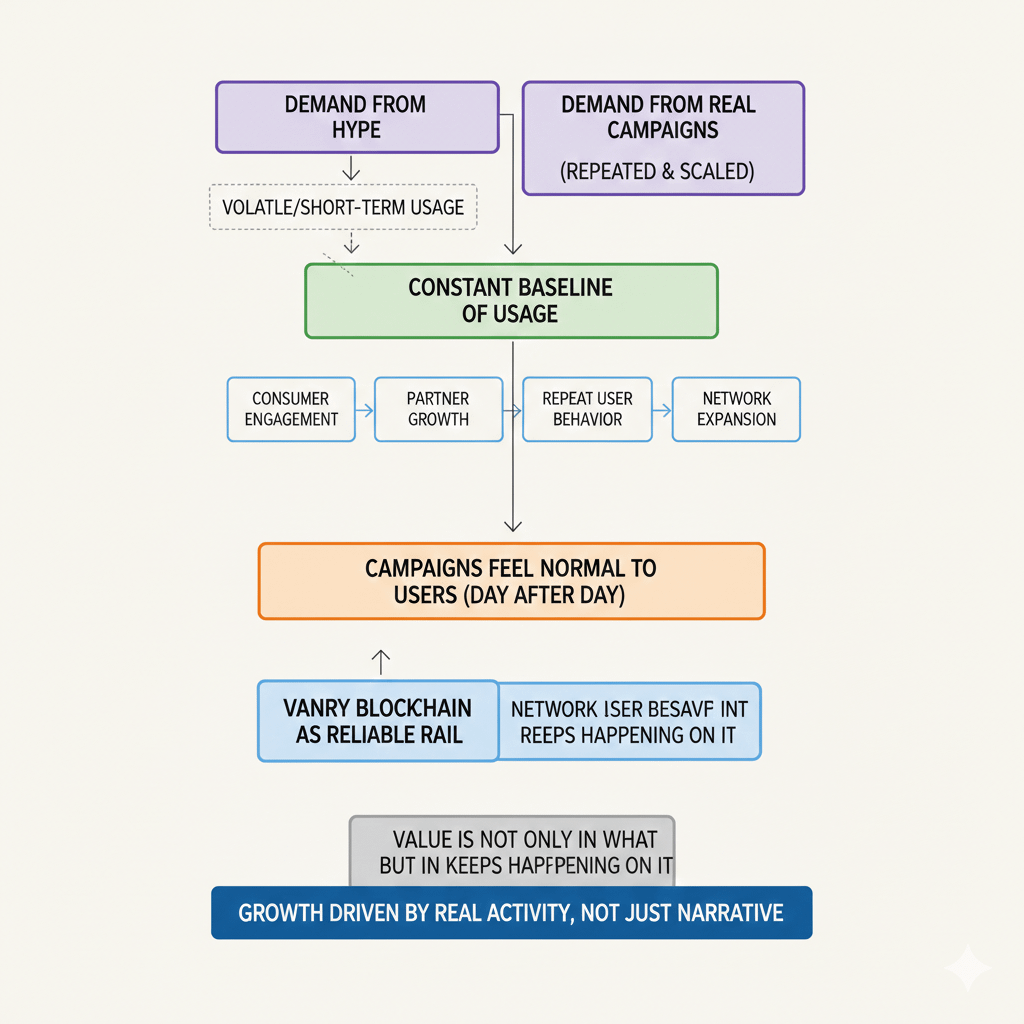
This is where the link to VANRY becomes clear in a grounded way, because demand that comes from repeated real campaigns looks different from demand that comes from hype, and if brands and eco programs run at scale they create a constant baseline of usage, partner growth, and repeat user behavior that does not need a new narrative every week, and when a chain becomes the reliable rail for these consumer loops, the value is not only in what people say about it, but in what keeps happening on it day after day through campaigns that feel normal to users while quietly expanding the network’s real footprint.
Vanar executes this direction with discipline, the eco and brand solutions layer becomes the part that normalizes onchain activity through everyday consumer behavior, because it turns participation into proof, rewards into transparent rules, loyalty into something portable, and campaigns into systems that can be measured and repeated, and that is the kind of adoption that grows from real communities doing real actions again and again rather than from short bursts of excitement.
