

I understood that Midnight devnet is not only a blockchain testing environment.
I’ve been following how Midnight Network is slowly taking shape and what keeps pulling my attention back to it is not hype or marketing noise It is the problem the project is trying to explore. After watching the crypto industry for years one pattern becomes very clear Many projects promise speed scalability or new ecosystems, but very few spend time confronting one of the quiet contradictions inside blockchain itself The technology was built around transparency yet the world that might eventually use it does not always operate comfortably under total visibility.
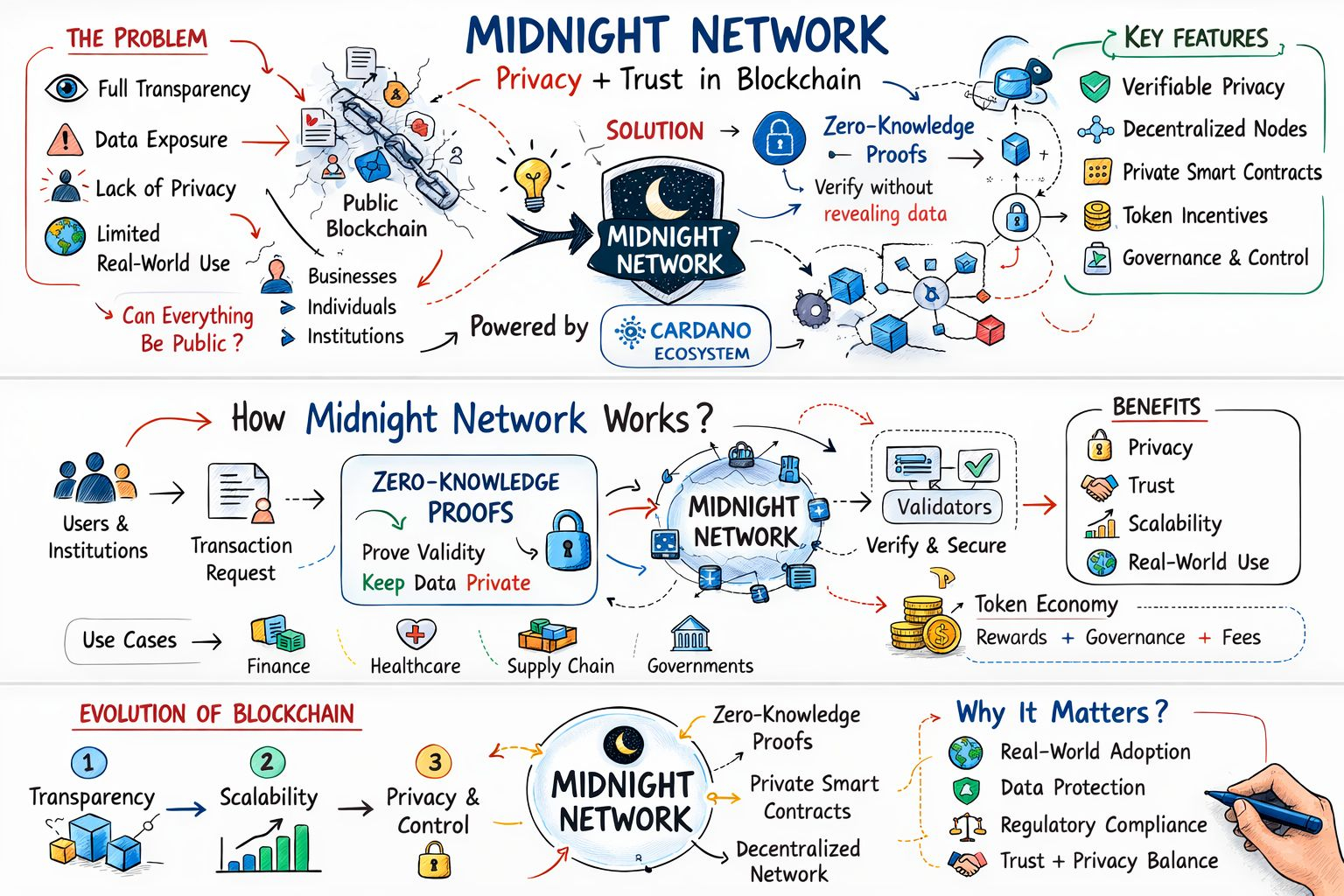
Blockchains originally gained trust because everything was visible. Anyone could inspect transactions check balances, and confirm that the rules of the system were being followed. This openness helped create confidence in a decentralized network where no single authority controlled the ledger. If every movement could be audited publicly, manipulation became much harder to hide. In the early days of cryptocurrency, that transparency felt almost revolutionary.
But over time another reality started to appear. The same transparency that strengthens trust can also create a strange level of exposure. Businesses rarely want competitors to see their financial behavior in real time. Individuals generally expect their financial activity to remain private. Even institutions that value accountability still operate with layers of confidentiality. The real economy works through selective disclosure, not complete exposure.
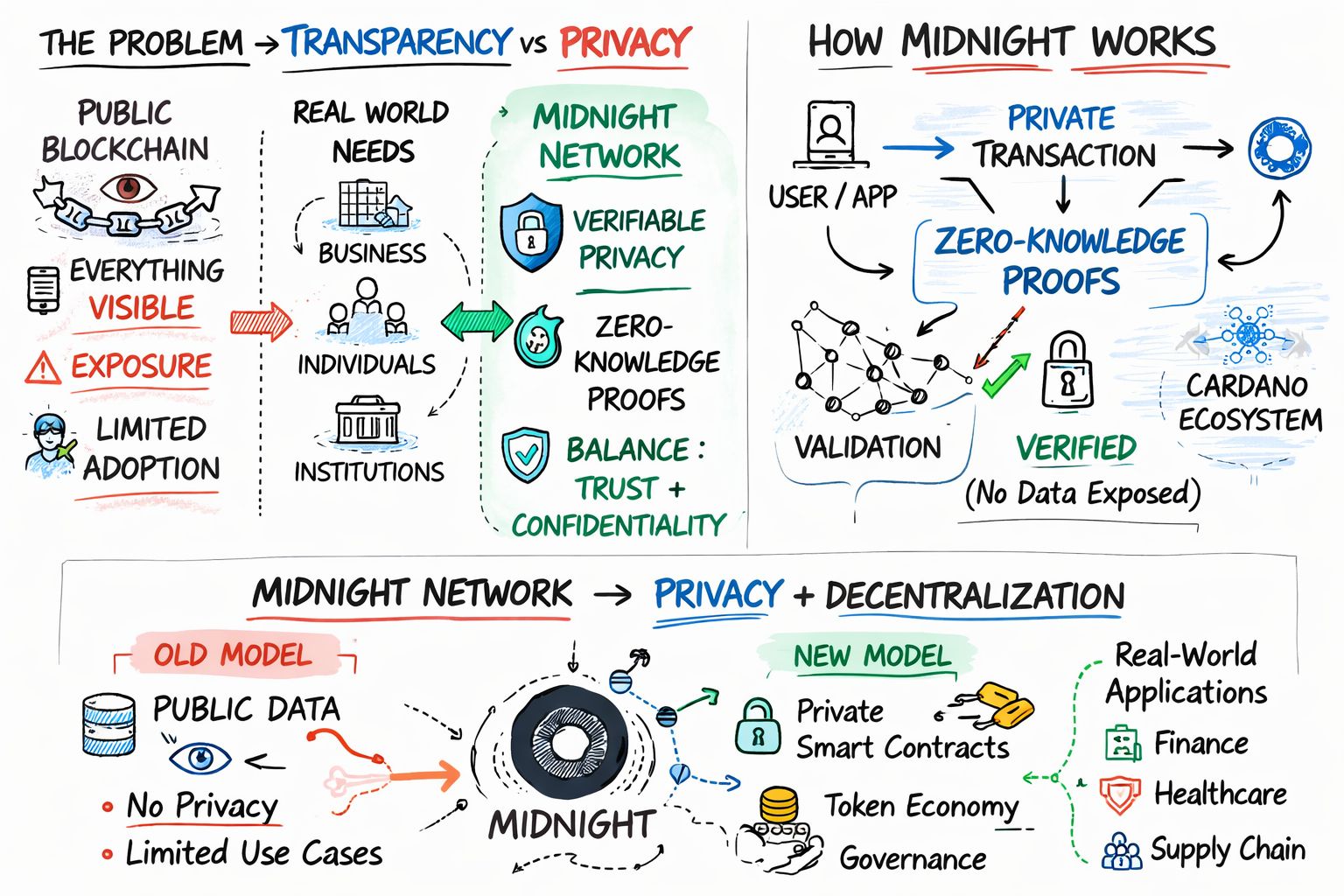
This is where Midnight Network becomes interesting to study. The project does not try to reject blockchain transparency entirely. Instead, it seems to question whether transparency and privacy must always be opposites. The idea is not to hide everything, but to create a system where information can be verified without necessarily revealing the details behind it.
The technology behind this approach relies on a concept called zero-knowledge proofs. In simple terms, it allows one party to prove that something is true without revealing the underlying data that makes it true. For blockchain systems, this opens an unusual possibility. A transaction can follow all the rules of the network and still keep sensitive information private. The system verifies the result without exposing the inputs.
While the mathematics behind zero-knowledge cryptography can be complex, the basic idea is surprisingly intuitive. Imagine proving that you have enough funds for a transaction without showing your full account balance. Or confirming that a business transaction followed regulatory rules without revealing every piece of internal financial data. The network can still verify the integrity of the action, but the sensitive information stays protected.
Midnight is being developed within the broader Cardano ecosystem, which gives it an interesting position. Instead of trying to replace existing public blockchains, the network appears designed to complement them. Public chains continue to provide transparency and security, while Midnight introduces an environment where private interactions and confidential computations can occur when necessary. In theory, this layered structure could allow both open and private systems to coexist within a single technological framework.
This idea becomes more relevant when thinking about how blockchain technology might interact with real industries. Financial institutions, healthcare systems, supply chain networks, and government agencies all deal with sensitive data. These sectors often require strong verification, but they cannot operate in a system where every detail becomes publicly visible forever. A blockchain that cannot handle confidential information will struggle to integrate with these environments.
Midnight’s design attempts to respond to that limitation. The network still relies on validators and nodes to maintain the integrity of the system, but the data they verify can remain shielded. The blockchain confirms that the rules were followed, yet the underlying information does not need to appear on a fully public ledger. In effect, the network tries to preserve decentralization while introducing controlled privacy.
Of course, technology alone is not enough to sustain a blockchain system. Every decentralized network also depends on an economic layer that keeps participants involved. This is where the project’s token becomes important. The token helps power transactions, incentivizes validators, and supports the overall functioning of the network.
Whenever users interact with the system, computational resources are required to verify those actions. The token acts as the mechanism that rewards the nodes performing this work. At the same time, it creates a circulating economic structure within the ecosystem, allowing developers and participants to build applications that rely on the network’s infrastructure.
The token may also play a role in governance, giving stakeholders a way to influence how the network evolves over time. Governance structures are particularly important in privacy-focused systems because the balance between confidentiality and transparency often requires careful adjustment as regulations and technological standards change.
Looking at Midnight from a wider perspective, the project feels like part of a broader shift happening inside blockchain development. The first generation of networks proved that decentralized ledgers could function without central control. Later projects focused on improving scalability and expanding smart contract capabilities. Now the conversation is slowly moving toward how these systems interact with real-world economic and legal environments.
Privacy is becoming a central part of that conversation. Not because the industry suddenly discovered the value of secrecy, but because real-world systems depend on controlled information flow. Transparency is useful when verifying public data, but it becomes problematic when every action is permanently visible to anyone with internet access.
That is why Midnight feels less like a radical reinvention and more like a careful adjustment to an existing model. It acknowledges the strengths of transparent blockchains while exploring how cryptographic tools might allow a more balanced structure. Whether that balance can be achieved at scale remains an open question.
Privacy technologies often face difficult trade-offs. Systems that protect data must still ensure that they cannot be abused for harmful purposes. Regulators and institutions frequently worry that confidential transactions could hide illegal activity. Developers therefore face the challenge of designing systems that protect legitimate privacy without undermining accountability.
Midnight appears to be navigating this tension by focusing on verifiable privacy rather than absolute secrecy. The system still produces cryptographic proof that the rules are followed. What changes is the amount of information that becomes publicly visible during the process. In theory, this could allow organizations to participate in blockchain networks without exposing their internal operations.
Whether the model will succeed is something only time can answer. Blockchain history is filled with ambitious technical experiments, and many of them encountered unexpected obstacles once they reached real-world scale. Privacy-focused infrastructure introduces additional complexity, both technically and politically.
Still, Midnight Network represents a thoughtful attempt to confront a question that the industry has quietly carried for years. How can decentralized systems maintain trust without forcing every participant to reveal everything they do?
For someone who has spent years observing the evolution of blockchain technology, that question alone makes the project worth watching. Not because it promises a perfect solution, but because it reflects a more mature stage of thinking within the ecosystem. The industry is no longer only asking how to build decentralized networks. It is starting to ask how those networks can coexist with the practical realities of the world they hope to serve.
