
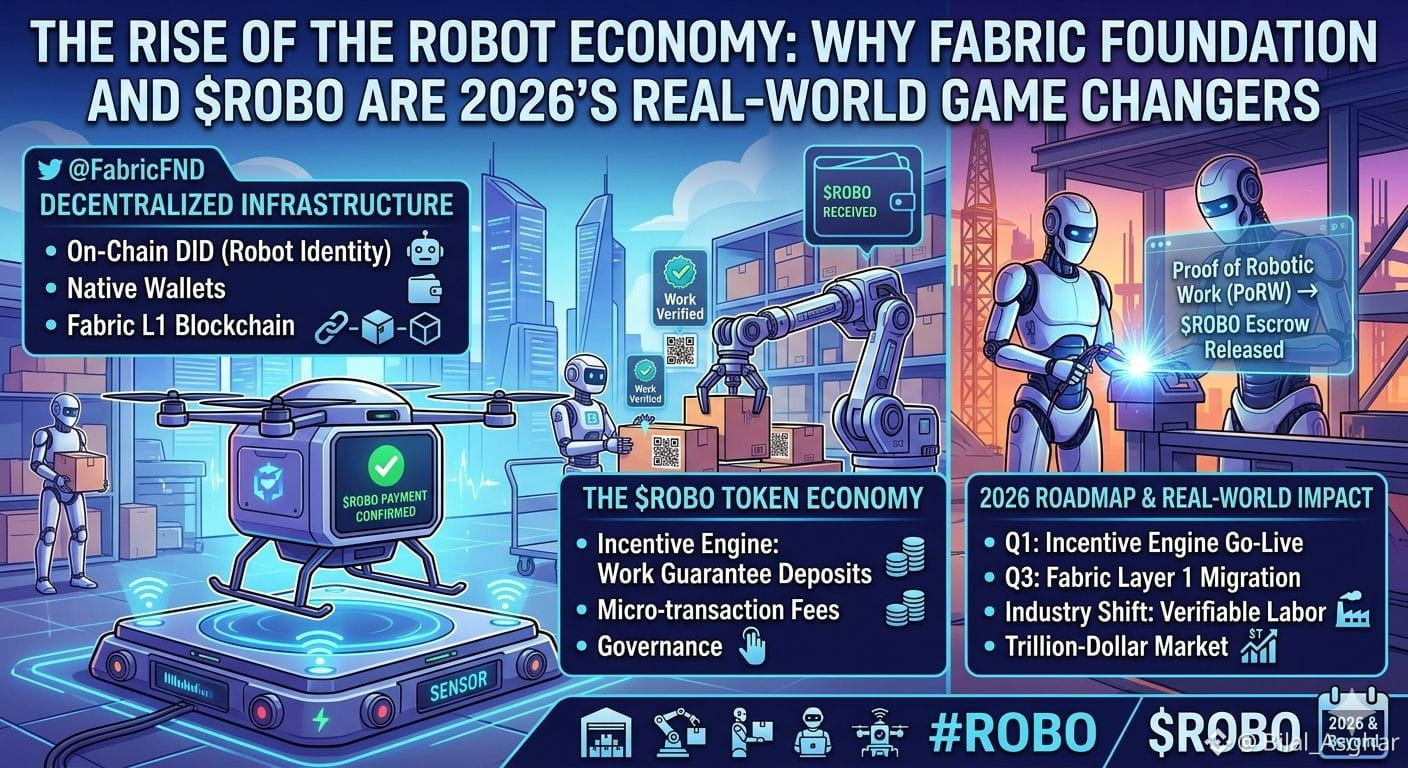
The intersection of AI and blockchain has long been a hotbed for speculation, but as we move through 2026, the focus has shifted from "digital brains" to "physical labor." While many projects focus solely on LLMs, @FabricFND (Fabric Foundation) is tackling the much harder problem: creating the economic and identity layer for the multi-trillion-dollar robotics industry.
The Problem: Robots Are "Economic Ghosts"
Currently, robots in factories, warehouses, and logistics centers are siloed tools. They cannot own a bank account, sign a service-level agreement, or pay for their own electricity. This lack of economic agency limits the scalability of autonomous systems.
The Solution: Fabric’s Decentralized Infrastructure
The Fabric Foundation is bridging this gap by providing:
On-Chain Identity (DID): Every robot gets a unique, verifiable identity.
Native Wallets: Machines can hold and transact $ROBO to pay for parts, charging, or data.
Proof of Robotic Work (PoRW): A consensus mechanism that verifies tasks were actually completed in the physical world before releasing payment.
Why $ROBO is the Engine of This Transition
The $ROBO token isn't just a governance asset; it is the lifeblood of this new machine economy. As of Q1 2026, we are seeing the "Incentive Engine" phase go live. Operators are now required to stake $ROBO as a work guarantee deposit, ensuring that if a robot fails its task or provides poor data, the stake is slashed. This creates a high-integrity marketplace for autonomous labor.
Looking ahead to Q3 2026, the migration to a dedicated Fabric Layer 1 (L1) is the catalyst many are watching. Robots require near-instant settlement and micro-transaction fees that general-purpose chains can't always guarantee. By moving to a sovereign L1, ND is optimizing for the "machine-speed" demands of warehouse handling and patrol security.
The Bottom Line:
As we see o utility shift from simple staking to mandatory collateral for industrial-scale robotics, the fundamental value proposition becomes undeniable. The "Robot Economy" is no longer a concept—it’s an infrastructure play.