The blockchain industry has long wrestled with a fundamental dilemma: public ledgers offer unparalleled transparency and security, but their inherent openness exposes sensitive user, commercial, and enterprise data. This forced transparency has been a massive roadblock for institutional adoption and real-world Web3 integration. Enter Midnight Network (@MidnightNetwork MidnightNetwork)—a cutting-edge, fourth-generation blockchain built to solve this exact problem through what it calls "rational privacy."
Incubated by Input Output Global (IOG, the engineering powerhouse behind Cardano) and spearheaded by Charles Hoskinson, Midnight utilizes advanced Zero-Knowledge (ZK) proof technology. This allows developers to build decentralized applications (dApps) that offer verifiable compliance without sacrificing data confidentiality. Whether it's protecting healthcare records, securing financial workflows, or preserving digital identity, Midnight ensures users and enterprises only reveal what they explicitly choose to reveal.
The Ingenious Dual-Token System: $NIGHT and DUST
What truly sets Midnight apart from legacy privacy networks is its innovative, composite tokenomics designed to separate economic value from operational costs.
1. The NIGHT (Value & Governance):
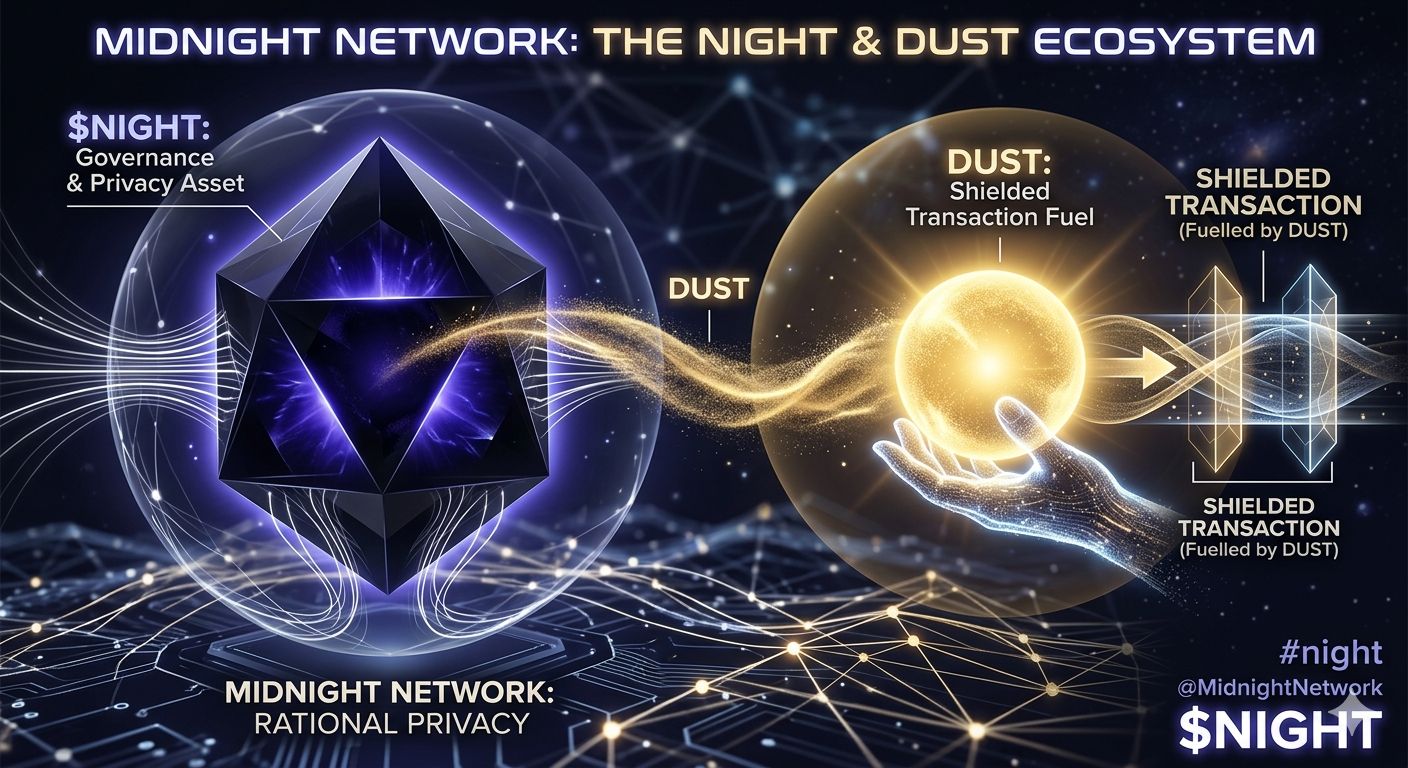
$NIGHT is the primary utility, staking, and governance token of the ecosystem. Holding night grants users voting rights to shape the network's future and acts as a digital yielding asset that continuously generates the network’s secondary operational resource.
2. DUST (The Privacy Fuel):
Unlike traditional gas fees that fluctuate wildly with market volatility, DUST is a shielded, non-transferable, and decaying resource used exclusively to pay for metadata-shielded transactions and zero-knowledge computations. By simply holding $NIGHT, users automatically generate DUST. This guarantees predictable, stable operational costs for enterprises and developers, completely decoupled from the market speculation of the $NIGHT token.
Why Midnight is a Category-Defining L1
istorically, privacy coins have faced heavy regulatory scrutiny because they obscure everything by default, making them incompatible with global financial systems. Midnight, however, focuses on programmable privacy.
Developers can code smart contracts in Compact (Midnight’s accessible, TypeScript-based language) that selectively disclose necessary information. For example, a user can cryptographically prove they have sufficient funds for a transaction, or meet an age requirement, without ever exposing their actual wallet balance, transaction history, or birthdate to the public ledger.
Following its massive multi-chain "Glacier Drop" distribution—which rewarded users across major ecosystems like Cardano and Bitcoin—the broader crypto market is finally waking up to the necessity of rational privacy. With major institutional players reportedly exploring its federated node structure and a clear architectural focus on regulatory compliance, Midnight isn’t just another Layer 1. It is the missing infrastructure needed to bring global finance safely and legally on-chain.
Developers can code smart contracts in Compact (Midnight’s accessible, TypeScript-based language) that selectively disclose necessary information. For example, a user can cryptographically prove they have sufficient funds for a transaction, or meet an age requirement, without ever exposing their actual wallet balance, transaction history, or birthdate to the public ledger.
Following its massive multi-chain "Glacier Drop" distribution—which rewarded users across major ecosystems like Cardano and Bitcoin—the broader crypto market is finally waking up to the necessity of rational privacy. With major institutional players reportedly exploring its federated node structure and a clear architectural focus on regulatory compliance, Midnight isn’t just another Layer 1. It is the missing infrastructure needed to bring global finance safely and legally on-chain.