
@MidnightNetwork $NIGHT #night
The conversation around blockchain is changing. For a long time the industry focused on speed, scalability, and transaction costs. Those things matter, but another issue has quietly become just as important: data ownership. If decentralized systems are meant to give users control, then protecting personal data and digital identity should be a core part of the design, not an afterthought.
That’s exactly why the new campaign from Midnight Foundation caught my attention.
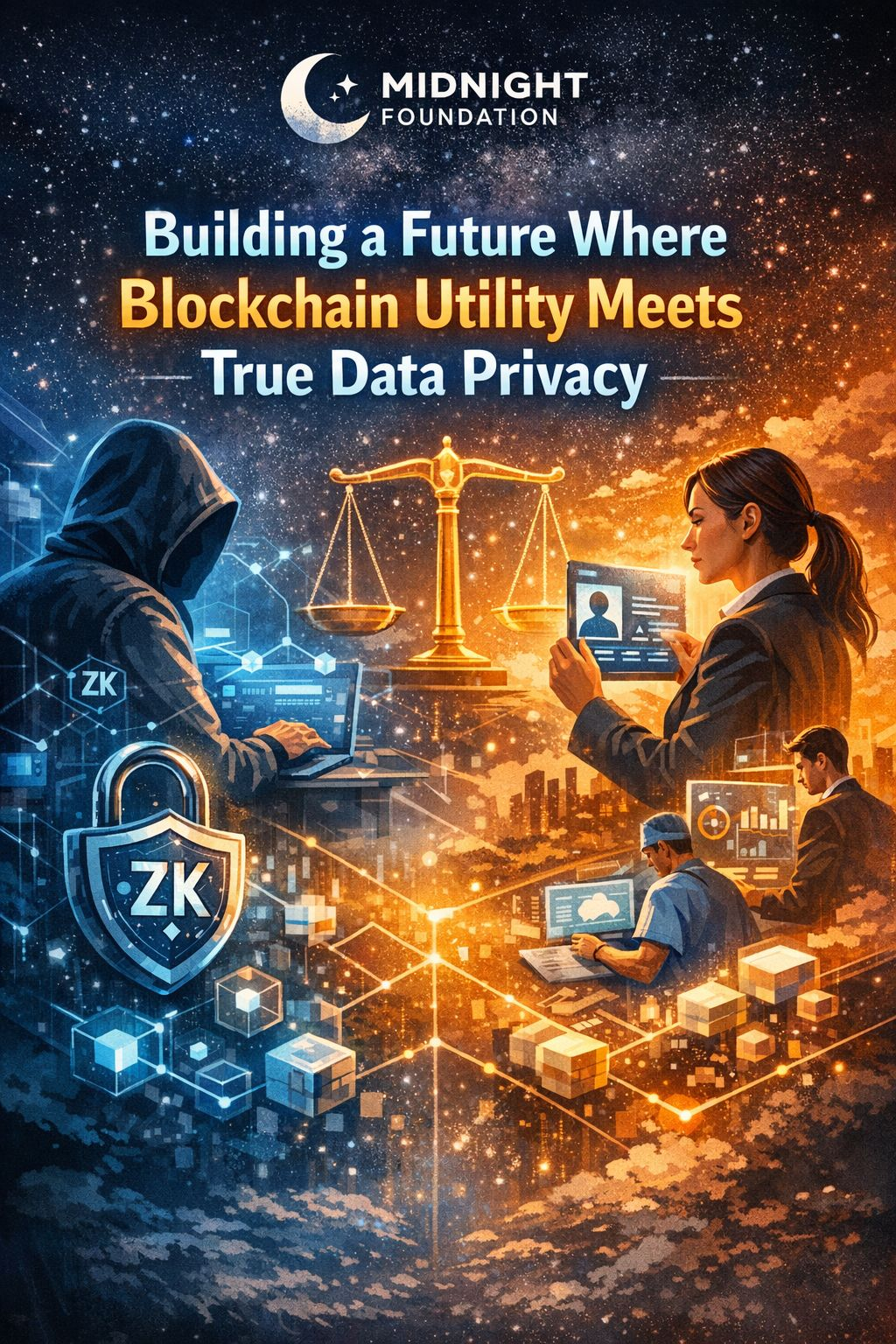
Midnight is exploring a direction that feels increasingly necessary for the next phase of Web3. Instead of forcing users to choose between transparency and privacy, the network is being designed around zero-knowledge proof technology. This cryptographic approach allows information to be verified without exposing the underlying data itself.
In simple terms, it means a system can confirm that something is true without revealing the sensitive details behind it.
This might sound technical, but the real-world implications are powerful.
Think about how many blockchain applications rely on public data. Wallet activity, transaction flows, and interactions are often visible to everyone. While transparency has benefits, it also creates a situation where personal activity can become traceable. For individuals, organizations, and institutions exploring blockchain adoption, that level of exposure can become a barrier.
Midnight is approaching the problem differently.
By using zero-knowledge technology as a core component, the network aims to enable programmable utility while still protecting user information. Developers can build applications that verify actions, permissions, or compliance requirements without revealing the underlying private data.
That balance is something many people in Web3 have been asking for.
Privacy does not mean secrecy or hiding information from the system. Instead, it means allowing users to maintain ownership over their data while still participating in decentralized networks. Midnight’s design philosophy seems to revolve around exactly that idea.
Another interesting angle is how this approach could influence broader blockchain adoption.
Industries such as finance, healthcare, supply chain management, and digital identity often require strong verification processes. However, they also deal with sensitive information that cannot simply be exposed on a fully public ledger. Zero-knowledge systems make it possible to verify conditions without revealing confidential details, which could open the door to entirely new categories of decentralized applications.
From a builder perspective, this creates new opportunities as well.
Developers are increasingly searching for infrastructure that lets them design applications with privacy and compliance in mind from the start. Instead of building complicated workarounds on top of existing networks, a privacy-aware architecture allows those features to exist at the protocol level.
That’s where Midnight’s vision becomes particularly interesting.
The campaign around Midnight Foundation is also a reminder that innovation in blockchain is not only about launching tokens or creating new narratives. Sometimes the most important developments happen quietly at the infrastructure layer, where new technologies reshape how networks operate behind the scenes.
Zero-knowledge proofs are often described as one of the most important cryptographic breakthroughs for decentralized systems. They allow networks to maintain trust while reducing the amount of exposed information required to prove that something is valid.
Midnight is positioning itself within that movement.
If the ecosystem continues to move toward a future where data sovereignty, privacy, and verifiable computation matter more than ever, then infrastructure designed around these principles could play a significant role in shaping the next generation of blockchain applications.
For me, the most exciting part is the philosophy behind it.
A decentralized world should not force people to sacrifice ownership of their data in order to participate. Instead, technology should empower users to verify, interact, and build while still maintaining control over what belongs to them.
Midnight’s approach suggests a future where privacy and utility can exist together rather than compete with each other.
And as this campaign continues, it will be interesting to see how the community, builders, and researchers contribute to pushing that vision forward.