🚨 THE U.S. ECONOMY MAY BE ENTERING A STAGFLATION PHASE.
The latest economic data released today shows growth slowing while inflation remains elevated.
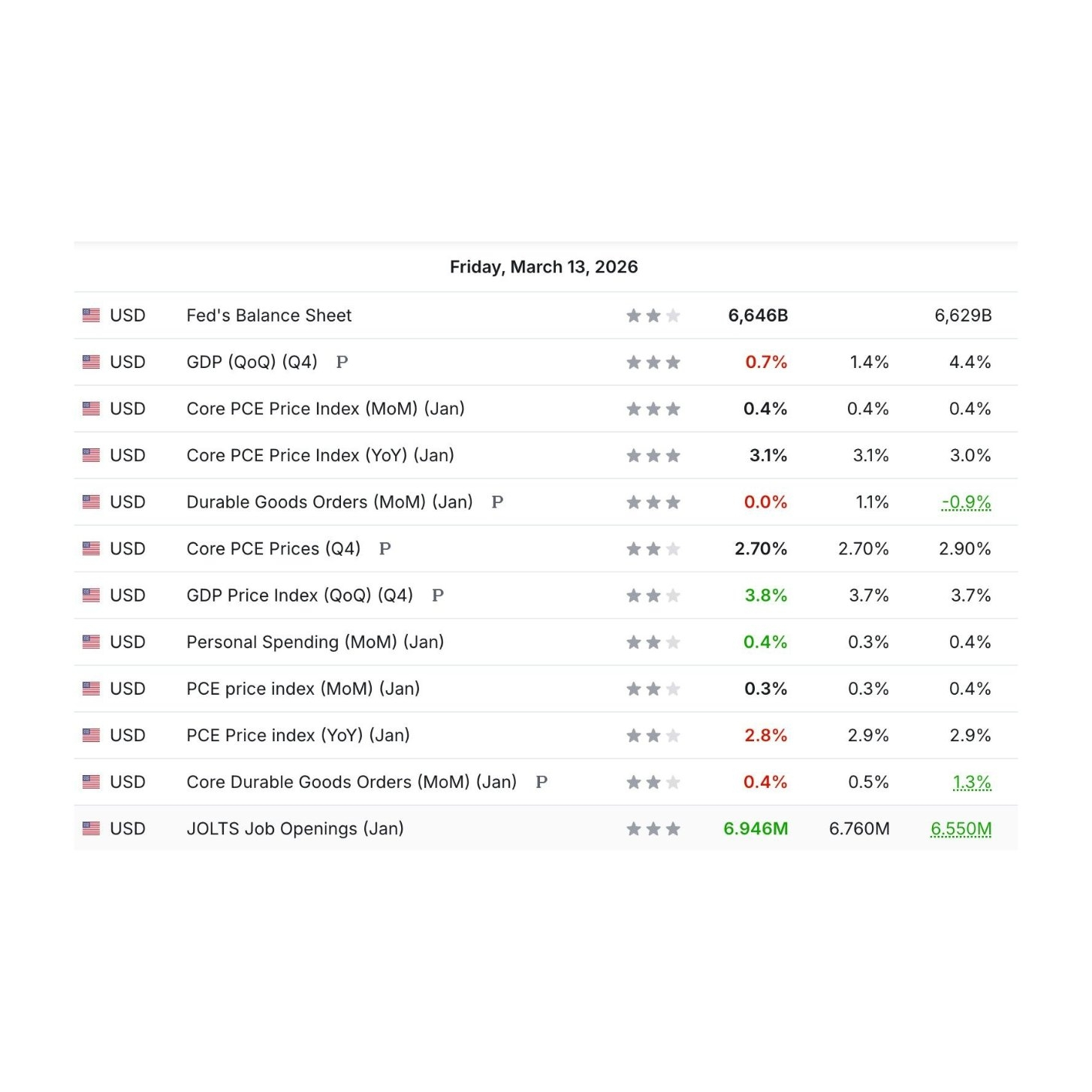
First, U.S. GDP growth for Q4 came in at just 0.7%.
This is one of the weakest readings in recent years and the lowest growth print in the last three quarters. Markets were expecting 1.4%, meaning the economy grew half as fast as forecasts suggested.
At the same time, inflation is not cooling.
The Core PCE Price Index, the Federal Reserve’s preferred inflation gauge, came in higher than expected.
• Core PCE (MoM): 0.4%
• Core PCE (YoY): 3.1%
The yearly reading of 3.1% shows inflation has started moving higher again after months of slowing.
Meanwhile, other economic data is also weakening.
Durable goods orders came in at 0%, missing expectations of 1.1% growth.
Core durable goods orders rose 0.4%, below expectations of 0.5% and sharply down from the previous 1.3%.
This suggests business investment and manufacturing demand are starting to slow.
But some data also came in the favour of the economy.
The GDP Price Index for Q4 came in at 3.8%, above the 3.7% forecast.
Meanwhile, broader inflation data showed:
• PCE Price Index (MoM): 0.3%
• PCE Price Index (YoY): 2.8%
Personal spending increased 0.4% in January, slightly above the 0.3% forecast, showing consumers are still spending.
The labor market also showed some resilience.
JOLTs Job Openings came in at 6,946,000, above expectations of 6,700,000, suggesting demand for workers remains relatively stable.
At the same time, the Federal Reserve’s balance sheet stands at $6.646 trillion, compared to $6.629 trillion previously.
But when these indicators are combined, they point to a complex situation for policymakers.
Economic growth is slowing.
Inflation remains elevated.
The labor market is still relatively stable.
This combination can start to resemble stagflation, where the economy weakens while prices remain high.
That creates a policy dilemma for the Fed. If the Fed cuts interest rates to support growth, inflation could rise again.
If the Fed keeps policy tight to control inflation, economic growth could weaken further.
Geopolitical risks may add more pressure.
Rising oil prices and ongoing global tensions could push energy costs higher, which would feed into inflation.
At the same time, structural changes in the labor market are creating uncertainty.
Automation and AI are reshaping employment across several industries, while companies adjust hiring and spending as economic conditions slow.
Looking forward, three scenarios are possible.
Bullish scenario:
Inflation continues to cool toward 2%, allowing the Fed to gradually cut rates while the labor market remains stable.
Bearish scenario:
Oil prices and geopolitical tensions push inflation higher again while growth continues to slow, creating a prolonged stagflation environment.
Neutral scenario:
Growth slows but does not collapse, inflation gradually declines, and the Fed moves cautiously with small policy adjustments.
For now, the data shows an economy that is slowing but not yet breaking. And that leaves the Fed in a very difficult position.