
“Could $ROBO enable autonomous machine economies where robots negotiate, trade compute, and coordinate labor through on-chain incentive markets?”
I’ve been watching a quiet idea gaining traction across crypto and robotics circles: machines that don’t just execute tasks, but actually participate in markets. Not markets run by humans on behalf of machines—but markets where the machines themselves negotiate resources, price their work, and coordinate activity. When I first encountered the concept, it sounded like sci-fi. But projects like ROBO are pushing that conversation into something more concrete: the possibility of autonomous machine economies.
To understand why this matters, zoom out for a second. The world is rapidly filling with autonomous systems—warehouse robots, delivery drones, AI inference nodes, industrial automation, even decentralized compute clusters. These machines generate value by performing work: moving goods, processing data, running models. But here’s the strange thing: they still depend on human-controlled infrastructure to coordinate that work.
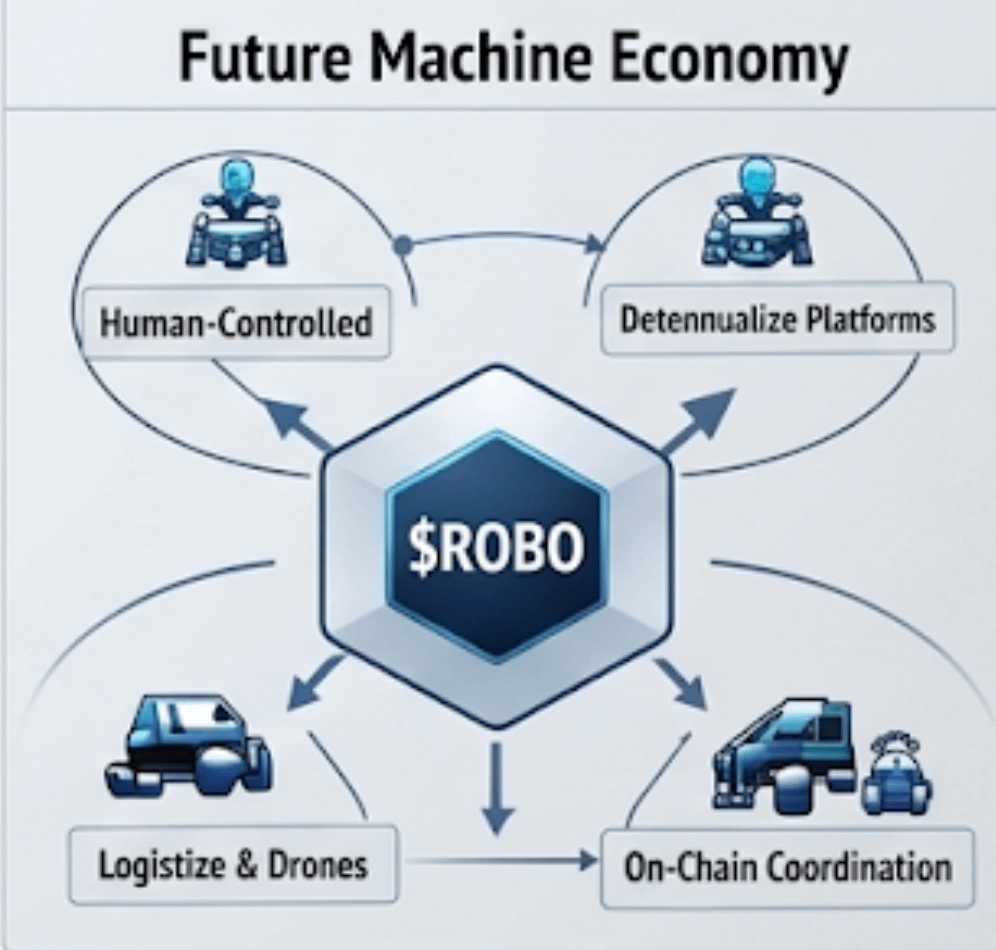
Imagine a city where thousands of robots exist, but every job assignment, payment settlement, and resource allocation has to pass through a centralized platform owned by a company. That’s basically how automation works today. The robots are autonomous, but the economy around them isn’t.
This is the gap where I think ROBO becomes interesting.
The core idea is simple but powerful: use blockchain infrastructure to create on-chain incentive markets where machines can discover work, negotiate pricing, and settle transactions automatically. In other words, robots interacting economically the same way humans interact with decentralized finance.
A helpful analogy I keep coming back to is ride-sharing. Platforms like Uber coordinate drivers, passengers, routes, and payments. But imagine if the drivers were autonomous vehicles that could discover riders through an open protocol rather than a centralized app. Each vehicle could bid for rides, calculate optimal routes, and receive payment instantly once the service is completed.
Now replace vehicles with robots, drones, AI agents, and compute nodes. That’s the kind of ecosystem ROBO is aiming to support.
In practical terms, the architecture revolves around a few key components.
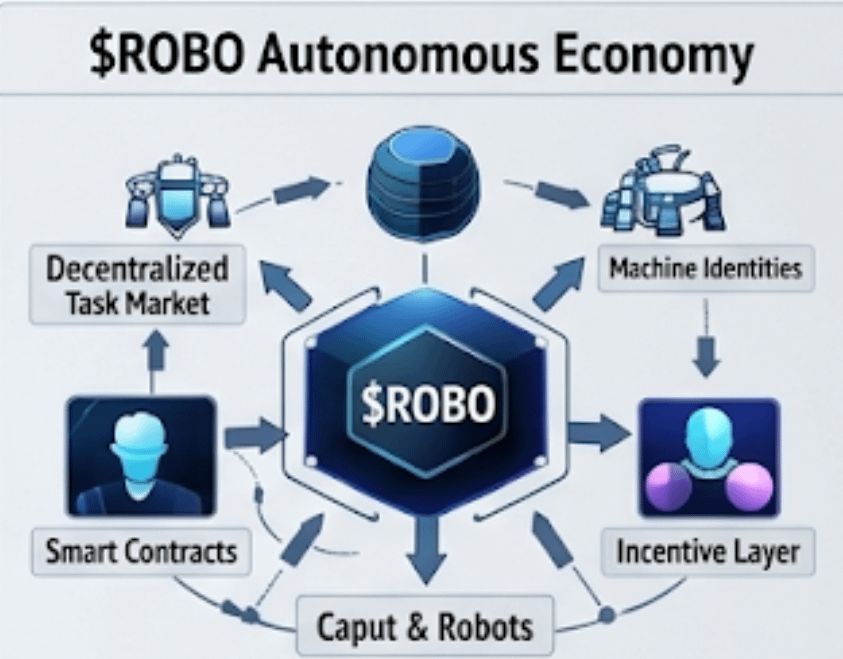
First, machines need verifiable digital identities. A robot participating in a decentralized labor market must be identifiable on-chain so that reputation, performance history, and reliability can be tracked. Without this layer, trust collapses instantly.
Second, there needs to be a mechanism for task discovery and pricing. Think decentralized job boards, but for machines. A compute network might request GPU processing. A warehouse system might request robotic transport capacity. A drone network might request mapping or surveillance tasks. Smart contracts can handle bidding, escrow, and settlement automatically.
Third, incentive alignment matters. Tokens like ROBO can function as the economic glue of these systems—rewarding machines that provide services, staking for reliability guarantees, and coordinating participation across decentralized networks.
What fascinates me is how this changes the scale of coordination.

Traditional robotic systems are designed for controlled environments: a factory floor, a logistics warehouse, a distribution center. But if robots can interact through open blockchain protocols, suddenly coordination doesn’t have to stop at organizational boundaries.
A drone owned by one company could sell aerial mapping services to another network. A compute cluster could dynamically allocate resources across AI workloads from different ecosystems. A robotic arm in a manufacturing plant could rent idle capacity to external production systems.
The result starts to look less like isolated automation and more like a machine-to-machine marketplace.
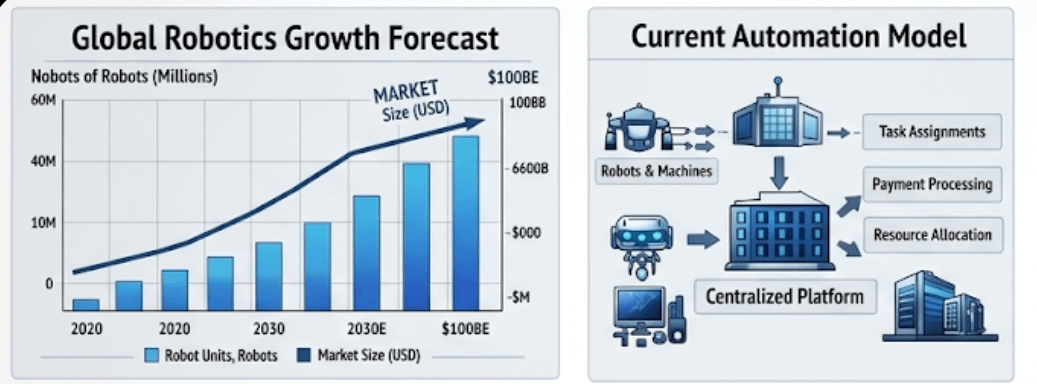
One statistic I often think about comes from industrial robotics forecasts. Analysts expect the global robot population to exceed 50 million operational units by the early 2030s. If even a small fraction of those machines were connected to programmable economic systems, the scale of machine-driven markets could rival some human digital economies.
But there are real challenges here too.
Autonomous machine economies raise questions about verification and accountability. If a robot fails to complete a task, who is responsible—the manufacturer, the owner, the software developer, or the machine’s operator? Smart contracts can enforce payment logic, but they can’t easily solve physical-world disputes.
Security is another concern. Any system allowing machines to transact value autonomously becomes a potential attack surface. Malicious actors could attempt to manipulate reputation systems, spoof robotic identities, or exploit task allocation mechanisms.
Then there’s the regulatory layer. Governments are still figuring out how to regulate crypto assets, let alone networks where autonomous agents are executing economic transactions.
Despite those uncertainties, the direction feels inevitable. As AI systems become more capable and robotics hardware becomes cheaper, machines will increasingly handle tasks that were once human-only. Once that happens at scale, coordinating those machines efficiently becomes a massive infrastructure problem.
Centralized platforms can handle part of that coordination. But open protocols—especially those with programmable incentives—offer something fundamentally different: a shared economic layer where machines from different ecosystems can interact.
That’s why I’ve been paying attention to projects like ROBO. Not because they promise short-term hype, but because they’re exploring what happens when automation meets decentralized market design.
If this model works, the long-term implication is pretty wild to think about: an economy where machines don’t just perform labor, but actively participate in the systems that allocate and price that labor.
And at that point, the blockchain isn’t just tracking transactions between humans anymore.
It’s coordinating the economic behavior of machines.
#robo #Robo #ROBO @Fabric Foundation $ROBO
