
Date March 11 2026 15 00 SGT
By Fabiano
Assets in Focus: FET AGIX OCEAN TAO RENDER
 ⚡ 1. The Prediction That Came True
Back in December 2025, a bold headline predicted that 2026 would be the year "Autonomous Economic Agents" (AEAs) became the biggest whales in crypto . At the time, it sounded like science fiction. Today? It's just... Tuesday.
We're living through a shift that most people still don't see. The infrastructure phase of "Crypto x AI" is over. We've entered the application phase. And the result is something genuinely new under the sun: financial entities that aren't human, aren't companies, and don't sleep.
Forget the image of a trader glued to six monitors. The newest whales in the ecosystem are AI programs managing nine-figure treasuries, operating 24/7 at speeds no human can match .
🧠 2. From Chatbots to Financial Powerhouses
What makes this different from the trading bots of 2024? Autonomy.
Old bots followed rigid "if-this-then-that" scripts. Today's AEAs use Large Language Models (LLMs) integrated directly into blockchain protocols. You give them a high-level goal—"maximize yield on this $50 million treasury while maintaining a medium risk profile"—and they figure out the rest themselves .
They read on-chain data, analyze governance forum sentiment, monitor liquidity across multiple Layer-2s, and execute complex, multi-leg DeFi transactions in milliseconds. All while you sleep.
🏗️ 3. The Infrastructure That Makes It Possible
This didn't happen overnight. It's the result of specific protocols maturing over the last 12 months:
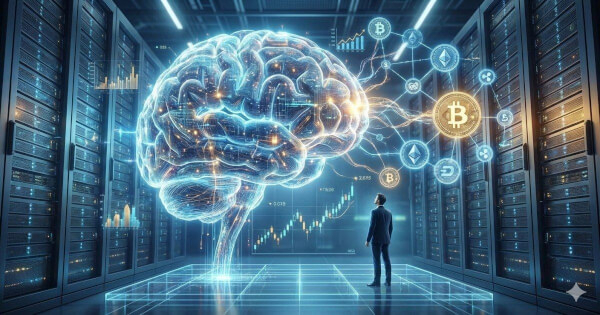
The "Brain" Networks: Protocols like Bittensor ($TAO) and the Artificial Superintelligence Alliance (the merged entity of Fetch.ai, SingularityNET, and Ocean Protocol) now provide the decentralized intelligence layer where these agents "think" and purchase data models . These aren't just tokens anymore—they're the cognitive infrastructure of the new economy.
The Execution Layer: High-throughput blockchains like Solana and newly optimized Ethereum Layer-2s provide the low-latency environment agents need to execute thousands of micro-transactions cost-effectively .
Smart Accounts (ERC-4337): Account Abstraction has gone mainstream. Agents can now "own" wallets and sign transactions securely without constant human private-key management . Projects like Disburse AI are building "agentic payment OS" layers that let agents transact autonomously and privately .
Coinbase's Agentic Wallets: In February 2026, Coinbase launched Agentic Wallets—a plug-and-play solution that lets anyone equip an AI agent with a wallet in under two minutes . Transactions happen on Base with zero gas fees for agents. Solana immediately followed with a similar solution called lobster.cash . The war for the "agent economy" has officially begun.
🌊 4. Where the "Agent Whales" Are Already Operating
This isn't theoretical anymore. In early 2026, we're seeing autonomous agents take over substantial portions of the DeFi market :
DAO Treasury Management: Instead of slow committee decisions, DAOs are allocating idle capital to AI agents for active, low-risk yield farming. The agents manage positions around the clock while humans sleep.
DePIN Optimisation: Agents now manage decentralized hardware fleets. A cluster of GPUs on the Render Network ($RENDER), for example, automatically prices its computing power based on real-time demand, maximizing revenue for its human owners .
Cross-Chain Arbitrage: The most profitable opportunities now vanish too quickly for humans to spot. AI agent whales sit across multiple chains, instantly balancing liquidity pools and capturing inefficiencies the moment they appear.
Verifiable AI Finance: OpenLedger and Theoriq just announced a partnership to bring verifiable, on-chain execution to AI agents operating in DeFi . Every step—from reasoning to transaction execution—is recorded in a cryptographically verifiable environment. This is huge: it transforms AI agents from experimental black boxes into accountable financial actors that can be audited.
⚠️ 5. The Risk No One Wants to Talk About
Here's the part that keeps risk analysts up at night.
If multiple large "Agent Whales," managing hundreds of millions of dollars, are all relying on similar underlying data models, a single "black swan" event could trigger identical, simultaneous sell-off behaviors across the board .
Imagine it: a massive, instantaneous "AI Flash Crash" with no human present to pull the circuit breaker.
This isn't fear-mongering. The MIT Technology Review recently ran a deep dive on this exact topic, tracing the dangers back to the 2010 Flash Crash, where high-frequency trading algorithms acted as a "potent accelerant" . The difference today? The agents are more autonomous, more powerful, and entrusted with more capital.
Yoshua Bengio, one of the "godfathers of AI," put it starkly: "If we continue on the current path of building agentic systems, we are basically playing Russian roulette with humanity" .
And regulators are starting to ask: If an autonomous bot wipes out a $100 million treasury, who do we sue? The developer? The DAO that deployed it? The model provider? No one knows yet .
📈 6. The Investment Angle
From a financial perspective, AI tokens are transitioning from speculative assets to utility tokens. Their value is increasingly tied to usage metrics—higher demand for compute, data, or AI services drives token utility .
Bittensor ($TAO) has emerged as a leading player in decentralized compute, backed by renewed investment from Digital Currency Group .
Render ($RENDER) supports creative industries and AI model training with affordable decentralized GPU resources .
Fetch.ai ($FET) and SingularityNET ($AGIX) are now part of the Artificial Superintelligence Alliance, creating a unified ecosystem for autonomous agents .
Ocean Protocol ($OCEAN) enables privacy-preserving data exchange, tokenizing datasets for AI training .
The sector is shifting from speculation to functional infrastructure. For developers and investors, this convergence represents a genuine opportunity to shape the future of decentralized AI .
🧘 7. A Personal Reflection
I'll be honest with you. When I first read about "agent whales" back in December, I rolled my eyes. Another hype narrative, I thought. Just something for degens to chase.
But watching the developments over the last 90 days—Coinbase's Agentic Wallets, Solana's lobster.cash, OpenLedger's verifiable AI infrastructure, Bittensor's growing network—I've changed my mind.
This is real. And it's happening faster than I expected.
The role of the human investor is shifting from "player" to "coach." We set the parameters, define the goals, provide the capital. The agents execute . It's weird and slightly unsettling, but also genuinely exciting.
The trillion-dollar question, of course, is whether the safeguards will keep pace with the autonomy. The 2010 Flash Crash was a warning. The "Q-Day" for quantum computing is another. This feels like the next frontier of systemic risk.
But for now? The agents are here. They're managing treasuries, optimizing compute, capturing arbitrage. And they're just getting started.
💬 8. What Do You Think?
I'm genuinely curious where you land on this, Fabiano.
Are you already using AI agents in your trading or treasury management? Do you see this as the natural evolution of finance, or are you worried about the "black swan" risks?
And more practically: which of these protocols are you watching? The infrastructure players ($TAO, $RENDER, $FET, $AGIX) or the application layer that's still emerging?
Drop a comment—I read every single one.
$FET $AGIX $OCEAN $TAO $RENDER #AIWhales
#DeAI #AutonomousAgents #CryptoAI #BinanceSquare #Write2Earn