
Your AI Has No Idea It's Wrong
A doctor asks an AI for a drug dosage. The AI answers in a calm, authoritative tone. It's wrong. Nobody knows.
This is the hallucination problem — and it's not a bug being patched. It's baked into how neural networks work. Large language models generate text that sounds plausible, not text that is provably true. The model doesn't "know" it's guessing.
Existing fixes are duct tape at scale. xAI's Grok uses human tutors to fact-check outputs manually. Rule-based filters only catch what developers anticipated. Self-verification fails because AI is notoriously poor at catching its own errors — and overconfidence in wrong answers is one of the most persistent failure modes.
"Overconfidence in false answers is a persistent issue — and internal feedback loops often fail to correct it."
None of these scale. And none of them are trustless. That's the gap Mira is targeting.
How Mira Actually Works
#Mira doesn't retrain AI models to be smarter. It builds a verification layer around them — like a blockchain for truth.
Here's the process in plain terms:
1 .CLAIM DECOMPOSITION
An AI output is broken into discrete, independently checkable facts. "Paris is the capital of France and the Eiffel Tower is its most famous landmark" becomes two separate claims — each evaluated alone.
2 .DISTRIBUTED VERIFICATION
Each claim is routed to multiple independent verifier nodes across Mira's network. Each node runs a different #Aİ model — different architecture, different training data, different perspective. No node sees the full output.
3 .CONSENSUS MECHANISM
Nodes vote: true, false, or uncertain. If a supermajority agrees, the claim is verified. If not, it's flagged or dropped. The whole process is on-chain — cryptographically auditable.
4 .CRYPTOGRAPHIC CERTIFICATE
Every verified output comes with a traceable record: which claims were evaluated, which models voted, how they voted. First time AI outputs become auditable objects.
MIRA Token: Infrastructure Play or Speculative Bet?
$MIRA is the fuel for the entire system. Node operators stake MIRA to earn verification rewards. Developers pay MIRA to access the verification API. Holders vote on protocol upgrades.
Total supply is capped at 1 billion tokens. The network launched on Base (Ethereum L2), making transactions cheap. Binance listed MIRA in September 2025 as its 45th HODLer Airdrop project — distributing 20 million tokens (2% of supply) to $BNB stakers.
The price chart tells a blunt story: MIRA spiked from $1.22 to $2.68 on listing day, then corrected hard. By December 2025, it was down over 90% from its peak TGE valuation — putting it among 2025's worst-performing token launches. This isn't unique; roughly 85% of 2025 token launches traded below their TGE price.
BULLISH CASE
4–5M active users, 19M queries/week
110+ AI models integrated
$10M Builder Fund deployed
Backed by Polygon founder, Framework Ventures, Accel
Real product with real usage metrics
AI verification demand will only grow
BEARISH RISKS
Token down 90%+ from peak
Latency overhead adds cost
Centralized AI labs can self-verify
Regulatory uncertainty
Token supply still heavily diluting
Network effects unproven at enterprise scale
This is not financial advice. Always do your own research before investing in any crypto asset.
04 — The Verdict
Is Mira Solving a Real Problem?
Yes — unambiguously. The confidence-correctness gap in AI is real, it's dangerous at scale, and existing solutions don't hold up under scrutiny.
Mira's approach — decentralized consensus verification across multiple independent models — is structurally sound. It's the same logic that makes blockchains resistant to manipulation: no single node controls the outcome.
The question isn't whether the problem is worth solving. It is. The question is whether Mira will win the race to solve it, or whether OpenAI, Google, or a well-funded startup will build an equivalent layer themselves and own the distribution.
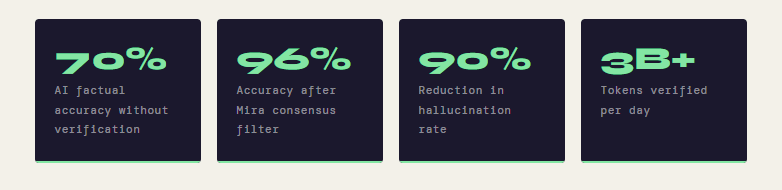
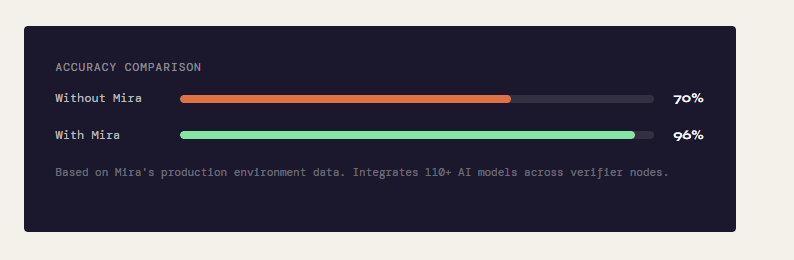
At 4+ million users and 3 billion daily tokens verified, Mira isn't vaporware. It's infrastructure with early traction. Whether that traction compounds into a moat is the real bet. @Mira - Trust Layer of AI
#OilPricesSlide #Web4theNextBigThing?
