
This is the challenge that Mira Network aims to solve by building infrastructure that secures what can be called the decision layer of AI-powered blockchain ecosystems.
The Growing Role of AI in Blockchain
Blockchain systems were originally designed to remove the need for centralized trust in financial transactions. But as decentralized applications become more complex, many of them are starting to rely on AI models for analysis, prediction, and automation.
For example, AI can help:
Analyze market data for decentralized finance (DeFi) strategies
Moderate community governance proposals
Automate trading decisions
Interpret large datasets for decentralized applications
In these scenarios, AI is not just providing information—it is influencing real blockchain actions. This creates a new layer of risk.
The Problem: Confident but Unverified AI
Modern AI models are powerful but not perfect. They generate outputs based on probabilities, which means they can sometimes produce confident answers that are incorrect. These errors, commonly known as hallucinations, are manageable when AI is used casually, but they become dangerous when AI decisions trigger on-chain activity.
Imagine an AI agent misinterpreting financial data and triggering a trading strategy, or incorrectly analyzing governance information before a DAO vote. Without verification, such mistakes could spread across decentralized systems.
This is why the decision layer—the point where AI outputs influence actions—needs stronger security.
Mira Network’s Verification Layer
Mira Network approaches this problem by introducing a decentralized verification system for AI outputs.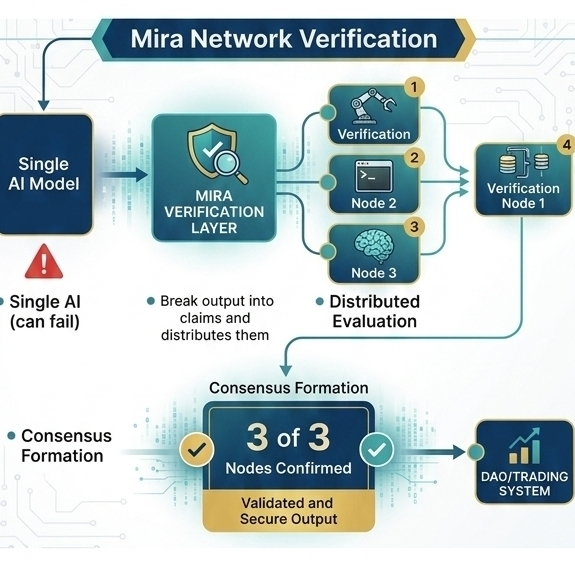
Instead of trusting a single AI model, Mira’s architecture checks AI-generated responses through multiple independent verifiers. The process generally works like this:
Claim Breakdown – AI outputs are divided into smaller factual claims.
Distributed Evaluation – Multiple models or verification nodes analyze each claim independently.
Consensus Formation – The network determines whether the claim is reliable through consensus.
Verified Output – Only validated information moves forward to influence blockchain actions.
This approach mirrors how blockchains verify financial transactions, but instead it verifies information and reasoning produced by AI.
Securing the Decision Layer
In AI-powered blockchain systems, there are typically three important layers:
Computation Layer: AI models generate insights or predictions.
Decision Layer: AI outputs influence actions and strategies.
Execution Layer: Smart contracts carry out transactions on the blockchain.
Mira focuses specifically on securing the decision layer, ensuring that AI outputs are validated before they affect real on-chain operations.
By doing this, Mira helps prevent unreliable AI results from triggering automated blockchain processes.
Incentives and Decentralization
Like many blockchain-based systems, Mira also relies on crypto-economic incentives. Participants who help verify AI outputs can earn rewards for accurate validation, while dishonest or unreliable behavior can be penalized.
This creates a decentralized ecosystem where:
Verification is distributed rather than centralized
Accuracy is incentivized through economic rewards
Trust emerges from consensus rather than authority
Why It Matters for the Future
The combination of AI and blockchain is expected to power a new generation of autonomous systems—sometimes referred to as machine-driven economies. In these environments, AI agents could manage assets, coordinate tasks, or make decisions across decentralized networks.
However, for such systems to function safely, AI outputs must be trustworthy.
By building infrastructure that verifies AI reasoning before it triggers blockchain actions, Mira Network is helping establish a critical layer of trust for the future of decentralized automatic.
#MIRA $MIRA @Mira - Trust Layer of AI