
Risk Management Didn’t Save Me. Guardrails Did.
I blew up more accounts than I like to admit. Not because I didn’t know what a stop-loss is.
I blew up because the rules I wrote in calm conditions disappeared under stress.
I’d trade small for a week… then go max size because it “felt different.”
I’d swear off revenge trading… then re-enter three times at the same level.
I’d say “no more all-nighters”… then stay up through Asia session trying to win it back.
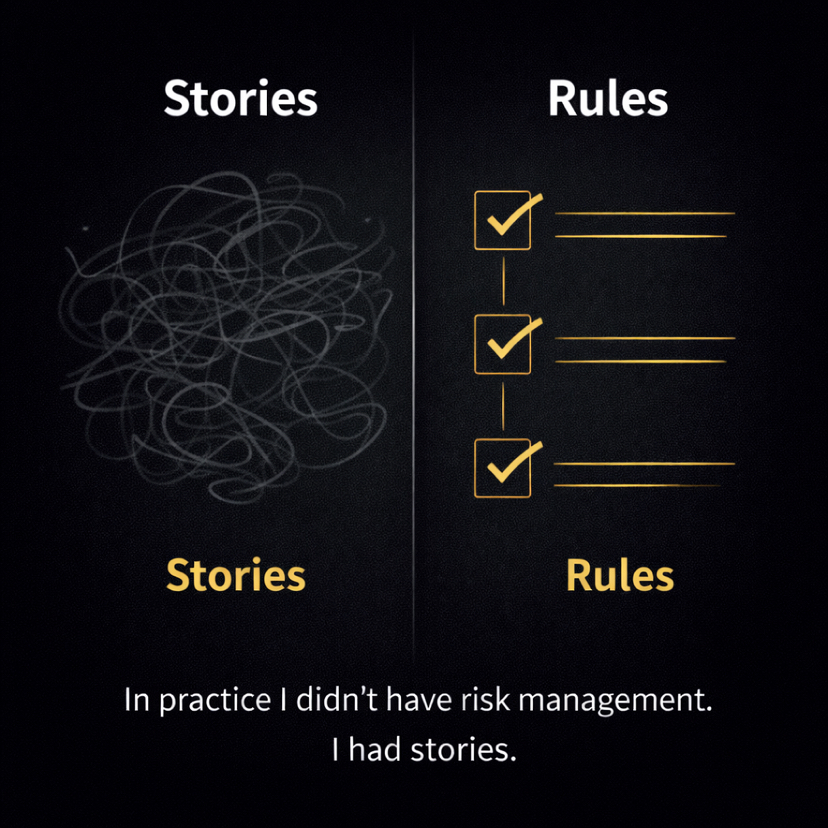
On paper I had risk management. In practice I had stories.
The uncomfortable truth
Most “risk management” fails for one reason: humans are not reliable decision-makers when losses hit.
Losses feel worse than gains feel good → so you hold losers, widen stops, size up after a hit, and call it “confidence.” The market doesn’t care if it was emotion or logic.
The account dies either way.
What changed: I turned trades into data
My memory of my trading was fake.I remembered clean winners in detail. I conveniently forgot the ugly strings of rule-breaks that actually caused the damage.
So I started journaling properly. Not as “homework”. as a feedback loop: Trade → record → review → adjust → repeat
Each trade became a row with:
Entry / Stop / TP / R multiple
Setup + context
Followed rules? (Y/N)
Emotion tag (FOMO, boredom, tilt)
And patterns appeared that PnL alone hides:
My worst days weren’t “volatile days” — they were rule-break days.
Some setups were fine… until I mixed them with size creep after a win streak.
“One last trade” late session had a horrible expectancy.
Journaling didn’t make me smarter.
t made me honest.
The real edge: precommitment (not willpower)
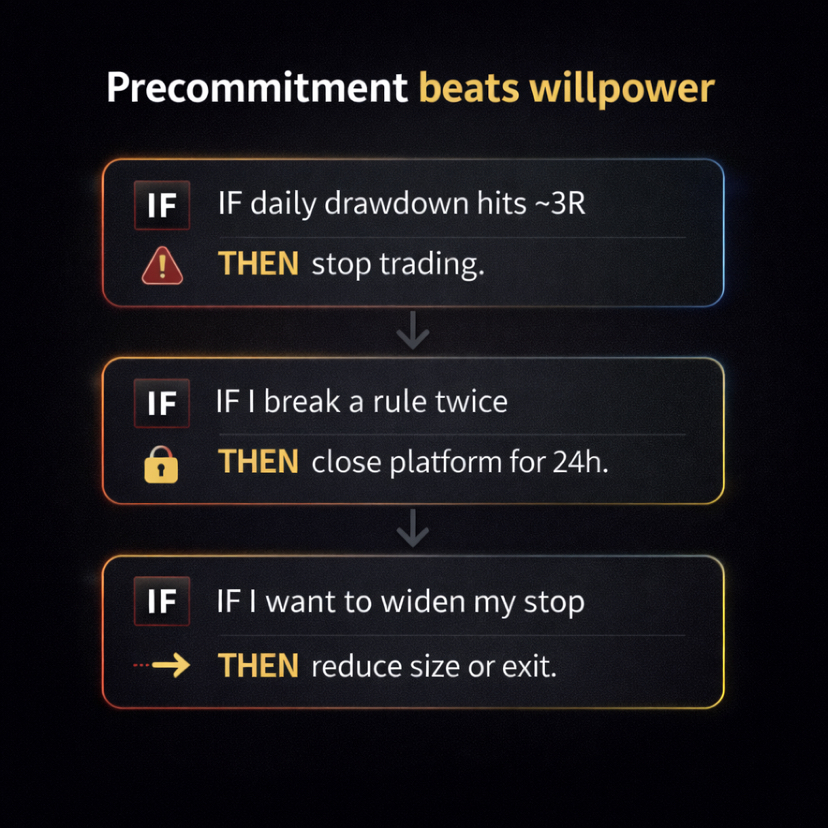
Willpower is unreliable in real time. So I stopped relying on it. I wrote rules as if–then commitments:
for example, 3 hard guardrails
IF I hit −3R on the day → THEN I stop trading.
IF I break a rule twice → THEN platform closed for 24h. (cool-off period function)
IF I want to widen my stop → THEN I reduce or exit.
That’s the whole trick:
Rules written clearly
Decisions made before emotion
Violations recorded in the journal
Weekly review like a business
Once you do that, blowing up stops being a mystery…
and becomes a choice.
Journaling is risk management
Most traders treat journaling as optional. But here’s what I learned:
Risk rules without a journal → you’ll break them and forget.
A journal without rules → you’ll collect data and change nothing.
Real risk management is: guardrails + tracking + review. t’s not glamorous. Rather boring. But it’s the only edge that doesn’t decay.
If you’re still “starting over” with fresh deposits. stop hunting a better setup.
Build rules that survive stress.
(If you’re curious how I automated the journal + guardrails -> reforgeinstitute.com